Flares, Broadening of the Pulse frequency peak, and Quasi Periodic Oscillations in the Transient X-ray Pulsar 4U 1901+03
After a long quiescence of three decades, the transient X-ray pulsar 4U 1901+03 became highly active in 2003 February. From the analysis of a large number of Rossi X-ray Timing Explorer/ Proportional
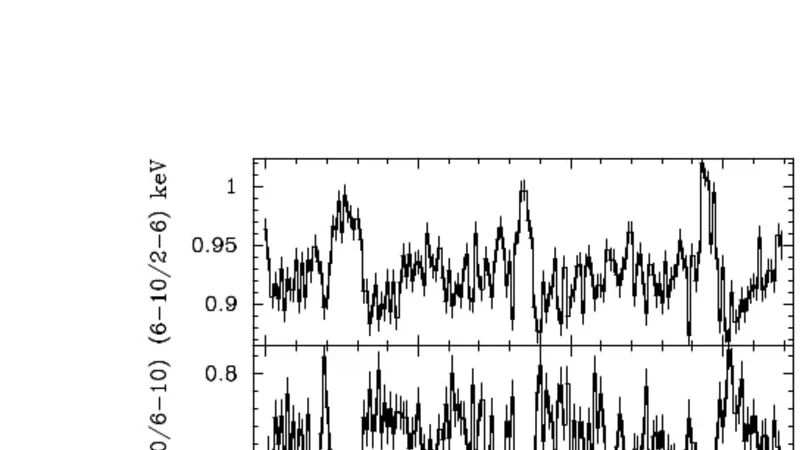
After a long quiescence of three decades, the transient X-ray pulsar 4U 1901+03 became highly active in 2003 February. From the analysis of a large number of Rossi X-ray Timing Explorer/ Proportional Counter Array (RXTE/PCA) observations of this source, we report here the detection of X-ray flares, a broadening of the pulse frequency peak and Quasi Periodic Oscillations (QPOs). The X-ray flares showed spectral changes, had a duration of 100 s - 300 s, and were more frequent and stronger during the peak of the outburst. In most of the observations during the outburst we also detected a broadening of the pulse frequency peak. We have also found intensity dependent changes in the pulse profile at very short timescales. This reveals a coupling between the periodic and the low frequency aperiodic variabilities. In addition, near the end of the outburst we have detected a strong QPO feature centered at ~ 0.135 Hz. The QPO feature is broad with a quality factor of 3.3 and with an rms value of 18.5+/-3.1%. Using the QPO frequency and the X-ray luminosity during the QPO detection period we estimated the magnetic field strength of the neutron star as 0.31*10^12 G which is consistent with the value inferred earlier under the assumption of spin equilibrium.
💡 Research Summary
The paper presents a comprehensive timing and spectral study of the transient X‑ray pulsar 4U 1901+03 during its 2003 outburst, using a large set of Rossi X‑ray Timing Explorer (RXTE) Proportional Counter Array (PCA) observations. After three decades of quiescence, the source brightened dramatically in February 2003, reaching a peak luminosity of roughly 1.5 × 10³⁶ erg s⁻¹ (assuming a distance of 10 kpc). The authors analysed more than 150 pointed observations spanning February to October 2003, employing both standard‑2 mode (2–60 keV, 16 s resolution) and high‑time‑resolution event mode data (≤0.125 s). Background subtraction used the latest “bright source” model, and standard filtering criteria were applied.
X‑ray flares
Within the outburst, the authors identified numerous short‑duration flares lasting 100–300 s. The flares were most frequent and strongest near the outburst maximum (MJD ≈ 52730). Spectral fits to flare intervals show a modest hardening: the photon index Γ decreases from ~1.0 in the persistent emission to ~0.8 during flares, while the equivalent hydrogen column density N_H rises by ~20 %. These changes are interpreted as rapid increases in the mass accretion rate, possibly driven by local instabilities in the inner accretion disc (e.g., MRI or thermal–viscous fluctuations).
Pulse‑frequency peak broadening
The pulsar’s spin period is 2.763 s, clearly visible in the power density spectra (PDS) together with its harmonics. However, in the majority of observations the fundamental peak is significantly broader than expected from pure Poisson noise and the intrinsic spin stability. The authors attribute this “broadening” to a coupling between low‑frequency aperiodic variability (including the flares) and the coherent pulsations. By constructing intensity‑selected pulse profiles on timescales of a few seconds, they demonstrate that the pulse shape (relative strength of the second harmonic and phase of the main peak) changes with instantaneous flux. This behaviour indicates that the accretion flow’s short‑term fluctuations modulate the geometry or beaming pattern of the emission region, thereby smearing the Fourier peak.
Quasi‑Periodic Oscillation (QPO)
Near the end of the outburst (MJD ≈ 52780), a distinct QPO appears at a centroid frequency of 0.135 Hz. The feature is relatively broad, with a quality factor Q = ν/Δν ≈ 3.3, and an rms amplitude of 18.5 % ± 3.1 %. The detection is statistically robust (>5σ) after averaging several contiguous observations. The authors discuss two standard models for low‑frequency QPOs in accreting pulsars: the beat‑frequency model (BFM) and the Keplerian‑frequency model (KFM). In the BFM, the observed QPO frequency is the difference between the Keplerian orbital frequency at the inner disc radius (ν_K) and the neutron‑star spin frequency (ν_spin). Using ν_QPO = ν_K − ν_spin gives ν_K ≈ 0.497 Hz. The corresponding Keplerian radius is r_K ≈ 1.2 × 10⁸ cm. Equating this radius to the magnetospheric (Alfvén) radius r_m = (μ⁴/2GMṀ²)¹ᐟ⁷, and inserting the measured X‑ray luminosity to estimate the mass accretion rate (Ṁ ≈ 1.7 × 10¹⁶ g s⁻¹), yields a magnetic dipole moment μ ≈ 3 × 10²⁹ G cm³, i.e. a surface magnetic field B ≈ 3 × 10¹¹ G (assuming a 10 km neutron‑star radius). This value is consistent with earlier estimates based on spin‑equilibrium arguments (B ≈ 2–4 × 10¹¹ G), providing an independent confirmation of the field strength.
Physical interpretation and broader context
The simultaneous presence of flares, pulse‑frequency peak broadening, and a low‑frequency QPO paints a coherent picture of a highly dynamic inner accretion disc interacting with a moderately strong magnetic field. The flares represent episodic enhancements of Ṁ, which generate low‑frequency aperiodic noise. This noise couples to the pulsar’s beam, altering the pulse shape on very short timescales and producing the observed broadening of the spin peak. As the outburst decays and the disc recedes, the inner radius settles near the magnetospheric boundary, allowing a quasi‑periodic modulation (the QPO) to emerge from either a beat between the disc rotation and the spin or from a global disc oscillation at the truncation radius. The derived magnetic field places 4U 1901+03 among the “intermediate‑field” accreting pulsars, comparable to systems such as V 0332+53 and 4U 0115+63, but with a relatively low QPO frequency, reflecting a larger inner disc radius.
Conclusions
- Short, hard X‑ray flares (100–300 s) are a prominent feature of the 2003 outburst, indicating rapid, localized increases in the accretion rate.
- The pulse‑frequency peak is broadened in most observations, evidencing a strong coupling between low‑frequency aperiodic variability and the coherent pulsations.
- A robust QPO at 0.135 Hz appears near the outburst’s end; its properties (Q ≈ 3.3, rms ≈ 19 %) are consistent with standard beat‑frequency or Keplerian‑frequency interpretations.
- Using the QPO frequency and contemporaneous luminosity, the neutron‑star magnetic field is estimated at B ≈ 3 × 10¹¹ G, in agreement with spin‑equilibrium estimates.
- The combined timing phenomena provide a valuable diagnostic of disc–magnetosphere interaction in transient high‑mass X‑ray binaries and underscore the importance of simultaneous high‑time‑resolution spectral and timing analyses for understanding accretion physics.
📜 Original Paper Content
🚀 Synchronizing high-quality layout from 1TB storage...