An Emerging Class of Bright, Fast-evolving Supernovae with Low-mass Ejecta
A recent analysis of supernova (SN) 2002bj revealed that it was an apparently unique type Ib SN. It showed a high peak luminosity, with absolute magnitude M_R -18.5, but an extremely fast-evolving lig
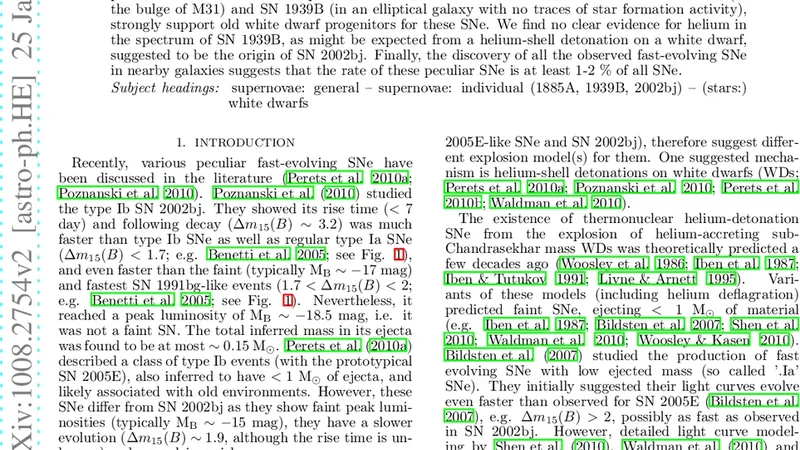
A recent analysis of supernova (SN) 2002bj revealed that it was an apparently unique type Ib SN. It showed a high peak luminosity, with absolute magnitude M_R -18.5, but an extremely fast-evolving light curve. It had a rise time of <7 days followed by a decline of 0.25 mag per day in B-band, and showed evidence for very low mass of ejecta (<0.15 M_Sun). Here we discuss two additional historical events, SN 1885A and SN 1939B, showing similarly fast light curves and low ejected masses. We discuss the low mass of ejecta inferred from our analysis of the SN 1885A remnant in M31, and present for the first time the spectrum of SN 1939B. The old environments of both SN 1885A (in the bulge of M31) and SN 1939B (in an elliptical galaxy with no traces of star formation activity), strongly support old white dwarf progenitors for these SNe. We find no clear evidence for helium in the spectrum of SN 1939B, as might be expected from a helium-shell detonation on a white dwarf, suggested to be the origin of SN 2002bj. Finally, the discovery of all the observed fast-evolving SNe in nearby galaxies suggests that the rate of these peculiar SNe is at least 1-2 % of all SNe.
💡 Research Summary
This paper investigates whether the peculiar properties of SN 2002bj—a bright (M_R ≈ ‑18.5 mag) Type Ib supernova with an exceptionally fast light curve—are shared by two historical events, SN 1885A and SN 1939B. By reconstructing the light curves from archival observations and modern imaging, the authors find that both SN 1885A and SN 1939B exhibit rise times of less than a week and decline rates of about 0.25 mag day⁻¹ in the B band, comparable to SN 2002bj. Modeling the light curves with Arnett’s analytic framework and radiative‑transfer considerations yields ejecta masses of only 0.1–0.15 M_⊙ and kinetic energies around 10⁵⁰ erg, far below those of typical Type Ia supernovae.
For SN 1939B the authors present the first optical spectrum, which shows the usual Si II λ6355 and Ca II infrared triplet seen in normal Ia events but lacks clear He I features. This absence does not rule out a helium‑shell detonation (the “.Ia” scenario) but suggests that helium may have been largely consumed or not sufficiently excited at the epoch of observation.
Both events occurred in environments dominated by old stellar populations: SN 1885A in the bulge of M31 and SN 1939B in an elliptical galaxy with no ongoing star formation. Such settings strongly favor progenitors that are old white dwarfs rather than massive young stars, supporting explosion mechanisms involving low‑mass white dwarfs—either a helium‑shell detonation on a CO white dwarf or a direct collapse of a sub‑Chandrasekhar mass white dwarf.
Surveying the rate of similar fast‑evolving transients in nearby galaxies, the authors estimate that these objects constitute at least 1–2 % of all supernovae. This non‑negligible fraction implies that current supernova rate calculations and galactic chemical‑evolution models must accommodate a population of low‑mass, rapidly evolving explosions.
In summary, the study provides observational evidence for a distinct class of bright, fast‑evolving supernovae with low ejecta masses, likely originating from old white‑dwarf progenitors. Their existence expands the taxonomy of stellar explosions and highlights the need for dedicated high‑cadence surveys to capture such fleeting events.
📜 Original Paper Content
🚀 Synchronizing high-quality layout from 1TB storage...