A Dichotomy Theorem for the Approximate Counting of Complex-Weighted Bounded-Degree Boolean CSPs
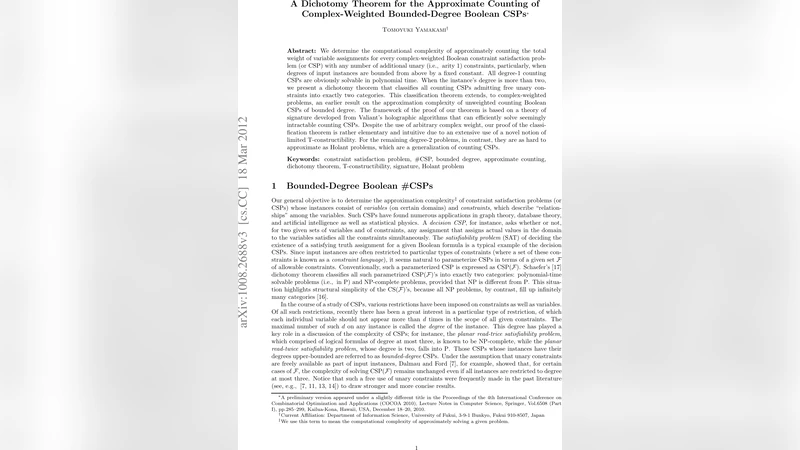
We determine the computational complexity of approximately counting the total weight of variable assignments for every complex-weighted Boolean constraint satisfaction problem (or CSP) with any number of additional unary (i.e., arity 1) constraints, particularly, when degrees of input instances are bounded from above by a fixed constant. All degree-1 counting CSPs are obviously solvable in polynomial time. When the instance’s degree is more than two, we present a dichotomy theorem that classifies all counting CSPs admitting free unary constraints into exactly two categories. This classification theorem extends, to complex-weighted problems, an earlier result on the approximation complexity of unweighted counting Boolean CSPs of bounded degree. The framework of the proof of our theorem is based on a theory of signature developed from Valiant’s holographic algorithms that can efficiently solve seemingly intractable counting CSPs. Despite the use of arbitrary complex weight, our proof of the classification theorem is rather elementary and intuitive due to an extensive use of a novel notion of limited T-constructibility. For the remaining degree-2 problems, in contrast, they are as hard to approximate as Holant problems, which are a generalization of counting CSPs.
💡 Research Summary
This paper establishes a complete classification of the approximation complexity of complex‑weighted Boolean constraint satisfaction problems (#CSP) when the input instances are bounded in degree by a fixed constant d. The authors consider the most general setting in which any number of unary (arity‑1) constraints may be used for free, and they focus on the case where each variable appears in at most d constraints.
The main result is a dichotomy theorem for d ≥ 3. Let E_D denote the set consisting of the equality functions EQ_k, the disequality functions NEQ_k, the two unary pinning functions Δ₀ and Δ₁, together with all possible unary constraints (which are free). If the constraint language F is a subset of E_D, then the counting problem #CSP*_d(F) can be solved exactly in polynomial time; formally, it belongs to the class FP_C of polynomial‑time computable complex‑valued functions. In every other case, #CSP*_d(F) is as hard as the complex‑weighted counting satisfiability problem #SAT_C under approximation‑preserving (AP) reductions; that is, #SAT_C ≤_AP #CSP*_d(F). Consequently, for d ≥ 3 the approximation landscape collapses to exactly two categories: tractable or #SAT‑hard.
A key technical bridge is Proposition 1.2, which shows that for any d ≥ 3 the bounded‑degree problem #CSP*_d(F) is AP‑equivalent to its unbounded counterpart #CSP*(F). The proof exploits a novel notion called limited T‑constructibility, a restricted form of the T‑constructibility used in earlier works on exact counting. Limited T‑constructibility guarantees that all gadget constructions used to simulate one constraint by others never increase the degree of any variable beyond the prescribed bound d.
The authors’ proof framework is built on signature theory, an algebraic formalism derived from Valiant’s holographic algorithms. Each constraint is represented as a complex‑valued tensor (signature), and operations such as pinning, projection, and scaling are used to transform arbitrary signatures into combinations of the basic signatures in E_D. Because unary constraints are freely available, any complex weight can be absorbed into a unary factor, which dramatically simplifies the reduction process.
For the special case d = 2, the situation changes. The authors show that #CSP*_2(F) is AP‑equivalent to the Holant problem with the same constraint set F, again assuming free unary constraints. Holant problems generalize counting CSPs by allowing constraints to be placed on both sides of a bipartite graph; when each variable appears at most twice, the CSP instance can be naturally expressed as a Holant instance, and the known complexity classifications for Holant problems apply.
When d = 1, every instance decomposes into isolated unary constraints, and the problem is trivially solvable in polynomial time.
The paper situates its contributions within the broader literature. In the unweighted setting, Dyer, Goldberg, and Jerrum gave a three‑way classification (FP, #BIS‑equivalent, #SAT‑hard) for bounded‑degree Boolean #CSPs. Cai, Lu, and Xia later extended the exact‑counting dichotomy to complex‑weighted Boolean CSPs without degree restrictions. The present work shows that, once arbitrary complex unary weights are allowed, the intermediate “#BIS‑like” class disappears for degree ≥ 3, leaving only the two extremes.
Methodologically, the introduction of limited T‑constructibility provides a clean, elementary proof technique that avoids the more intricate machinery (e.g., 3‑simulatability, ppp‑definability) used in earlier approximation‑hardness proofs. This approach may be adaptable to other bounded‑degree counting problems, such as hypergraph independent set or multi‑valued CSPs.
In summary, the paper delivers a sharp dichotomy for the approximation of complex‑weighted Boolean CSPs under bounded degree, demonstrates that free unary constraints dramatically increase expressive power, connects degree‑2 instances to the Holant framework, and introduces limited T‑constructibility as a versatile tool for future complexity analyses.
Comments & Academic Discussion
Loading comments...
Leave a Comment