An Energetic Magnetar in HESS J1713-381/CTB 37B
We obtained a second Chandra timing measurement of the 3.82 s pulsar CXOU J171405.7-381031 in the supernova remnant (SNR) CTB 37B, which shows that it is spinning down rapidly. The average period deri
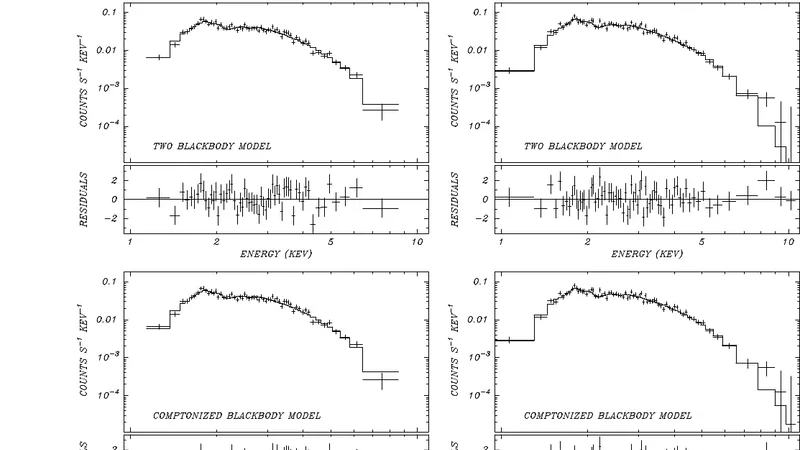
We obtained a second Chandra timing measurement of the 3.82 s pulsar CXOU J171405.7-381031 in the supernova remnant (SNR) CTB 37B, which shows that it is spinning down rapidly. The average period derivative of (5.88+/-0.08)E-11 over the 1 year time span corresponds to a dipole magnetic field strength B = 4.8E14 G, well into the magnetar range. The spin-down power E-dot = 4.2E34 erg/s is among the largest for magnetars, and the corresponding characteristic age Tau = P/2P-dot = 1030 years is comparable to estimates of the age of the SNR. The period derivative enables us to recover probable pulsations in an ASCA observation taken in 1996, which yields a mean characteristic age of 860 years over the longer 13 year time span. The source is well detected up to 10 keV, and its composite spectrum is typical of a magnetar. CTB 37B hosts HESS J1713-381, the first TeV source that is coincident with a magnetar. While the TeV emission has been attributed to the SNR shell, it is possibly centrally peaked, and we hypothesize that this particularly young, energetic magnetar may contribute to the HESS source. We also searched for pulsations from another source in a HESS SNR, XMMU J173203.3-344518 in HESS J1731-347/G353.6-0.7 but could not confirm pulsations or long-term flux variability, making it more likely that this source is a weakly magnetized central compact object.
💡 Research Summary
The authors present a comprehensive timing and spectral study of the 3.82 s X‑ray pulsar CXOU J171405.7‑381031 located inside the supernova remnant (SNR) CTB 37B. Using two Chandra observations spaced by roughly one year, they measure an average period derivative of (5.88 ± 0.08) × 10⁻¹¹ s s⁻¹. This large spin‑down rate translates, via the standard magnetic dipole formula, into a surface dipole magnetic field of B ≈ 4.8 × 10¹⁴ G, placing the object firmly in the magnetar regime. The inferred spin‑down power, Ė ≈ 4.2 × 10³⁴ erg s⁻¹, is among the highest measured for magnetars, and the characteristic age τ = P/(2Ṗ) ≈ 1.0 kyr matches independent age estimates for CTB 37B, suggesting that the pulsar is a very young magnetar born in the same supernova explosion.
To extend the timing baseline, the authors re‑analyzed archival ASCA data from 1996. By extrapolating the measured Ṗ back to that epoch, they recover a coherent pulsation at the expected period, yielding a 13‑year average characteristic age of ~860 yr. This consistency demonstrates that the spin‑down has remained roughly constant over more than a decade.
Spectrally, the source is detected up to 10 keV and requires a two‑component model: a blackbody with kT ≈ 0.5 keV plus a power‑law with photon index Γ ≈ 2–3. This composite spectrum is typical of known magnetars, reinforcing the classification.
CTB 37B also hosts the very‑high‑energy (VHE) γ‑ray source HESS J1713‑381, the first TeV emitter spatially coincident with a magnetar. Previous interpretations attributed the TeV emission to particle acceleration in the SNR shell. However, the HESS morphology shows a possible central peak, and the newly confirmed energetic, young magnetar could plausibly contribute to the VHE flux. The authors propose that relativistic particles accelerated in the magnetar’s wind nebula or magnetospheric processes might be responsible for at least part of the TeV emission, offering a novel channel for magnetar‑driven particle acceleration.
In contrast, the authors also examined XMMU J173203.3‑344518, the compact X‑ray source in the HESS J1731‑347 / G353.6‑0.7 SNR. No pulsations were detected, and long‑term X‑ray flux appears stable, favoring an interpretation as a weakly magnetized central compact object (CCO) rather than a magnetar.
Overall, the paper delivers three key contributions: (1) a robust confirmation that CXOU J171405.7‑381031 is a young, highly energetic magnetar; (2) the suggestion that such a magnetar can play a role in producing TeV γ‑rays, expanding the phenomenology of magnetar environments; and (3) a clear observational distinction between magnetars and CCOs based on timing, spectral, and variability properties. The work underscores the importance of continued high‑resolution VHE observations (e.g., with CTA) and long‑term X‑ray monitoring to unravel the interplay between magnetars, their host remnants, and the surrounding high‑energy universe.
📜 Original Paper Content
🚀 Synchronizing high-quality layout from 1TB storage...