On the co-evolution of supermassive black holes and their host galaxies since z = 3
[Abridged] To investigate the evolution in the relation between galaxy stellar and central black hole mass we construct a volume limited complete sample of 85 AGN with host galaxy stellar masses M_{*}
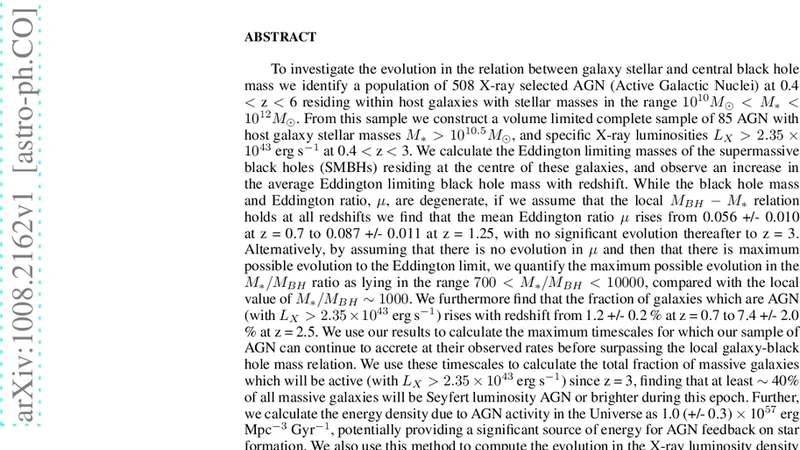
[Abridged] To investigate the evolution in the relation between galaxy stellar and central black hole mass we construct a volume limited complete sample of 85 AGN with host galaxy stellar masses M_{} > 10^{10.5} M_{sol}, and specific X-ray luminosities L_{X} > 2.35 x 10^{43} erg s^{-1} at 0.4 < z < 3. We calculate the Eddington limiting masses of the supermassive black holes residing at the centre of these galaxies, and observe an increase in the average Eddington limiting black hole mass with redshift. By assuming that there is no evolution in the Eddington ratio (\mu) and then that there is maximum possible evolution to the Eddington limit, we quantify the maximum possible evolution in the M_{} / M_{BH} ratio as lying in the range 700 < M_{}/M_{BH} < 10000, compared with the local value of M_{}/M_{BH} ~ 1000. We furthermore find that the fraction of galaxies which are AGN (with L_{X} > 2.35 x 10^{43} erg s^{-1}) rises with redshift from 1.2 +/- 0.2 % at z = 0.7 to 7.4 +/- 2.0 % at z = 2.5. We use our results to calculate the maximum timescales for which our sample of AGN can continue to accrete at their observed rates before surpassing the local galaxy-black hole mass relation. We use these timescales to calculate the total fraction of massive galaxies which will be active (with L_{X} > 2.35 x 10^{43} erg s^{-1}) since z = 3, finding that at least ~ 40% of all massive galaxies will be Seyfert luminosity AGN or brighter during this epoch. Further, we calculate the energy density due to AGN activity in the Universe as 1.0 (+/- 0.3) x 10^{57} erg Mpc^{-3} Gyr^{-1}, potentially providing a significant source of energy for AGN feedback on star formation. We also use this method to compute the evolution in the X-ray luminosity density of AGN with redshift, finding that massive galaxy Seyfert luminosity AGN are the dominant source of X-ray emission in the Universe at z < 3.
💡 Research Summary
This paper investigates how the relationship between galaxy stellar mass (M*) and the mass of the central super‑massive black hole (M_BH) evolves from the present epoch out to redshift z ≈ 3. The authors construct a volume‑limited, X‑ray selected sample of 85 active galactic nuclei (AGN) whose host galaxies satisfy M* > 10^10.5 M_⊙ and whose hard X‑ray luminosities exceed L_X = 2.35 × 10^43 erg s⁻¹. The redshift range of the sample (0.4 < z < 3) spans a period of roughly 11 Gyr, allowing a direct probe of the co‑evolution of massive galaxies and their central black holes over most of cosmic history.
The key methodological step is the estimation of an “Eddington‑limited” black‑hole mass for each source. By assuming a bolometric correction from the observed 2–10 keV X‑ray luminosity and adopting an Eddington ratio μ = L_bol/L_Edd, the authors compute a lower limit to M_BH: M_Edd = L_X/(μ L_Edd). Two extreme scenarios for μ are explored. In the first, μ is held constant with redshift (i.e., the accretion efficiency does not evolve). In the second, μ is allowed to increase up to the theoretical maximum μ = 1 (the Eddington limit). Under the constant‑μ assumption, the average inferred black‑hole mass rises from ≈10^7 M_⊙ at z ≈ 0.7 to ≈10^8 M_⊙ at z ≈ 2.5. If μ is allowed to reach unity, the inferred masses are correspondingly larger, yielding a broad possible range for the stellar‑to‑black‑hole mass ratio of 700 < M*/M_BH < 10 000. This range brackets the locally measured value of M*/M_BH ≈ 1000, indicating that at earlier epochs black holes may have grown more rapidly relative to their host galaxies.
The authors also quantify the fraction of massive galaxies that host an X‑ray luminous AGN (f_AGN). They find a clear increase with redshift: f_AGN = 1.2 ± 0.2 % at z ≈ 0.7, rising to 7.4 ± 2.0 % at z ≈ 2.5. By combining the observed luminosities with the Eddington‑limited masses, they estimate the maximum time each AGN can continue accreting at its present rate before overshooting the local M*/M_BH relation. Integrating these “accretion lifetimes” over the galaxy population yields a cumulative active fraction of at least ~40 % of all massive galaxies having experienced Seyfert‑luminosity (or brighter) AGN activity since z = 3.
A further important result concerns the energetic impact of this activity. The authors calculate the total energy density injected by AGN as 1.0 ± 0.3 × 10^57 erg Mpc⁻³ Gyr⁻¹. This level of energy input is comparable to, or exceeds, the energy required to heat or expel the interstellar medium in massive galaxies, supporting the idea that AGN feedback can play a dominant role in regulating star formation. In addition, they derive the evolution of the X‑ray luminosity density of AGN, showing that massive‑galaxy Seyfert‑luminosity AGN dominate the X‑ray output of the Universe at z < 3.
Overall, the paper provides a coherent observational framework linking black‑hole growth, host‑galaxy mass assembly, and AGN feedback across a large fraction of cosmic time. By presenting both a conservative (constant μ) and an extreme (μ = 1) scenario, the authors delineate the plausible bounds on the evolution of the M*/M_BH ratio. Their finding that a substantial fraction of massive galaxies undergo luminous AGN phases, coupled with the sizable energy density associated with these phases, reinforces the paradigm in which black‑hole accretion and galaxy evolution are tightly coupled processes. Future deeper X‑ray surveys and more precise stellar‑mass measurements will be essential to narrow the allowed range of μ, to directly track black‑hole mass growth, and to quantify the detailed mechanisms by which AGN feedback influences star formation and the baryon cycle in massive galaxies.
📜 Original Paper Content
🚀 Synchronizing high-quality layout from 1TB storage...