Cross-calibrating X-ray detectors with clusters of galaxies: an IACHEC study
We used a sample of 11 nearby relaxed clusters of galaxies observed with the X-ray instruments XMM-Newton (EPIC) pn and MOS, Chandra ACIS-S and ACIS-I and BeppoSAX MECS to examine the cross-calibratio
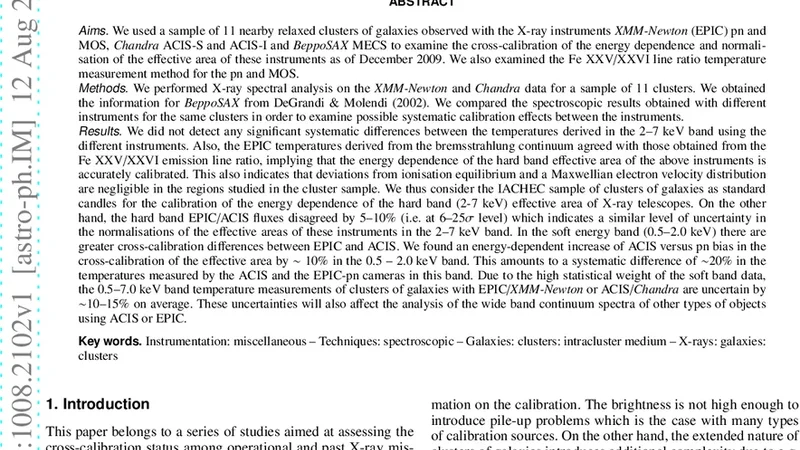
We used a sample of 11 nearby relaxed clusters of galaxies observed with the X-ray instruments XMM-Newton (EPIC) pn and MOS, Chandra ACIS-S and ACIS-I and BeppoSAX MECS to examine the cross-calibration of the energy dependence and normalisation of the effective area of these instruments as of December 2009. We also examined the Fe XXV/XXVI line ratio temperature measurement method for the pn and MOS. We performed X-ray spectral analysis on the XMM-Newton and Chandra data for a sample of 11 clusters. We obtained the information for BeppoSAX from DeGrandi & Molendi (2002). We compared the spectroscopic results obtained with different instruments for the same clusters in order to examine possible systematic calibration effects between the instruments. We did not detect any significant systematic differences between the temperatures derived in the 2-7 keV band using the different instruments. Also, the EPIC temperatures derived from the bremsstrahlung continuum agreed with those obtained from the Fe XXV/XXVI emission line ratio, implying that the energy dependence of the hard band effective area of the above instruments is accurately calibrated. On the other hand, the hard band EPIC/ACIS fluxes disagreed by 5-10% (i.e. at 6-25 sigma level) which indicates a similar level of uncertainty in the normalisations of the effective areas of these instruments in the 2–7 keV band. In the soft energy band (0.5-2.0 keV) there are greater cross-calibration differences between EPIC and ACIS. Due to the high statistical weight of the soft band data, the 0.5-7.0 keV band temperature measurements of clusters of galaxies with EPIC or ACIS are uncertain by ~10-15% on average.
💡 Research Summary
This paper presents a systematic cross‑calibration study of the effective area of four major X‑ray observatories—XMM‑Newton EPIC (pn and MOS), Chandra ACIS‑S and ACIS‑I, and BeppoSAX MECS—using a sample of eleven nearby, relaxed galaxy clusters. The authors selected these clusters because their intracluster medium (ICM) is dominated by a hot, optically thin plasma that emits a relatively simple X‑ray spectrum consisting of a bremsstrahlung continuum and prominent Fe XXV (6.7 keV) and Fe XXVI (6.9 keV) lines. Such spectra provide a clean laboratory for testing both the energy dependence and the absolute normalization of the instruments’ effective areas.
Data reduction was performed with the most recent calibration files available as of December 2009. For each instrument the authors extracted spectra in the 0.5–7 keV band, applied standard filtering, and generated response matrices. The analysis proceeded in two parallel ways. First, a single‑temperature APEC model was fitted to the 2–7 keV “hard” band to obtain the spectroscopic temperature (kT) and the model normalization, which is directly proportional to the flux and thus to the effective area. Second, the same spectra were used to measure the intensity ratio of the Fe XXV and Fe XXVI lines; this ratio provides an independent temperature estimate that depends only on atomic physics and is insensitive to the continuum calibration. Agreement between the two temperature determinations therefore tests the energy‑dependent part of the effective‑area calibration, while differences in the normalizations reveal discrepancies in the absolute effective‑area scale.
The main findings can be summarized as follows:
-
Hard‑band temperatures are consistent across instruments. All five detectors (pn, MOS, ACIS‑S, ACIS‑I, and MECS) yield statistically indistinguishable temperatures in the 2–7 keV range. This indicates that, as of the 2009 calibration release, the energy dependence of the effective area in the hard band is accurately modeled for all instruments.
-
Line‑ratio temperatures validate the EPIC calibration. For EPIC pn and MOS, temperatures derived from the Fe XXV/XXVI line ratio agree with those obtained from the bremsstrahlung continuum within the statistical uncertainties. This reinforces confidence that the EPIC hard‑band effective area is correctly calibrated both in shape and in absolute scale for line‑based diagnostics.
-
Flux normalizations differ at the 5–10 % level. Despite the agreement in temperature, the absolute fluxes (i.e., model normalizations) measured by EPIC and ACIS differ by 5–10 % in the hard band, corresponding to a 6–25 σ statistical significance given the high photon counts. This discrepancy points to a systematic uncertainty in the overall normalization of the effective areas of the two observatories.
-
Soft‑band (0.5–2 keV) cross‑calibration is poorer. In the softer part of the spectrum the EPIC–ACIS differences become larger, both in terms of energy‑dependent response and absolute normalization. Because the soft band carries a large fraction of the total counts, these discrepancies dominate the overall temperature uncertainty when fitting the full 0.5–7 keV band.
-
Implications for cluster science. The combined effect of the hard‑band flux offset and the soft‑band calibration differences leads to an average systematic uncertainty of ~10–15 % on temperatures derived from EPIC or ACIS data alone. Since cluster temperature is a key proxy for mass, and cluster mass functions are used to constrain cosmological parameters (e.g., Ω_m, σ_8), the identified calibration uncertainties directly translate into systematic errors on cosmological inferences.
The authors conclude that, while the hard‑band spectral shape is well calibrated, the absolute effective‑area normalizations—especially in the soft band—require further refinement. They suggest that coordinated observations, joint fitting of simultaneous data sets, and continued updates to the calibration databases are essential to reduce these systematic offsets. Moreover, the successful use of the Fe XXV/XXVI line ratio as an independent temperature diagnostic validates this technique for future high‑resolution missions such as XRISM and Athena, where line‑based plasma diagnostics will play a central role.
In summary, this IACHEC study provides a comprehensive benchmark of the current state of X‑ray detector cross‑calibration, quantifies the level of systematic uncertainty that remains, and outlines a path forward for achieving the sub‑5 % calibration precision needed for next‑generation cluster cosmology.
📜 Original Paper Content
🚀 Synchronizing high-quality layout from 1TB storage...