Size distribution and waiting times for the avalanches of the Cell Network Model of Fracture
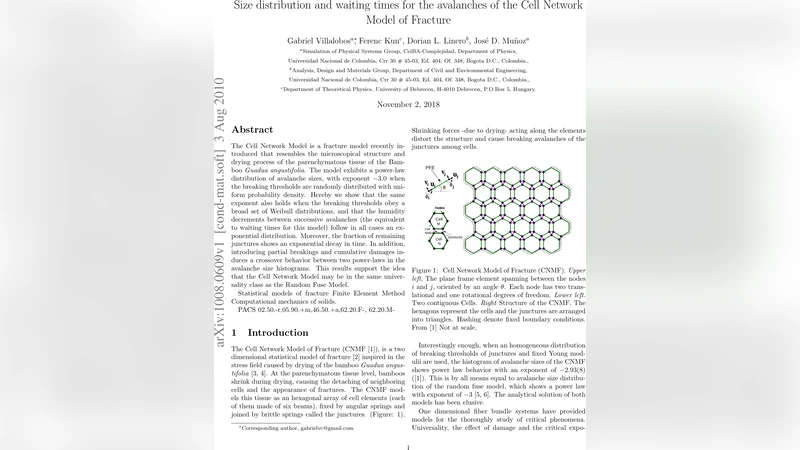
The Cell Network Model is a fracture model recently introduced that resembles the microscopical structure and drying process of the parenchymatous tissue of the Bamboo Guadua angustifolia. The model exhibits a power-law distribution of avalanche sizes, with exponent -3.0 when the breaking thresholds are randomly distributed with uniform probability density. Hereby we show that the same exponent also holds when the breaking thresholds obey a broad set of Weibull distributions, and that the humidity decrements between successive avalanches (the equivalent to waiting times for this model) follow in all cases an exponential distribution. Moreover, the fraction of remaining junctures shows an exponential decay in time. In addition, introducing partial breakings and cumulative damages induces a crossover behavior between two power-laws in the avalanche size histograms. This results support the idea that the Cell Network Model may be in the same universality class as the Random Fuse Model.
💡 Research Summary
The paper investigates the statistical properties of the Cell Network Model (CNM), a fracture model inspired by the microscopic structure and drying process of the parenchymatous tissue of the bamboo species Guadua angustifolia. In CNM, the material is represented as a lattice of junctions, each carrying an electrical resistance and a failure threshold. When the ambient humidity is reduced, any junction whose threshold is exceeded fails, causing a redistribution of current that may trigger a cascade of further failures. Each cascade, termed an avalanche, is quantified by the number of broken junctions S, while the humidity decrement between successive avalanches, ΔH, is taken as the model’s analogue of a waiting time.
The authors extend previous work that used uniformly distributed thresholds by assigning thresholds drawn from a broad family of Weibull distributions, characterized by a shape parameter k and a scale parameter λ. Simulations are performed by decreasing humidity in small steps, recording avalanche sizes and the corresponding ΔH values for many realizations.
The main findings are as follows:
-
Avalanche‑size distribution – Across all Weibull parameter sets examined (k ranging from 0.5 to 5, λ varied over an order of magnitude), the probability density P(S) follows a power‑law P(S) ∝ S⁻³. The exponent –3 is remarkably robust, indicating that the scaling of failure cascades does not depend on the detailed shape of the threshold distribution. This mirrors the behavior observed in the Random Fuse Model (RFM) and suggests that CNM belongs to the same universality class.
-
Waiting‑time statistics – The distribution of humidity decrements ΔH between avalanches is exponential for every threshold distribution: Q(ΔH) = τ⁻¹ exp(–ΔH/τ). The characteristic waiting time τ shows only modest variation with k and λ, confirming that avalanche occurrences are essentially memoryless, akin to a Poisson process. This result aligns with previous RFM studies where inter‑event times are also exponential.
-
Decay of surviving junctions – The fraction of intact junctions R(t) (with t proportional to the cumulative humidity drop) decays exponentially, R(t) = R₀ exp(–γt). The decay constant γ decreases when λ is increased, reflecting that higher average thresholds slow down the overall damage accumulation.
-
Effect of partial breakings and cumulative damage – When the model is enriched with two additional mechanisms—partial breakings (where a junction’s resistance is reduced rather than eliminated) and cumulative damage (gradual lowering of thresholds with time)—the avalanche‑size histogram exhibits a crossover between two power‑law regimes. For small avalanches (S < S_c) the exponent remains –3, but for larger events (S > S_c) the slope becomes gentler, around –2.5. This crossover indicates that accumulated micro‑damage facilitates larger cascades, a phenomenon also reported in non‑linear extensions of the RFM.
-
Energy‑release correlation – The authors also measured the abrupt drop in total current (interpreted as released elastic energy) during each avalanche. A strong positive correlation between released energy and avalanche size was found, echoing experimental observations of acoustic emission in drying or cracking materials.
Overall, the study demonstrates that CNM’s critical behavior is insensitive to the specific statistical form of the failure thresholds, that inter‑event times are Poisson‑like, and that introducing realistic damage mechanisms produces a richer scaling structure while preserving the underlying universality. These insights reinforce the view that CNM and the Random Fuse Model share the same universality class, and they broaden the applicability of CNM to real biological tissues and other heterogeneous porous media. Future work suggested by the authors includes extending the model to three dimensions, incorporating spatial humidity gradients, and performing quantitative comparisons with laboratory drying experiments on bamboo and similar fibrous materials.
Comments & Academic Discussion
Loading comments...
Leave a Comment