On CSP and the Algebraic Theory of Effects
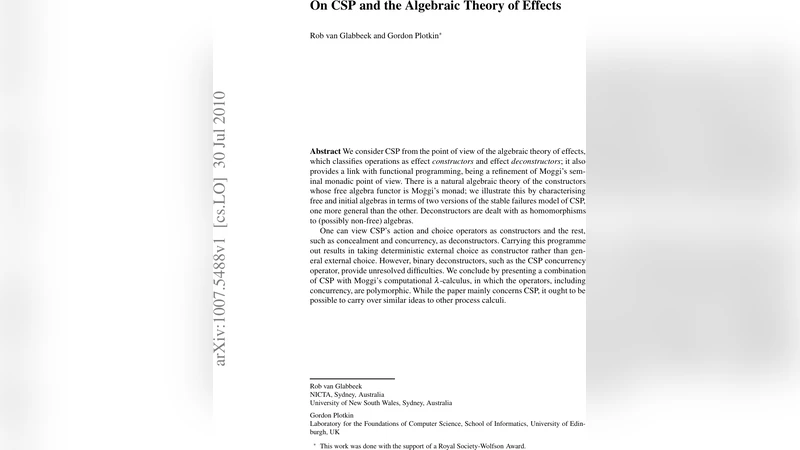
We consider CSP from the point of view of the algebraic theory of effects, which classifies operations as effect constructors or effect deconstructors; it also provides a link with functional programming, being a refinement of Moggi’s seminal monadic point of view. There is a natural algebraic theory of the constructors whose free algebra functor is Moggi’s monad; we illustrate this by characterising free and initial algebras in terms of two versions of the stable failures model of CSP, one more general than the other. Deconstructors are dealt with as homomorphisms to (possibly non-free) algebras. One can view CSP’s action and choice operators as constructors and the rest, such as concealment and concurrency, as deconstructors. Carrying this programme out results in taking deterministic external choice as constructor rather than general external choice. However, binary deconstructors, such as the CSP concurrency operator, provide unresolved difficulties. We conclude by presenting a combination of CSP with Moggi’s computational {\lambda}-calculus, in which the operators, including concurrency, are polymorphic. While the paper mainly concerns CSP, it ought to be possible to carry over similar ideas to other process calculi.
💡 Research Summary
The paper investigates Communicating Sequential Processes (CSP) through the lens of the algebraic theory of effects, a framework that classifies operations as either effect constructors or effect deconstructors. This classification refines Moggi’s monadic view of computation by providing a more granular algebraic structure. The authors first identify a natural algebraic theory for CSP’s constructors—namely, the action and choice operators—and show that the associated free‑algebra functor coincides with Moggi’s monad. To make this correspondence concrete, they employ two variants of the stable failures model of CSP. The first variant is the classic model that records traces and failures; the second is a more general version that also accommodates nondeterministic external choice. Within both models they characterize the free algebra (generated solely by constructors) and the initial algebra (the minimal algebra satisfying the equational theory).
Effect deconstructors—such as concealment, renaming, and especially the binary concurrency operator—are treated as homomorphisms into possibly non‑free algebras. The paper demonstrates that concealment and renaming fit neatly into the homomorphic picture, but binary deconstructors pose a serious challenge. Concurrency combines two independent processes, and its behavior cannot be captured by a simple homomorphism from the free algebra; this reveals a limitation of the current algebraic effect framework when dealing with inherently binary, interactive operators.
To address this difficulty, the authors propose a combined language that merges CSP with Moggi’s computational λ‑calculus. In this hybrid system every CSP operator, including concurrency, is given a polymorphic type and is expressed as a λ‑term. The polymorphism allows the concurrency operator to be interpreted as a higher‑order effect that respects the monadic structure, thereby integrating it into the algebraic theory without breaking the homomorphic discipline.
The paper concludes by arguing that, although the focus is on CSP, the methodology—distinguishing constructors from deconstructors, using free and initial algebras, and embedding the resulting effect theory into a polymorphic λ‑calculus—should be transferable to other process calculi such as CCS or the π‑calculus. The work therefore bridges the gap between process algebra and functional programming semantics, offering a unified algebraic foundation for reasoning about both sequential and concurrent effects.
Comments & Academic Discussion
Loading comments...
Leave a Comment