A Variable Black Hole X-Ray Source in a NGC 1399 Globular Cluster
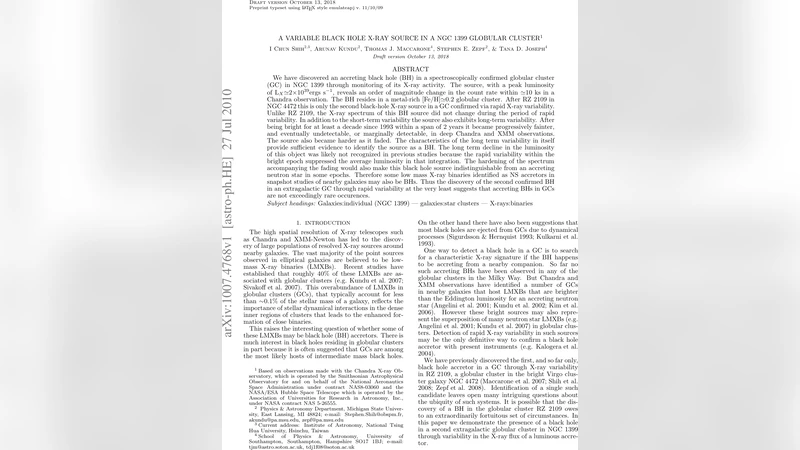
We have discovered an accreting black hole (BH) in a spectroscopically confirmed globular cluster (GC) in NGC 1399 through monitoring of its X-ray activity. The source, with a peak luminosity of L_x=2x10^39 ergs/s, reveals an order of magnitude change in the count rate within ~10 ks in a Chandra observation. The BH resides in a metal-rich [Fe/H]~0.2 globular cluster. After RZ2109 in NGC 4472 this is only the second black-hole X-ray source in a GC confirmed via rapid X-ray variability. Unlike RZ2109, the X-ray spectrum of this BH source did not change during the period of rapid variability. In addition to the short-term variability the source also exhibits long-term variability. After being bright for at least a decade since 1993 within a span of 2 years it became progressively fainter, and eventually undetectable, or marginally detectable, in deep Chandra and XMM observations. The source also became harder as it faded. The characteristics of the long term variability in itself provide sufficient evidence to identify the source as a BH. The long term decline in the luminosity of this object was likely not recognized in previous studies because the rapid variability within the bright epoch suppressed the average luminosity in that integration. The hardening of the spectrum accompanying the fading would also make this black hole source indistinguishable from an accreting neutron star in some epochs. Therefore some low mass X-ray binaries identified as NS accretors in snapshot studies of nearby galaxies may also be BHs. Thus the discovery of the second confirmed BH in an extragalactic GC through rapid variability at the very least suggests that accreting BHs in GCs are not exceedingly rare occurences.
💡 Research Summary
The authors report the discovery of an accreting black hole (BH) residing in a spectroscopically confirmed globular cluster (GC) of the giant elliptical galaxy NGC 1399. The cluster is metal‑rich, with an iron abundance of
Comments & Academic Discussion
Loading comments...
Leave a Comment