Extended X-ray Emission in the HI Cavity of NGC 4151: Galaxy-scale AGN Feedback?
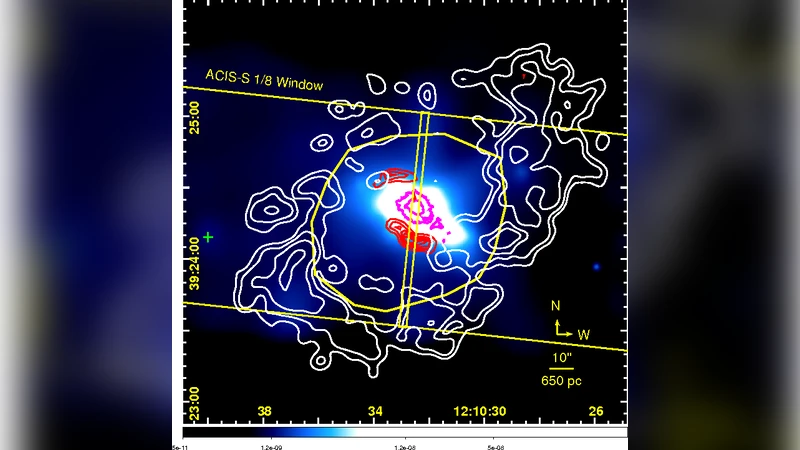
We present the Chandra discovery of soft diffuse X-ray emission in NGC 4151 (L[0.5-2keV]~10^{39} erg s$^{-1}$), extending 2 kpc from the active nucleus and filling in the cavity of the HI material. The best fit to the X-ray spectrum requires either a kT0.25 keV thermal plasma or a photoionized component. In the thermal scenario, hot gas heated by the nuclear outflow would be confined by the thermal pressure of the HI gas and the dynamic pressure of inflowing neutral material in the galactic disk. In the case of photoionization, the nucleus must have experienced an Eddington limit outburst. For both scenarios, the AGN-host interaction in NGC 4151 must have occured relatively recently (some 10^4 yr ago). This very short timescale to the last episode of high activity phase may imply such outbursts occupy $\gtrsim$1% of AGN lifetime.
💡 Research Summary
This paper reports the discovery of extended soft X‑ray emission surrounding the active nucleus of the nearby Seyfert 1 galaxy NGC 4151, based on deep Chandra ACIS‑S observations. The diffuse component, with a luminosity of L ≈ 10³⁹ erg s⁻¹ in the 0.5–2 keV band, stretches out to a projected radius of roughly 2 kpc and fills the cavity that is evident in the galaxy’s neutral hydrogen (HI) distribution. After carefully excising point sources and the bright nuclear PSF, the authors demonstrate that the residual X‑ray surface brightness is roughly uniform across the HI hole, indicating a genuine, galaxy‑scale phenomenon rather than a projection effect or scattered nuclear light.
Spectral analysis shows that the emission can be modeled either as a low‑temperature thermal plasma (kT ≈ 0.25 keV, corresponding to ≈3 × 10⁶ K) or as a photo‑ionized gas component. In the thermal scenario, the best‑fit emission measure implies an electron density of nₑ ≈ 0.02 cm⁻³ and a total thermal energy of order 10⁵⁴ erg. The hot gas would be confined by the combined thermal pressure of the surrounding HI (P ≈ 10⁻¹² dyne cm⁻²) and the dynamic pressure of inflowing neutral material in the galactic disk (P_dyn ≈ 10⁻¹¹ dyne cm⁻²). Such confinement suggests that the hot plasma is the product of a nuclear outflow—likely a wind driven by the AGN’s radiation pressure or a small‑scale jet—heating the ambient interstellar medium (ISM) as it expands. The cooling time of the plasma, estimated from its temperature and density, is on the order of 10⁵ yr, implying that the outflow must have been active relatively recently.
The alternative photo‑ionization model requires that the nucleus emitted an intense burst of ionizing radiation in the recent past, with a luminosity near the Eddington limit for the black hole (L ≈ 10⁴⁵ erg s⁻¹). In this picture, the observed soft X‑rays are recombination radiation from gas that was photo‑ionized by that burst and is now recombining as the ionizing flux declines. The required ionizing photon flux to sustain the observed surface brightness at a distance of ~2 kpc translates into an outburst that would have occurred ≲10⁴ yr ago. This timescale is comparable to the dynamical crossing time of the HI cavity and much shorter than the typical AGN duty cycle.
Both interpretations converge on a key implication: the most recent episode of strong AGN activity in NGC 4151 must have taken place within the last ∼10⁴ yr. Given that the galaxy shows no evidence of a current Eddington‑level outburst, the authors argue that such high‑luminosity phases are intermittent, occupying at least ∼1 % of the total active lifetime of the black hole. This fraction is significant because it suggests that brief, powerful feedback events can inject enough energy into the host galaxy’s ISM to influence star formation, gas dynamics, and the overall evolution of the galaxy, even if the AGN spends most of its time in a low‑luminosity state.
The paper concludes by emphasizing the need for future observations with higher spectral resolution (e.g., XRISM, Athena) and complementary multi‑wavelength data (optical integral‑field spectroscopy, radio interferometry) to disentangle the thermal and photo‑ionized contributions definitively. Such studies will refine estimates of the energy budget, the coupling efficiency between AGN output and the surrounding ISM, and the frequency of galaxy‑scale feedback events in Seyfert galaxies.
Comments & Academic Discussion
Loading comments...
Leave a Comment