Compton degradation of gamma-ray line emission from radioactive isotopes in the classical nova V2491 Cygni
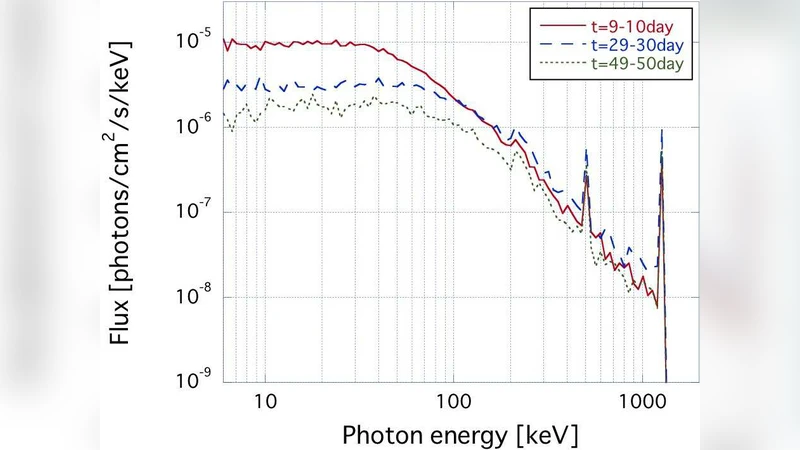
To account for the non-thermal emission from the classical nova V2491 Cygni, we perform a series of numerical calculations of radiative transfer of \gamma-ray photons from the radioactive isotope $^{22}$Na in the matter ejected from a white dwarf. Using a simple wind model for the dynamical evolution of the ejecta and a monte-carlo code, we calculate radiative transfer of the \gamma-ray photons in the ejecta. Repeated scattering of the \gamma-ray photons by electrons in the ejecta, i.e., Compton degradation, results in an extremely flat spectrum in the hard X-ray range, which successfully reproduces the observed spectrum of the X-ray emission from V2491 Cygni. The amount of the isotope $^{22}$Na synthesized in the ejecta is required to be 3\times 10^{-5} M_\odot to account for the flux of the hard X-ray emission. Our model indicates that the ejecta become transparent to the \gamma-ray photons within several tens days. Using the results, we briefly discuss the detectability of the \gamma-ray line emission by the {\it INTEGRAL} gamma-ray observatory and the {\it Fermi} Gamma-ray Space Telescope.
💡 Research Summary
The paper addresses the origin of the hard X‑ray emission observed from the classical nova V2491 Cygni by modeling the radiative transfer of γ‑ray photons produced in the decay of the radioactive isotope ^22Na within the expanding ejecta. The authors adopt a simple wind model for the dynamical evolution of the ejecta, assuming a constant mass‑loss rate and a linearly decreasing expansion velocity that reproduces the observed ejecta mass (~10⁻⁴ M⊙) and velocity (~2000 km s⁻¹). Using a Monte‑Carlo code, they follow thousands of photons emitted in the 1.275 MeV line (direct ^22Na decay) and the 511 keV annihilation line, tracking each Compton scattering event with free electrons according to the Klein‑Nishina cross‑section.
Repeated Compton scatterings degrade the photon energies, converting the initially narrow γ‑ray lines into a broad, nearly flat continuum in the 10–100 keV range. This “Compton degradation” naturally reproduces the unusually flat hard X‑ray spectrum measured from V2491 Cygni, without invoking non‑thermal particle acceleration or shock‑generated bremsstrahlung. By adjusting the amount of ^22Na, the authors find that a synthesized mass of ≈3 × 10⁻⁵ M⊙ is required to match the observed X‑ray flux. This value is modestly higher than standard ONe white‑dwarf nucleosynthesis predictions, suggesting that V2491 Cygni may have experienced especially efficient ^22Na production.
The simulations also show that the ejecta become transparent to γ‑rays within a few tens of days (≈30–40 d). After this epoch, the Compton‑degraded continuum fades and the original γ‑ray lines begin to emerge. The authors therefore assess the detectability of the 1.275 MeV and 511 keV lines with current γ‑ray observatories. They argue that INTEGRAL/SPI, with its high spectral resolution, and Fermi/GBM, with its broad energy coverage, could detect the lines if observations are carried out within the first 2–3 weeks after outburst, when the line fluxes are still appreciable. Detection would provide a direct measurement of the ^22Na yield and, through line width and shape, constraints on the electron density, temperature, and optical depth of the ejecta.
In summary, the study demonstrates that Compton degradation of ^22Na decay photons offers a robust, quantitative explanation for the hard X‑ray emission of V2491 Cygni. It links the observed X‑ray continuum to a specific nucleosynthetic product, predicts a realistic ^22Na mass, and outlines a clear observational strategy for confirming the model with γ‑ray line measurements. This work thus bridges the gap between nova nucleosynthesis theory and high‑energy observations, providing a valuable framework for interpreting future nova outbursts.
Comments & Academic Discussion
Loading comments...
Leave a Comment