INTEGRAL/IBIS observations of a hard X-ray outburst in high mass X-ray binary 4U 2206+54
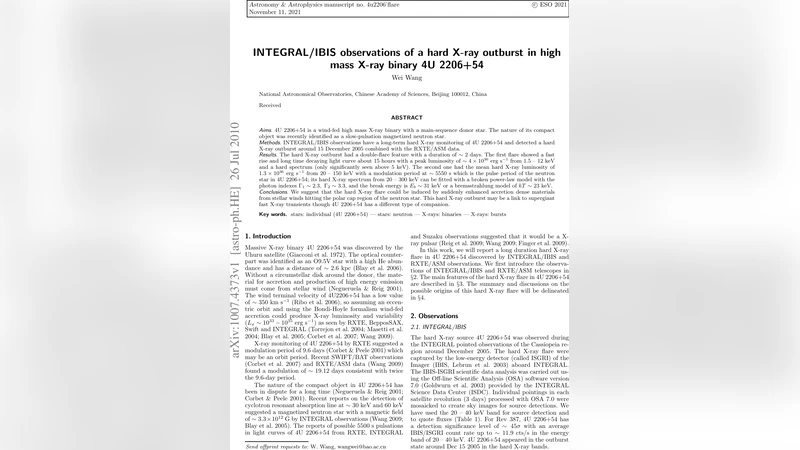
U 2206+54 is a wind-fed high mass X-ray binary with a main-sequence donor star. The nature of its compact object was recently identified as a slow-pulsation magnetized neutron star. INTEGRAL/IBIS observations have a long-term hard X-ray monitoring of 4U 2206+54 and detected a hard X-ray outburst around 15 December 2005 combined with the RXTE/ASM data.The hard X-ray outburst had a double-flare feature with a duration of $\sim$ 2 days. The first flare showed a fast rise and long time decaying light curve about 15 hours with a peak luminosity of $\sim 4\times 10^{36}$ erg s$^{-1}$ from 1.5 – 12 keV and a hard spectrum (only significantly seen above 5 keV). The second one had the mean hard X-ray luminosity of $1.3\times 10^{36}$ erg s$^{-1}$ from 20 – 150 keV with a modulation period at $\sim 5550$ s which is the pulse period of the neutron star in 4U 2206+54; its hard X-ray spectrum from 20 – 300 keV can be fitted with a broken power-law model with the photon indexes $\Gamma_1 \sim 2.3,\ \Gamma_2 \sim 3.3$, and the break energy is $E_b \sim 31$ keV or a bremsstrahlung model of $kT\sim 23$ keV. We suggest that the hard X-ray flare could be induced by suddenly enhanced accretion dense materials from stellar winds hitting the polar cap region of the neutron star. This hard X-ray outburst may be a link to supergiant fast X-ray transients though 4U 2206+54 has a different type of companion.
💡 Research Summary
The paper presents a detailed study of a hard X‑ray outburst from the high‑mass X‑ray binary (HMXB) 4U 2206+54, using long‑term monitoring data from INTEGRAL/IBIS together with contemporaneous RXTE/ASM observations. 4U 2206+54 is a wind‑fed system with a main‑sequence donor and, more recently, has been identified as hosting a slowly rotating, magnetised neutron star with a pulse period of about 5550 s. During the monitoring campaign, an unusual outburst was detected around 15 December 2005. The event lasted roughly two days and displayed a distinctive double‑flare morphology.
The first flare was primarily visible in the soft X‑ray band (1.5–12 keV). It rose rapidly within a few hours, peaked at a luminosity of ~4 × 10³⁶ erg s⁻¹, and then decayed slowly over ~15 hours. The emission was hard in the sense that it was only significantly detected above ~5 keV, suggesting that the flare’s spectrum was dominated by higher‑energy photons despite being observed in the soft band.
The second flare was observed in the hard X‑ray band (20–150 keV). Its mean luminosity was ~1.3 × 10³⁶ erg s⁻¹, and the light curve exhibited a clear modulation with a period of ~5550 s, identical to the known neutron‑star spin period. Spectral fitting over 20–300 keV could be achieved with either a broken power‑law model (photon indices Γ₁≈2.3 below the break, Γ₂≈3.3 above, break energy E_b≈31 keV) or a thermal bremsstrahlung model with kT≈23 keV. Both fits are statistically acceptable, indicating that the emission could be interpreted as thermal plasma radiation modified by Comptonisation, or as a non‑thermal continuum with a high‑energy cutoff.
The authors interpret the outburst as the result of a sudden increase in the density of the stellar wind material that impinges on the neutron‑star magnetic poles. In this scenario, a dense clump or stream in the wind penetrates the magnetosphere, leading to a rapid, localized rise in the accretion rate onto the polar caps. The first, softer flare may correspond to the initial impact and heating of the polar cap, while the second, harder flare reflects the subsequent, more sustained accretion onto the magnetically channelled column, producing the observed pulsations.
Importantly, although 4U 2206+54 has a main‑sequence donor rather than a supergiant, the temporal and spectral characteristics of the event resemble those of Supergiant Fast X‑ray Transients (SFXTs), which are known for brief, intense flares caused by wind clumps. This similarity suggests that clumpy wind accretion may be a universal mechanism for producing rapid X‑ray variability across different classes of HMXBs. The paper therefore proposes that the observed hard X‑ray flare could represent a bridge between the behavior of classical wind‑fed systems and the extreme, short‑lived outbursts seen in SFXTs.
The study highlights the need for coordinated multi‑wavelength campaigns to resolve the structure of the donor’s wind, to monitor the neutron‑star spin evolution during such events, and to refine models of magnetospheric gating and clump‑induced accretion. Future observations with higher temporal resolution and broader energy coverage (e.g., using NuSTAR or NICER) could test the proposed scenario by tracking spectral evolution across the flare rise and decay, and by searching for correlated changes in the pulse profile or cyclotron resonance features. In summary, the paper provides compelling evidence that sudden, dense wind structures can trigger hard X‑ray outbursts in wind‑fed HMXBs, expanding our understanding of accretion physics beyond the traditional supergiant paradigm.