A few days before the end of the 2008 extreme outburst of EX Lup : accretion shocks and a smothered stellar corona unveiled by XMM-Newton
In mid-January 2008, EX Lup, the prototype of the small class of eruptive variables called EXors, began an extreme outburst that lasted seven months. We observed EX Lup during about 21 h with XMM-Newt
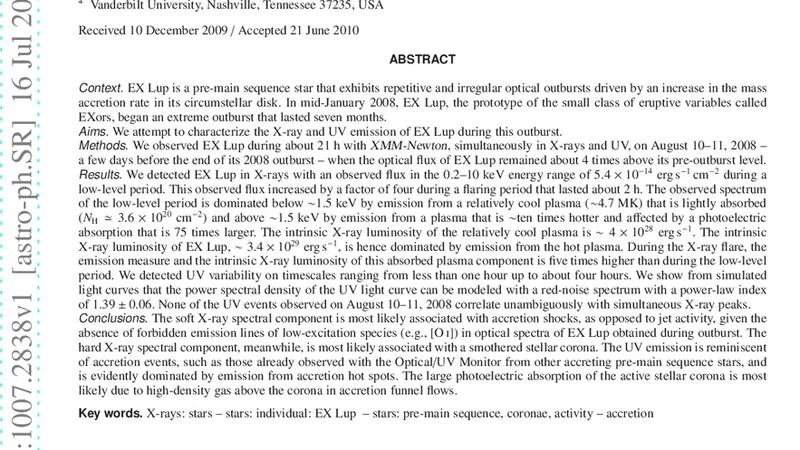
In mid-January 2008, EX Lup, the prototype of the small class of eruptive variables called EXors, began an extreme outburst that lasted seven months. We observed EX Lup during about 21 h with XMM-Newton, simultaneously in X-rays and UV, on August 10-11, 2008 – a few days before the end of its 2008 outburst – when the optical flux of EX Lup remained about 4 times above its pre-outburst level. The observed spectrum of the low-level period is dominated below ~1.5 keV by emission from a relatively cool plasma (4.7 MK) that is lightly absorbed (NH3.6E20 cm^-2) and above ~1.5 keV by emission from a plasma that is ~ten times hotter and affected by a photoelectric absorption that is 75 times larger. During the X-ray flare, the emission measure and the intrinsic X-ray luminosity of this absorbed plasma component is five times higher than during the low-level period. The soft X-ray spectral component is most likely associated with accretion shocks, as opposed to jet activity, given the absence of forbidden emission lines of low-excitation species (e.g., [O I]) in optical spectra of EX Lup obtained during outburst. The hard X-ray spectral component, meanwhile, is most likely associated with a smothered stellar corona. The UV emission is reminiscent of accretion events, such as those already observed with the Optical/UV Monitor from other accreting pre-main sequence stars, and is evidently dominated by emission from accretion hot spots. The large photoelectric absorption of the active stellar corona is most likely due to high-density gas above the corona in accretion funnel flows (abridged).
💡 Research Summary
The paper presents a coordinated X‑ray and ultraviolet (UV) observation of the prototype EXor variable EX Lup during the final days of its 2008 extreme outburst. The outburst began in mid‑January 2008, lasted about seven months, and at the time of the XMM‑Newton observation (10–11 August 2008) the optical flux was still roughly four times higher than the quiescent level. Using the EPIC‑pn, MOS detectors and the Optical/UV Monitor (OM), the authors obtained ~21 h of simultaneous data, allowing a detailed spectral and temporal analysis of both low‑energy (soft) and high‑energy (hard) X‑ray components, as well as the UV variability.
Spectral fitting reveals two distinct plasma components. The soft component dominates below ~1.5 keV and is well described by an optically thin plasma with a temperature of kT≈0.4 keV (≈4.7 MK) and a modest line‑of‑sight hydrogen column density NH≈3.6×10²⁰ cm⁻². This low absorption indicates that the emitting region is relatively unobscured, consistent with emission from accretion shocks at the stellar surface where the infalling material from the disk impacts the photosphere. The hard component, which dominates above ~1.5 keV, requires a much hotter plasma (kT≈3–4 keV, i.e., ≈30–40 MK) and a dramatically larger absorbing column, NH≈2.7×10²² cm⁻², about 75 times the soft‑component value. The authors interpret this as a “smothered” stellar corona, whose intrinsic emission is heavily attenuated by dense gas situated above the corona, most plausibly the high‑density funnel flows that channel material from the inner disk onto the star during the outburst.
During the observation a clear X‑ray flare occurred. The flare primarily affected the hard component: its emission measure and intrinsic X‑ray luminosity increased by a factor of ~5 relative to the low‑level interval, while the soft component remained essentially unchanged. This behavior mirrors that seen in other pre‑main‑sequence stars, where coronal flares boost the high‑energy emission without significantly altering the accretion‑shock contribution.
The UV light curve obtained with the OM shows rapid, stochastic variability on timescales of minutes to tens of minutes, with amplitudes of a few tenths of a magnitude. Such flickering is characteristic of accretion hot spots rotating into and out of view, and it is consistent with the UV behavior observed in other accreting T Tauri stars. The authors note that optical spectra taken contemporaneously lack low‑excitation forbidden lines such as
📜 Original Paper Content
🚀 Synchronizing high-quality layout from 1TB storage...