Implementing and comparing sink particles in AMR and SPH
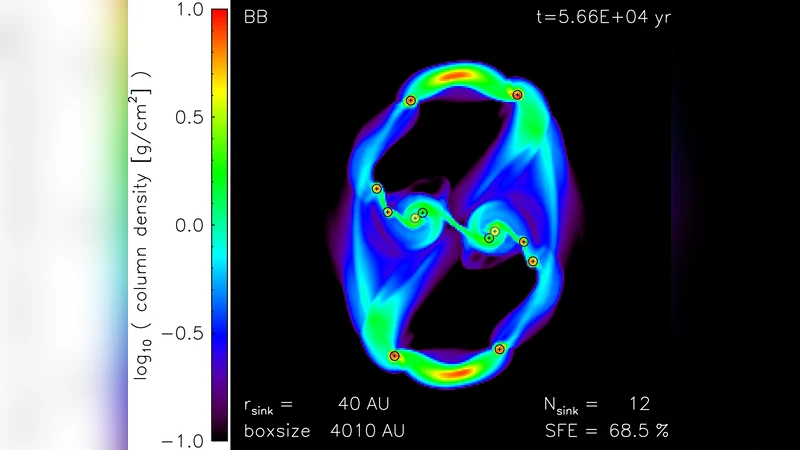
We implemented sink particles in the Adaptive Mesh Refinement (AMR) code FLASH to model the gravitational collapse and accretion in turbulent molecular clouds and cores. Sink particles are frequently used to measure properties of star formation in numerical simulations, such as the star formation rate and efficiency, and the mass distribution of stars. We show that only using a density threshold for sink particle creation is insufficient in case of supersonic flows, because the density can exceed the threshold in strong shocks that do not necessarily lead to local collapse. Additional physical collapse indicators have to be considered. We apply our AMR sink particle module to the formation of a star cluster, and compare it to a Smoothed Particle Hydrodynamics (SPH) code with sink particles. Our comparison shows encouraging agreement of gas and sink particle properties between the AMR and SPH code.
💡 Research Summary
This paper presents the implementation of sink particles in the Adaptive Mesh Refinement (AMR) code FLASH and a systematic comparison with a Smoothed Particle Hydrodynamics (SPH) code that also employs sink particles. Sink particles are a widely used sub‑grid technique to represent collapsed objects (protostars) in numerical simulations of turbulent molecular clouds, allowing researchers to measure star formation rates, efficiencies, and the resulting stellar mass distribution without resolving the full protostellar collapse.
The authors first point out a fundamental limitation of the most common sink‑particle creation criterion: a simple density threshold. In supersonic turbulent flows, strong shocks can temporarily raise the gas density above any reasonable threshold without leading to genuine gravitational collapse. Relying solely on density therefore produces spurious sink particles that contaminate the star‑formation statistics. To overcome this, the paper introduces a set of four physically motivated checks that must all be satisfied before a sink particle is created: (1) the candidate cell (or particle) must be a local minimum of the gravitational potential, (2) the flow must be converging (negative velocity divergence), (3) the mass enclosed within the candidate region must exceed the Jeans mass appropriate for self‑gravity, and (4) the free‑fall time of that mass must be shorter than the current simulation timestep. These criteria effectively filter out shock‑induced density spikes while preserving true collapsing cores.
In the FLASH implementation, sink particles are tightly coupled to the AMR hierarchy. When a sink is created, its mass, linear momentum, and angular momentum are subtracted from the underlying grid cells, and the particle is inserted at the cell centre. The particle’s gravity is computed using the multi‑level Poisson solver, ensuring that forces are consistent across refinement levels. Accretion onto existing sinks proceeds by checking the gas within a predefined accretion radius; gas that satisfies the same convergence and bound‑ness conditions is transferred to the particle while conserving total momentum. Mergers are allowed when two sinks approach within a specified distance, with the combined particle inheriting the summed mass and momentum.
The SPH counterpart uses an identical set of creation criteria, applied to the smoothed density field and particle neighbours. Accretion is handled by removing gas particles that satisfy the convergence and binding tests within an accretion kernel, and merging follows the standard SPH prescription based on particle proximity.
Both codes are initialized with identical turbulent molecular‑cloud conditions: a total mass of ~100 M⊙, a box size of 0.5 pc, mean density 10⁻²⁰ g cm⁻³, temperature 10 K, and a supersonic turbulent velocity field with a power‑law spectrum (k⁻²) and Mach number ≈5. Periodic boundary conditions are used, and the simulations are evolved for ~1 Myr, covering several global free‑fall times.
The results show remarkable agreement between the AMR and SPH runs. The gas density probability distribution functions (PDFs) evolve similarly, and the overall morphology of filaments and dense cores is comparable. The first massive sink particles appear at nearly the same time in both codes, followed by a cascade of lower‑mass sinks. The star‑formation rate (SFR) as a function of time follows an almost identical curve, reaching a final conversion efficiency of ~30 % of the gas into sink particles. The sink‑particle mass function (IMF) reproduces a Salpeter‑like high‑mass slope (α≈2.35) in both cases, with only minor differences at the low‑mass end that can be attributed to resolution effects inherent to each method.
The comparative analysis highlights the complementary strengths of the two approaches. AMR excels at capturing sharp shock fronts and resolving steep density gradients because the grid can be refined locally where needed, which helps to prevent artificial density spikes from triggering spurious sinks. SPH, on the other hand, naturally adapts to high‑density regions through particle concentration, providing a smooth representation of complex flow patterns without the need for explicit refinement criteria. Nevertheless, when the same physically motivated sink‑creation checks are applied, both methods produce consistent star‑formation statistics, demonstrating that the sink‑particle algorithm is robust across fundamentally different numerical frameworks.
In conclusion, the study demonstrates that a density‑threshold‑only approach is insufficient for supersonic turbulent environments. Incorporating additional collapse diagnostics yields a reliable sink‑particle creation scheme that works equally well in AMR and SPH codes. This work therefore provides a solid benchmark for future star‑formation simulations, offering a pathway toward standardized sink‑particle implementations that can be confidently used in large‑scale studies of molecular‑cloud evolution, cluster formation, and galaxy‑scale star‑formation modeling.
Comments & Academic Discussion
Loading comments...
Leave a Comment