On the properties of discs around accreting brown dwarfs
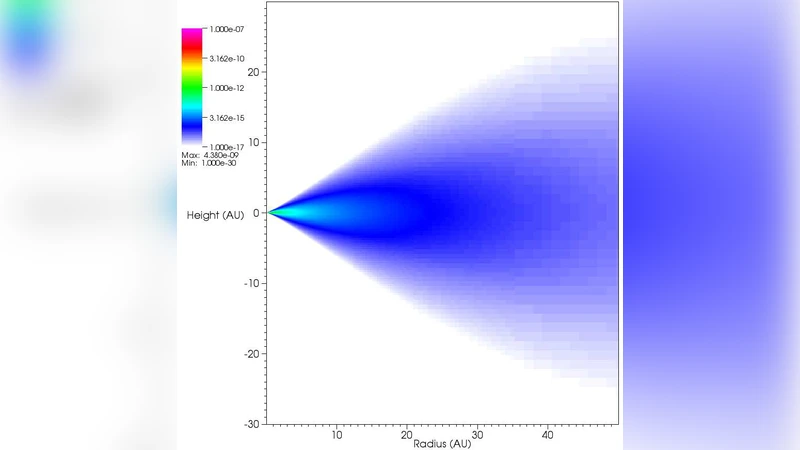
We present a grid of models of accreting brown dwarf systems with circumstellar discs. The calculations involve a self-consistent solution of both vertical hydrostatic and radiative equilibrium along with a sophisticated treatment of dust sublimation. We have simulated observations of the spectral energy distributions and several broadband photometric systems. Analysis of the disc structures and simulated observations reveal a natural dichotomy in accretion rates, with \logmdot $>-$9 and $\leq -$9 classed as extreme and typical accretors respectively. Derivation of ages and masses from our simulated photometry using isochrones is demonstrated to be unreliable even for typical accretors. Although current brown dwarf disc candidate selection criteria have been shown to be largely reliable when applied to our model grid we suggest improved selection criteria in several colour indices. We show that as accretion rates increase brown dwarf disc systems are less likely to be correctly identified. This suggests that, within our grid, systems with higher accretion rates would be preferentially lost during brown dwarf target selection. We suggest that observations used to assert a $\dot{M}\propto M_*^2$ relationship may contain an intrinsic selection bias.
💡 Research Summary
This paper presents a comprehensive grid of self‑consistent models for accreting brown dwarf (BD) systems surrounded by circumstellar discs. The authors solve the vertical hydrostatic equilibrium together with radiative equilibrium for each model, and they incorporate a sophisticated treatment of dust sublimation that dynamically adjusts the inner disc rim where temperatures exceed the dust destruction threshold. The parameter space spans brown dwarf masses from 0.02 to 0.08 M⊙, disc outer radii from 10 to 200 au, and mass‑accretion rates from 10⁻¹² to 10⁻⁷ M⊙ yr⁻¹, covering both “typical” and “extreme” accretors. For each configuration the spectral energy distribution (SED) is computed over 0.3–30 µm using the RADMC‑3D radiative transfer code, and synthetic photometry is generated for major broadband systems (2MASS, Spitzer IRAC/MIPS, WISE, etc.).
The analysis of the synthetic SEDs and colour‑colour diagrams reveals a natural dichotomy in accretion behaviour. Systems with log Ṁ > −9 (the “extreme” accretors) exhibit strong radiative heating of the inner disc, causing the dust sublimation front to move outward by several tens of astronomical units. This leads to an excess in near‑infrared flux and a relative deficit at mid‑ and far‑infrared wavelengths. Consequently, conventional colour cuts used to identify brown‑dwarf disc candidates (e.g., K −
Comments & Academic Discussion
Loading comments...
Leave a Comment