Limits on the quiescent radio emission from the black hole binaries GRO J1655-40 and XTE J1550-564
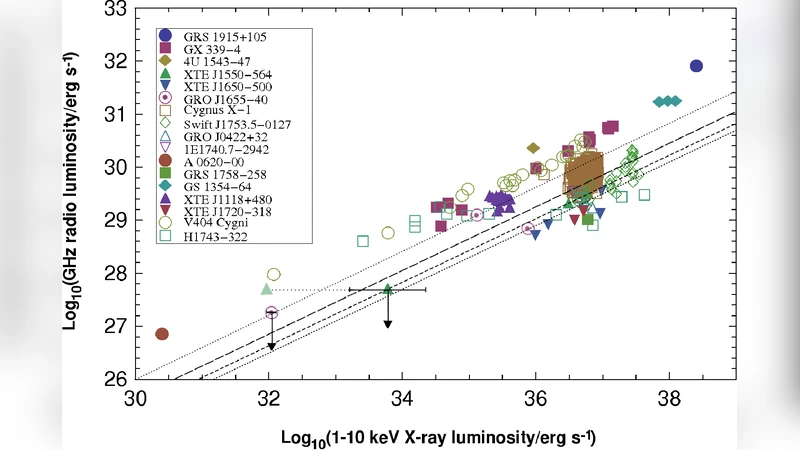
We present the results of radio observations of the black hole binaries GRO J1655-40 and XTE J1550-564 in quiescence, with the upgraded Australia Telescope Compact Array. Neither system was detected. Radio flux density upper limits (3 sigma) of 26 micro Jy (at 5.5 GHz), 47 micro Jy (at 9 GHz) for GRO J1655-40, and 1.4 mJy (at 1.75 GHz), 27 micro Jy (at 5.5 GHz), 47 micro Jy (at 9 GHz) for XTE J1550-564 were measured. In conjunction with quasi-simultaneous Chandra X-ray observations (in the case of GRO J1655-40) and Faulkes Telescope optical observations (XTE J1550-564) we find that these systems provide the first evidence of relatively `radio quiet’ black hole binaries at low luminosities; indicating that the scatter observed in the hard state X-ray:radio correlation at higher luminosities may also extend towards quiescent levels.
💡 Research Summary
The paper reports deep radio observations of two well‑studied black‑hole X‑ray binaries, GRO J1655‑40 and XTE J1550‑564, while they were in quiescence. Using the upgraded Australia Telescope Compact Array (ATCA), the authors observed each source at multiple frequencies: 5.5 GHz and 9 GHz for both objects, and additionally 1.75 GHz for XTE J1550‑564. Integration times of 8–12 hours per band yielded rms noise levels of 8–15 µJy, representing a substantial sensitivity improvement over previous ATCA campaigns.
No radio emission was detected from either system. The 3σ upper limits are 26 µJy (5.5 GHz) and 47 µJy (9 GHz) for GRO J1655‑40, and 1.4 mJy (1.75 GHz), 27 µJy (5.5 GHz), and 47 µJy (9 GHz) for XTE J1550‑564. To place these limits in context, the authors obtained quasi‑simultaneous X‑ray data for GRO J1655‑40 with Chandra (30 ks exposure) and optical V‑band monitoring for XTE J1550‑564 with the Faulkes Telescope. The Chandra spectrum is well described by an absorbed power‑law with photon index ≈2.1 and an unabsorbed 0.5–10 keV flux of ~1.2 × 10⁻¹⁴ erg cm⁻² s⁻¹, corresponding to a luminosity of ≈10⁻⁸ L_Edd. The optical counterpart of XTE J1550‑564 was measured at V≈22 mag, confirming a deep quiescent state.
When plotted on the canonical hard‑state X‑ray–radio correlation (L_R ∝ L_X^0.6), both sources fall well below the expected radio luminosity by one to two orders of magnitude. This constitutes the first clear evidence that black‑hole binaries can be “radio‑quiet” even at the lowest accretion rates, extending the known scatter of the correlation from the bright hard state down to quiescence.
The authors discuss several possible physical interpretations. A reduced jet power at low accretion rates could simply lower the synchrotron output. Alternatively, the jet may become more compact or the magnetic field weaker, shifting the synchrotron peak to frequencies below the observed bands and suppressing the detected flux. Changes in the coupling efficiency between the inner accretion flow and the jet launching region are also considered. The fact that the observations were performed at relatively high frequencies (≥5 GHz) suggests that low‑frequency (≤1 GHz) observations with next‑generation facilities could reveal hidden emission.
In conclusion, the study demonstrates that the X‑ray–radio correlation is not a universal scaling law extending unchanged into quiescence. The presence of radio‑quiet black‑hole binaries at L_X ≈ 10⁻⁸ L_Edd implies that jet formation and radiative efficiency can vary dramatically even when the accretion flow is extremely faint. Future work with more sensitive low‑frequency radio arrays (e.g., MeerKAT, ASKAP, and eventually the SKA) combined with coordinated X‑ray and optical monitoring will be essential to map the full parameter space of jet production in the lowest luminosity regime.