Parameterizing by the Number of Numbers
The usefulness of parameterized algorithmics has often depended on what Niedermeier has called, 'the art of problem parameterization'. In this paper we introduce and explore a novel but general form o
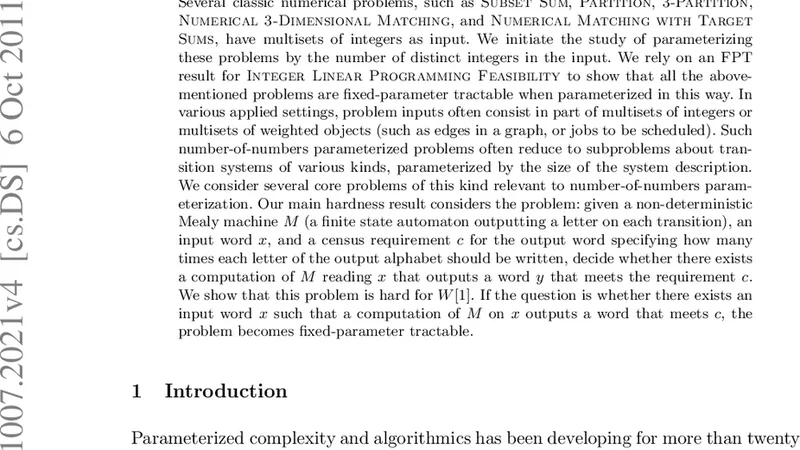
The usefulness of parameterized algorithmics has often depended on what Niedermeier has called, “the art of problem parameterization”. In this paper we introduce and explore a novel but general form of parameterization: the number of numbers. Several classic numerical problems, such as Subset Sum, Partition, 3-Partition, Numerical 3-Dimensional Matching, and Numerical Matching with Target Sums, have multisets of integers as input. We initiate the study of parameterizing these problems by the number of distinct integers in the input. We rely on an FPT result for ILPF to show that all the above-mentioned problems are fixed-parameter tractable when parameterized in this way. In various applied settings, problem inputs often consist in part of multisets of integers or multisets of weighted objects (such as edges in a graph, or jobs to be scheduled). Such number-of-numbers parameterized problems often reduce to subproblems about transition systems of various kinds, parameterized by the size of the system description. We consider several core problems of this kind relevant to number-of-numbers parameterization. Our main hardness result considers the problem: given a non-deterministic Mealy machine M (a finite state automaton outputting a letter on each transition), an input word x, and a census requirement c for the output word specifying how many times each letter of the output alphabet should be written, decide whether there exists a computation of M reading x that outputs a word y that meets the requirement c. We show that this problem is hard for W[1]. If the question is whether there exists an input word x such that a computation of M on x outputs a word that meets c, the problem becomes fixed-parameter tractable.
💡 Research Summary
The paper introduces a novel parameterization paradigm for classic numerical combinatorial problems: the number of distinct integers appearing in the input multiset, which the authors call the “number‑of‑numbers” parameter. While traditional parameterized complexity has focused on parameters such as the target value, solution size, or input length, this work argues that many real‑world instances contain a large amount of duplication (e.g., many jobs share the same processing time, many edges have identical weights). Consequently, the count of distinct values, denoted k, is often much smaller than the total input size and can serve as a powerful lever for fixed‑parameter tractability (FPT).
The technical core rests on the known FPT algorithm for Integer Linear Programming Feasibility (ILPF) when the number of variables is the parameter. The authors systematically encode five well‑studied problems—Subset Sum, Partition, 3‑Partition, Numerical 3‑Dimensional Matching, and Numerical Matching with Target Sums—into ILP instances whose variable set corresponds exactly to the k distinct numbers. For each problem, multiplicities of the numbers become bounded coefficients, and the original combinatorial constraints translate into linear equations or inequalities. Because the number of variables never exceeds k (or a linear function of k), the ILPF algorithm solves each instance in time f(k)·poly(n), establishing that all five problems are FPT under the number‑of‑numbers parameter.
Beyond pure number‑theoretic problems, the paper studies a more expressive computational model: a nondeterministic Mealy machine M (a finite‑state transducer that emits an output symbol on each transition). The decision problem is: given a fixed input word x, a census requirement c (specifying how many times each output alphabet symbol must appear), does there exist a computation of M on x that produces an output word y satisfying c? The authors prove that this problem is W
📜 Original Paper Content
🚀 Synchronizing high-quality layout from 1TB storage...