Exponential Time Complexity of Weighted Counting of Independent Sets
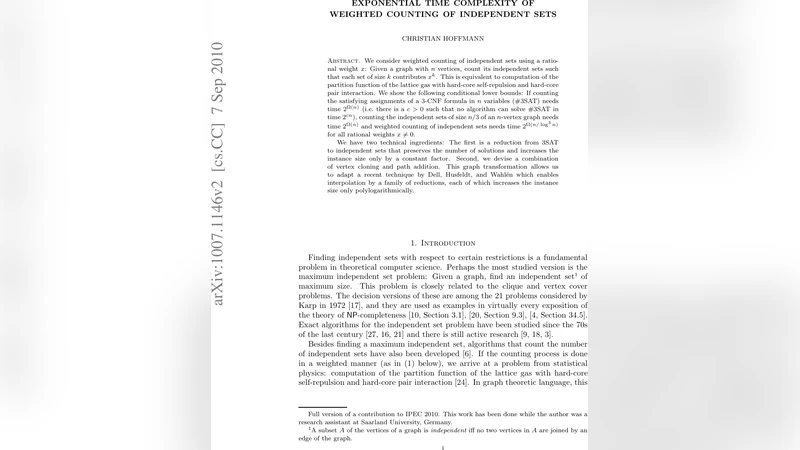
We consider weighted counting of independent sets using a rational weight x: Given a graph with n vertices, count its independent sets such that each set of size k contributes x^k. This is equivalent to computation of the partition function of the lattice gas with hard-core self-repulsion and hard-core pair interaction. We show the following conditional lower bounds: If counting the satisfying assignments of a 3-CNF formula in n variables (#3SAT) needs time 2^{\Omega(n)} (i.e. there is a c>0 such that no algorithm can solve #3SAT in time 2^{cn}), counting the independent sets of size n/3 of an n-vertex graph needs time 2^{\Omega(n)} and weighted counting of independent sets needs time 2^{\Omega(n/log^3 n)} for all rational weights x\neq 0. We have two technical ingredients: The first is a reduction from 3SAT to independent sets that preserves the number of solutions and increases the instance size only by a constant factor. Second, we devise a combination of vertex cloning and path addition. This graph transformation allows us to adapt a recent technique by Dell, Husfeldt, and Wahlen which enables interpolation by a family of reductions, each of which increases the instance size only polylogarithmically.
💡 Research Summary
The paper investigates the exact computational difficulty of weighted counting of independent sets in graphs, a problem that can be viewed as computing the partition function of a hard‑core lattice gas with activity x (a rational number different from zero). The authors work under the counting exponential time hypothesis (#ETH), which asserts that counting the satisfying assignments of a 3‑CNF formula on n variables (#3SAT) cannot be solved in time 2^{c n} for any constant c > 0. Their main results are twofold: (i) counting independent sets of size exactly n/3 in an n‑vertex graph requires time 2^{Ω(n)}; (ii) for any rational weight x ≠ 0, computing the weighted sum Σ_{I independent} x^{|I|} needs time 2^{Ω(n / log³ n)}.
To obtain these lower bounds the authors develop two technical ingredients. The first is a parsimonious reduction from #3SAT to the unweighted independent‑set counting problem. Unlike ordinary NP‑hardness reductions, this transformation preserves the exact number of solutions while inflating the instance size by only a constant factor. The construction replaces each variable and each clause by a small gadget and connects them so that each independent set corresponds bijectively to a satisfying assignment. Consequently, any algorithm that could count independent sets of a given size faster than 2^{Ω(n)} would violate #ETH.
The second ingredient addresses the weighted case. The authors introduce a graph transformation that combines vertex cloning and the addition of paths of controlled length. By cloning a vertex t times and inserting a path of length ℓ between each pair of clones, they can encode the contribution of each vertex to the weight x^{|I|} in the structure of the graph itself. Crucially, this operation increases the number of vertices only by a polylogarithmic factor (specifically O(log³ n)), so the transformed instance remains close in size to the original.
With this transformation in hand, the authors adapt the interpolation technique of Dell, Husfeldt, and Wahlen (2014). They generate a family of slightly larger graphs, each corresponding to a different evaluation point of a low‑degree polynomial whose coefficients encode the weighted independent‑set counts for the original graph. By solving the counting problem on each member of the family (which is only polylogarithmically larger), one can recover the full weighted count via polynomial interpolation. If a sub‑exponential algorithm existed for the weighted problem, the interpolation would yield a sub‑exponential algorithm for #3SAT, contradicting #ETH. The analysis shows that the overhead introduced by the family of instances is bounded by a factor of log³ n, leading to the stated lower bound of 2^{Ω(n / log³ n)}.
The paper also discusses the special case x = 1, where the weight disappears and the problem reduces to counting independent sets of a prescribed size. In this setting the polylogarithmic blow‑up is unnecessary, and the parsimonious reduction directly yields a 2^{Ω(n)} lower bound for counting independent sets of size n/3. This improves upon earlier results that only guaranteed hardness for counting independent sets of size k when k itself is linear in n.
Beyond the technical contributions, the work highlights the power of counting‑preserving reductions and modest graph transformations in establishing fine‑grained complexity lower bounds. It demonstrates that even when the underlying combinatorial structure (independent sets) is simple, the addition of a rational activity parameter does not make the problem any easier under standard complexity assumptions. The authors suggest that similar cloning‑and‑path techniques could be applied to other #P‑complete counting problems, and that further refinements of the interpolation framework might tighten the log‑factor in the exponent, possibly achieving a full 2^{Ω(n)} bound for all non‑zero rational weights.
Comments & Academic Discussion
Loading comments...
Leave a Comment