The longest observation of a low intensity state from a Supergiant Fast X-ray Transient: Suzaku observes IGRJ08408-4503
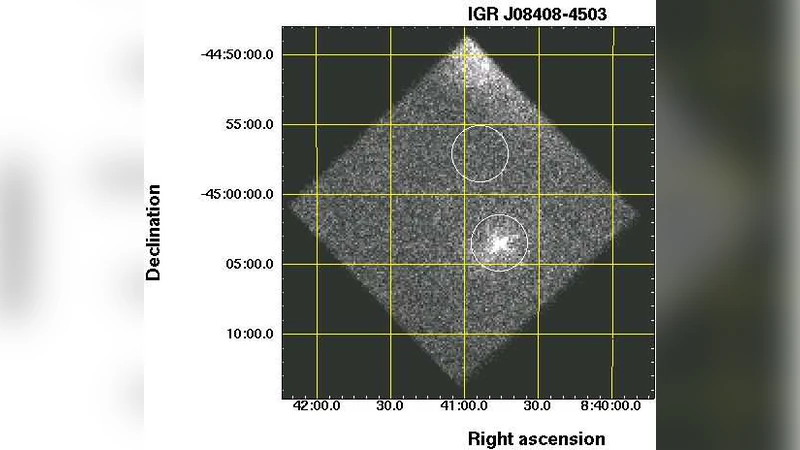
We report here on the longest deep X-ray observation of a SFXT outside outburst, with an average luminosity level of 1E33 erg/s (assuming 3 kpc distance). This observation was performed with Suzaku in December 2009 and was targeted on IGRJ08408-4503, with a net exposure with the X-ray imaging spectrometer (XIS, 0.4-10 keV) and the hard X-ray detector (HXD, 15-100 keV) of 67.4 ks and 64.7 ks, respectively, spanning about three days. The source was caught in a low intensity state characterized by an initially average X-ray luminosity level of 4E32 erg/s (0.5-10 keV) during the first 120 ks, followed by two long flares (about 45 ks each) peaking at a flux a factor of about 3 higher than the initial pre-flare emission. Both XIS spectra (initial emission and the two subsequent long flares) can be fitted with a double component spectrum, with a soft thermal plasma model together with a power law, differently absorbed. The spectral characteristics suggest that the source is accreting matter even at this very low intensity level. From the HXD observation we place an upper limit of 6E33 erg/s (15-40 keV; 3 kpc distance) to the hard X-ray emission, which is the most stringent constrain to the hard X-ray emission during a low intensity state in a SFXT, to date. The timescale observed for the two low intensity long flares is indicative of an orbital separation of the order of 1E13 cm in IGRJ08408-4503.
💡 Research Summary
This paper presents the longest continuous X‑ray observation of a Supergiant Fast X‑ray Transient (SFXT) outside of an outburst, focusing on IGR J08408‑4503. The Suzaku satellite observed the source for three days in December 2009, accumulating 67.4 ks of exposure with the X‑ray Imaging Spectrometer (XIS, 0.4–10 keV) and 64.7 ks with the Hard X‑ray Detector (HXD, 15–100 keV). During the first 120 ks the source remained in a low‑intensity state with an average 0.5–10 keV luminosity of ≈4 × 10³² erg s⁻¹ (assuming a distance of 3 kpc). This baseline was followed by two long flares, each lasting about 45 ks, during which the flux rose by a factor of ≈3, reaching a peak luminosity of ≈1.2 × 10³³ erg s⁻¹.
Spectral analysis of both the initial low‑intensity emission and the subsequent flares required a two‑component model: a soft thermal plasma (kT ≈ 0.6 keV) and a harder power‑law (photon index Γ ≈ 1.5). The two components experience different absorption columns, indicating that the soft emission is partially screened by the stellar wind, while the hard component suffers a distinct, possibly more localized, absorption. The spectral shape remains essentially unchanged between the quiescent and flaring intervals, suggesting that the flares are driven primarily by variations in the amount of accreted material rather than by changes in the emission mechanism itself.
The HXD data provide only an upper limit for hard X‑ray emission: ≤6 × 10³³ erg s⁻¹ in the 15–40 keV band, the most stringent constraint to date for an SFXT in a low‑intensity state. This limit implies that any non‑thermal or Comptonized component is strongly suppressed when the source is not in a bright outburst.
The timing of the two long flares, separated by roughly 1 × 10⁵ s, can be interpreted in terms of the orbital geometry and the clumpy wind model. Assuming a typical supergiant wind velocity of ~1000 km s⁻¹, the inferred orbital separation is on the order of 1 × 10¹³ cm (≈0.7 AU). In this framework, the long flares correspond to the passage of dense wind clumps across the neutron star’s accretion radius, producing enhanced accretion for tens of kiloseconds. The observed flare duration and recurrence are consistent with clump sizes of ~10¹¹–10¹² cm and an average inter‑clump spacing that yields a characteristic timescale of several days.
Overall, the study demonstrates that even in a very low‑luminosity regime (∼10³³ erg s⁻¹), IGR J08408‑4503 continues to accrete material, producing a persistent soft thermal component and a weak hard tail. The detection of long, moderate‑intensity flares indicates that the accretion flow is highly structured, supporting the clumpy wind scenario for SFXTs. By providing the deepest, longest exposure of an SFXT in quiescence, these Suzaku observations set new benchmarks for the low‑state X‑ray properties of this class, constrain theoretical models of wind‑fed accretion, and highlight the importance of sustained monitoring to capture the full dynamical range of SFXT behavior.
Comments & Academic Discussion
Loading comments...
Leave a Comment