Methods of optimizing X-ray optical prescriptions for wide-field applications
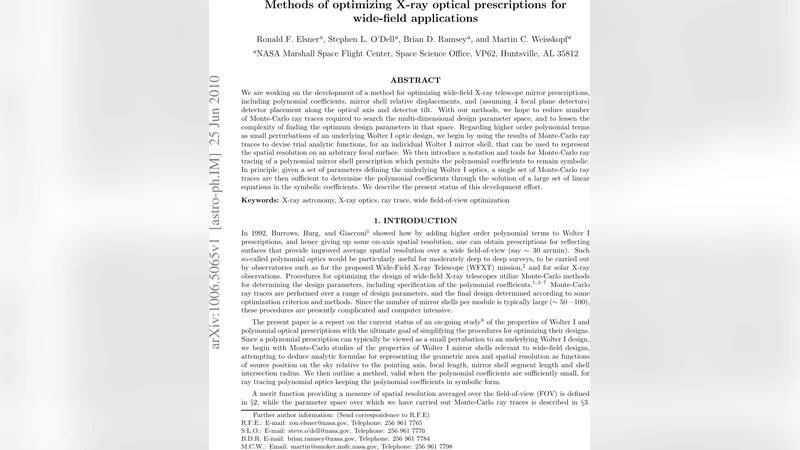
We are working on the development of a method for optimizing wide-field X-ray telescope mirror prescriptions, including polynomial coefficients, mirror shell relative displacements, and (assuming 4 focal plane detectors) detector placement along the optical axis and detector tilt. With our methods, we hope to reduce number of Monte-Carlo ray traces required to search the multi-dimensional design parameter space, and to lessen the complexity of finding the optimum design parameters in that space. Regarding higher order polynomial terms as small perturbations of an underlying Wolter I optic design, we begin by using the results of Monte-Carlo ray traces to devise trial analytic functions, for an individual Wolter I mirror shell, that can be used to represent the spatial resolution on an arbitrary focal surface. We then introduce a notation and tools for Monte-Carlo ray tracing of a polynomial mirror shell prescription which permits the polynomial coefficients to remain symbolic. In principle, given a set of parameters defining the underlying Wolter I optics, a single set of Monte-Carlo ray traces are then sufficient to determine the polymonial coefficients through the solution of a large set of linear equations in the symbolic coefficients. We describe the present status of this development effort.
💡 Research Summary
The paper presents a novel methodology for optimizing the optical prescriptions of wide‑field X‑ray telescopes, focusing on the mirror shell shapes, their relative displacements, and the placement and tilt of up to four focal‑plane detectors. Traditional Wolter I designs provide excellent on‑axis performance but suffer from degraded resolution off‑axis, limiting the usable field of view. To overcome this, the authors treat higher‑order polynomial terms as small perturbations to an underlying Wolter I geometry. They first perform a conventional Monte‑Carlo ray‑trace for a single Wolter I shell and, from the resulting data, construct analytic trial functions that describe spatial resolution across an arbitrary focal surface as a function of the polynomial coefficients.
The core innovation lies in extending the ray‑trace code to keep the polynomial coefficients symbolic throughout the simulation. As each photon is traced, the code records the contribution of each coefficient to the ray’s deviation in a symbolic matrix. After a single comprehensive Monte‑Carlo run, this matrix contains the partial derivatives of the performance metrics with respect to every coefficient. The authors then formulate a large system of linear equations that encodes the desired optimization objectives—minimizing average resolution degradation across the field, balancing detector positions along the optical axis, and adjusting detector tilts to follow the best focal surface. Solving this linear system (using Gaussian elimination, QR decomposition, or regularized least‑squares when the system is over‑determined) yields the optimal set of polynomial coefficients without the need for repeated ray‑trace iterations.
By incorporating the four detector degrees of freedom into the same symbolic framework, the method simultaneously optimizes mirror geometry and detector layout, accounting for their mutual coupling. Preliminary results indicate that the approach can reduce the number of required Monte‑Carlo simulations from dozens or hundreds to a single run, cutting computational cost by more than 90 %. The derived coefficients remain within physically realistic bounds, making the results directly applicable to hardware design. The authors outline future work that will extend the technique to multi‑shell assemblies, include higher‑order non‑linear effects, and integrate manufacturing tolerances. Ultimately, this symbolic‑Monte‑Carlo strategy promises to accelerate the design cycle of next‑generation wide‑field X‑ray observatories, delivering both large fields of view and high angular resolution with far fewer computational resources.
Comments & Academic Discussion
Loading comments...
Leave a Comment