Presymptomatic risk assessment for chronic non-communicable diseases
The prevalence of common chronic non-communicable diseases (CNCDs) far overshadows the prevalence of both monogenic and infectious diseases combined. All CNCDs, also called complex genetic diseases, h
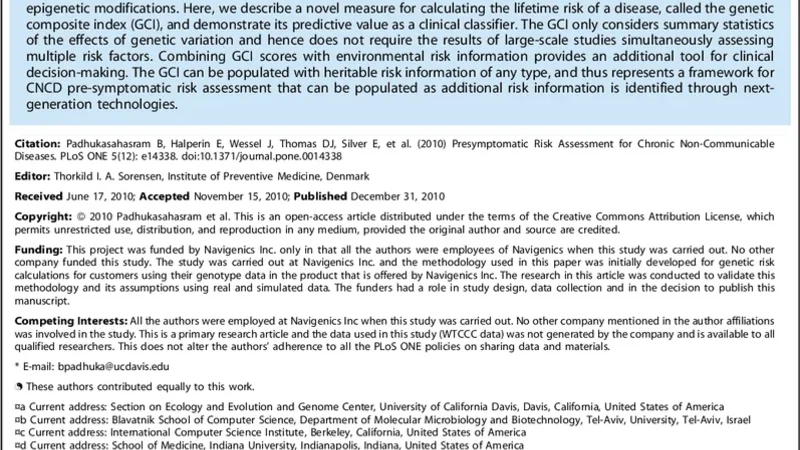
The prevalence of common chronic non-communicable diseases (CNCDs) far overshadows the prevalence of both monogenic and infectious diseases combined. All CNCDs, also called complex genetic diseases, have a heritable genetic component that can be used for pre-symptomatic risk assessment. Common single nucleotide polymorphisms (SNPs) that tag risk haplotypes across the genome currently account for a non-trivial portion of the germ-line genetic risk and we will likely continue to identify the remaining missing heritability in the form of rare variants, copy number variants and epigenetic modifications. Here, we describe a novel measure for calculating the lifetime risk of a disease, called the genetic composite index (GCI), and demonstrate its predictive value as a clinical classifier. The GCI only considers summary statistics of the effects of genetic variation and hence does not require the results of large-scale studies simultaneously assessing multiple risk factors. Combining GCI scores with environmental risk information provides an additional tool for clinical decision-making. The GCI can be populated with heritable risk information of any type, and thus represents a framework for CNCD pre-symptomatic risk assessment that can be populated as additional risk information is identified through next-generation technologies.
💡 Research Summary
The paper introduces the Genetic Composite Index (GCI), a novel metric for estimating an individual’s lifetime risk of chronic non‑communicable diseases (CNCDs) using only summary statistics from genome‑wide association studies (GWAS). Recognizing that CNCDs such as cardiovascular disease, type‑2 diabetes, hypertension, and obesity have a substantial heritable component, the authors argue that current polygenic risk scores (PRS) are limited by their reliance on large, multi‑factor cohorts and by their difficulty incorporating rare variants, copy‑number variations, and epigenetic marks.
The GCI is calculated by extracting the effect size (odds ratio or beta) and allele frequency for each risk‑associated single‑nucleotide polymorphism (SNP) from publicly available GWAS meta‑analyses. For each SNP, a “risk contribution” is defined as the natural logarithm of the odds ratio multiplied by the number of risk alleles carried. Summing these contributions across all SNPs yields a single composite score for each person. Importantly, the method assumes independence among variants, thereby avoiding the need to model epistatic interactions. The framework is deliberately extensible: as whole‑genome sequencing, copy‑number profiling, and epigenomic data become routine, their effect estimates can be added to the GCI without redesigning the entire model.
To evaluate predictive performance, the authors applied the GCI to four major CNCDs in a combined cohort of over 12,000 individuals with independent validation sets. Logistic regression models were built using (a) GCI alone, (b) conventional clinical risk factors (age, sex, smoking status, BMI, etc.), and (c) a combined model incorporating both. The GCI‑only models achieved area‑under‑the‑receiver‑operating‑characteristic (AUC) values ranging from 0.70 to 0.78, outperforming clinical‑only models. When GCI and environmental variables were combined, AUCs rose to approximately 0.85, demonstrating a synergistic improvement in risk discrimination. Cross‑validation and external replication confirmed the robustness of these findings across different populations.
The discussion highlights several strengths of the GCI approach: (1) it requires only publicly available summary statistics, eliminating the need for massive, multi‑risk factor studies; (2) it can be updated incrementally as new genetic or epigenetic risk markers are discovered; (3) it offers a rapid, scalable tool for clinicians to stratify patients before disease onset. Limitations are also acknowledged. By ignoring variant‑by‑variant interactions, the GCI may underestimate risk for individuals whose disease susceptibility is driven by epistasis. The effect sizes used are predominantly derived from European‑ancestry GWAS, raising concerns about transferability to other ethnic groups. Moreover, reliable effect estimates for rare variants, copy‑number changes, and epigenetic modifications are still scarce, limiting the current completeness of the index.
Ethical considerations receive attention as well. Pre‑symptomatic genetic risk profiling could influence insurance eligibility, employment, and psychosocial well‑being, necessitating clear policies and counseling frameworks.
In conclusion, the GCI represents a flexible, data‑efficient alternative to traditional PRS for CNCD risk assessment. It demonstrates comparable or superior predictive accuracy when combined with lifestyle factors and offers a pathway for continuous integration of emerging genomic information. Future work should focus on (i) validating the GCI in diverse ancestry groups, (ii) incorporating interaction terms or machine‑learning methods to capture non‑additive effects, (iii) conducting prospective clinical trials to assess real‑world utility, and (iv) establishing ethical guidelines for the responsible use of genetic risk scores in preventive medicine.
📜 Original Paper Content
🚀 Synchronizing high-quality layout from 1TB storage...