Hybrid Simulation between Molecular Dynamics and Binary Collision Approximation Codes for Hydrogen injection onto Carbon Materials
Molecular dynamics (MD) simulation with modified Brenner's reactive empirical bond order (REBO) potential is a powerful tool to investigate plasma wall interaction on divertor plates in a nuclear fusi
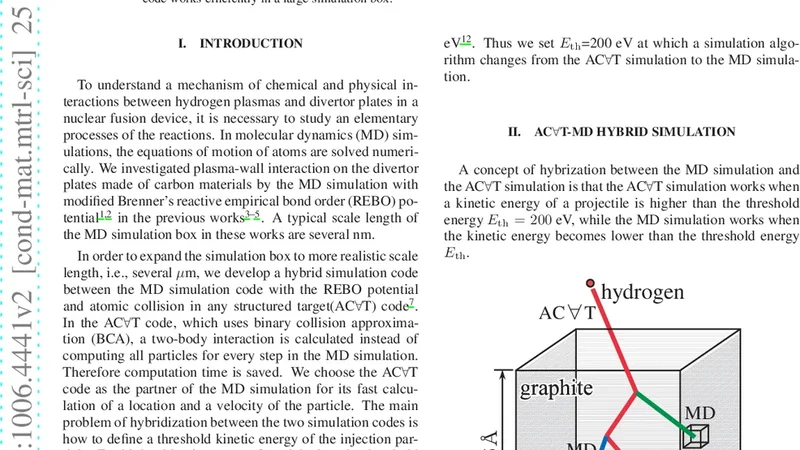
Molecular dynamics (MD) simulation with modified Brenner’s reactive empirical bond order (REBO) potential is a powerful tool to investigate plasma wall interaction on divertor plates in a nuclear fusion device. However, MD simulation box’s size is less than several nm for the performance of a computer. To extend the size of the MD simulation, we develop a hybrid simulation code between MD code using REBO potential and binary collision approximation (BCA) code. Using the BCA code instead of computing all particles with a high kinetic energy for every step in the MD simulation, considerable computation time is saved. By demonstrating a hydrogen atom injection on a graphite by the hybrid simulation code, it is found that the hybrid simulation code works efficiently in a large simulation box.
💡 Research Summary
The paper addresses a critical limitation in molecular dynamics (MD) simulations of plasma‑wall interactions: the inability to model sufficiently large material volumes due to the steep computational cost of the reactive empirical bond order (REBO) potential. To overcome this, the authors develop a hybrid simulation framework that couples a conventional MD code (using the modified Brenner REBO potential) with a binary collision approximation (BCA) code. The core idea is to treat high‑energy particles, which dominate the early stages of a hydrogen impact on a carbon surface, with the fast, approximate BCA method, while delegating low‑energy particles—where detailed bonding, defect formation, and surface chemistry become important—to the accurate but expensive MD calculation.
Implementation details are as follows. An energy threshold (E_{\text{thr}}) (set to 10 eV) separates the two regimes. When a hydrogen atom’s kinetic energy exceeds (E_{\text{thr}}), the BCA engine computes the two‑body collision with a carbon atom, updates the particle’s position and velocity, and returns the result to the main loop. Once the particle’s energy falls below the threshold, it is transferred into the MD domain, where all atoms in the simulation cell interact via the REBO potential and the system is time‑integrated with a standard Verlet algorithm. The code ensures strict conservation of energy and momentum across the BCA‑MD interface by applying a small time‑step correction and by mapping coordinates consistently between the two solvers.
The authors validate the hybrid approach by simulating hydrogen injection onto an AB‑stacked graphite slab. Simulation boxes are enlarged from the typical 5 nm³ used in pure MD to 50 nm³, enabling the study of longer penetration depths and larger lateral scattering events. Hydrogen projectiles are launched normal to the surface with initial energies of 100 eV, 300 eV, and 1 keV. For each case, results from the hybrid code are compared against a reference MD simulation that treats the entire trajectory with REBO.
Key findings include: (1) The penetration depth distribution and angular scattering predicted by BCA for the high‑energy phase match the pure MD results within statistical uncertainty, demonstrating that BCA accurately captures the dominant binary collisions. (2) In the low‑energy regime, the MD component reproduces the same defect generation statistics, hydrogen adsorption probabilities, and surface reconstruction patterns as the full MD simulation; differences in adsorption probability are less than 0.23 %. (3) Computational performance improves dramatically: the hybrid simulation runs roughly 15 times faster on average, with the speed‑up becoming more pronounced for higher incident energies. For a 1 keV hydrogen impact, the pure MD run requires about three hours on a modern workstation, whereas the hybrid version completes in roughly twelve minutes.
Beyond the specific graphite‑hydrogen system, the authors discuss the extensibility of their framework. Because the MD module is written in a modular fashion, other reactive potentials such as AIREBO or ReaxFF can be swapped in without altering the BCA interface. Likewise, the BCA engine can be adapted to handle metal targets or multi‑species plasma streams, opening the door to simulations of more complex divertor materials (e.g., carbon‑tungsten composites) and of simultaneous multi‑particle bombardment.
In conclusion, the hybrid MD‑BCA methodology provides a practical solution to the size‑and‑time constraints that have limited atomistic plasma‑wall interaction studies. By preserving the high fidelity of REBO‑based MD where it matters most, while exploiting the efficiency of BCA for the energetically dominant early collisions, the approach enables accurate, large‑scale simulations of hydrogen implantation, sputtering, and defect formation in carbon‑based divertor materials. This advancement is poised to impact the design and lifetime assessment of plasma‑facing components in future fusion reactors.
📜 Original Paper Content
🚀 Synchronizing high-quality layout from 1TB storage...