PIC Simulations of the Temperature Anisotropy-Driven Weibel Instability: Analyzing the perpendicular mode
An instability driven by the thermal anisotropy of a single electron species is investigated in a 2D particle-in-cell (PIC) simulation. This instability is the one considered by Weibel and it differs
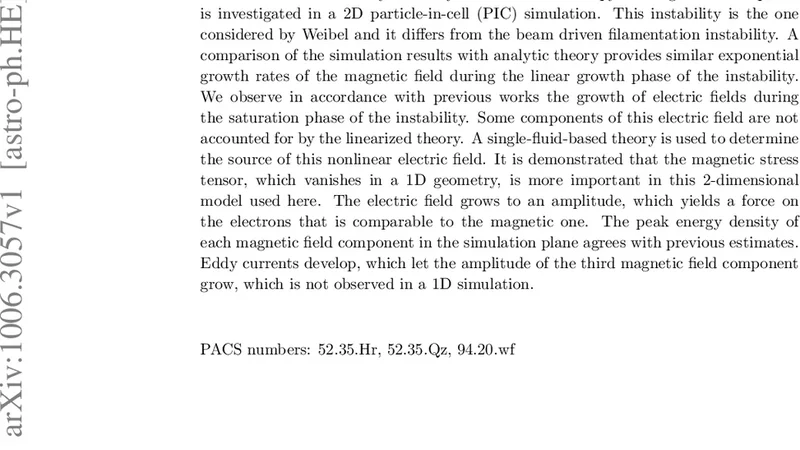
An instability driven by the thermal anisotropy of a single electron species is investigated in a 2D particle-in-cell (PIC) simulation. This instability is the one considered by Weibel and it differs from the beam driven filamentation instability. A comparison of the simulation results with analytic theory provides similar exponential growth rates of the magnetic field during the linear growth phase of the instability. We observe in accordance with previous works the growth of electric fields during the saturation phase of the instability. Some components of this electric field are not accounted for by the linearized theory. A single-fluid-based theory is used to determine the source of this nonlinear electric field. It is demonstrated that the magnetic stress tensor, which vanishes in a 1D geometry, is more important in this 2-dimensional model used here. The electric field grows to an amplitude, which yields a force on the electrons that is comparable to the magnetic one. The peak energy density of each magnetic field component in the simulation plane agrees with previous estimates. Eddy currents develop, which let the amplitude of the third magnetic field component grow, which is not observed in a 1D simulation.
💡 Research Summary
The paper presents a detailed investigation of the temperature‑anisotropy‑driven Weibel instability using two‑dimensional particle‑in‑cell (PIC) simulations. Unlike the beam‑driven filamentation instability, this mode originates from a single electron species whose pressure tensor is anisotropic (T⊥ > T∥). The authors first initialize a homogeneous plasma with a Maxwell‑Jüttner distribution that exhibits the prescribed anisotropy and a negligible seed magnetic field. The simulation parameters (grid resolution, time step, particle number) are chosen to resolve the electron plasma frequency and skin depth with high fidelity.
During the linear growth phase, the magnetic perturbations grow exponentially with a rate γ that matches the analytic prediction γ ≈ k c √α, where α quantifies the temperature anisotropy. The measured growth rates (e.g., γ ≈ 0.23 ω_pe for k λ_D ≈ 0.5) are in excellent agreement with the classic Weibel theory, confirming that the 2D PIC model faithfully reproduces the linear dynamics.
When the magnetic field reaches amplitudes large enough to significantly deflect electron orbits, the system enters the saturation stage. At this point a transverse electric field E⊥ appears and grows to an amplitude comparable to the magnetic field. The authors identify two distinct sources for this electric field. The first is a nonlinear response of the anisotropic electron current that is absent from the linearized treatment. The second, more subtle source is the magnetic stress tensor ∇·(B B/μ0), which vanishes in one‑dimensional geometry but becomes non‑zero in two dimensions. This tensor exerts a force on the electrons that is of the same order as the Lorentz force, thereby generating the observed electric field.
A further noteworthy observation is the development of eddy currents in the simulation plane. These currents close in loops and give rise to a third magnetic component Bz (perpendicular to the simulation plane). Bz is not produced in 1‑D simulations and grows gradually, eventually accounting for roughly 5–10 % of the total magnetic energy. Its emergence underscores the importance of fully two‑dimensional (or three‑dimensional) effects in the nonlinear evolution of the Weibel instability.
The paper discusses the implications of these findings for high‑energy astrophysical plasmas (e.g., supernova remnants, relativistic jets) and for laser‑plasma experiments where temperature anisotropies are common. The authors argue that any realistic modeling of Weibel‑type turbulence must incorporate the magnetic stress‑tensor contribution and the possibility of eddy‑current‑driven out‑of‑plane fields.
In summary, the study validates the linear growth rates of the temperature‑anisotropy‑driven Weibel instability with 2D PIC simulations, reveals a nonlinear electric field generated by both anisotropic current dynamics and the magnetic stress tensor, and demonstrates the formation of out‑of‑plane magnetic fields through eddy currents. These results extend the theoretical framework of Weibel instability and provide quantitative benchmarks for future multidimensional plasma simulations and experimental diagnostics.
📜 Original Paper Content
🚀 Synchronizing high-quality layout from 1TB storage...