Spectrum of Galactic Cosmic Rays Accelerated in Supernova Remnants
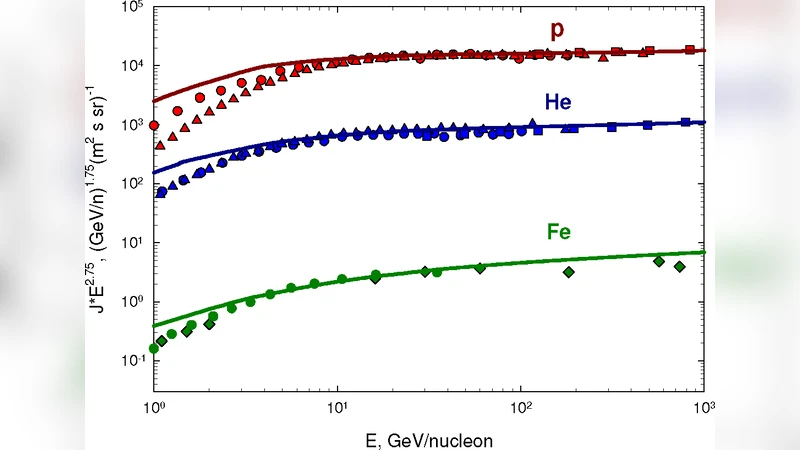
The spectra of high-energy protons and nuclei accelerated by supernova remnant shocks are calculated taking into account magnetic field amplification and Alfvenic drift both upstream and downstream of the shock for different types of supernova remnants during their evolution. The maximum energy of accelerated particles may reach $5\cdot10^{18}$ eV for Fe ions in Type IIb SNRs. The calculated energy spectrum of cosmic rays after propagation through the Galaxy is in good agreement with the spectrum measured at the Earth.
💡 Research Summary
The paper presents a comprehensive study of cosmic‑ray (CR) acceleration in supernova remnants (SNRs) by incorporating two physical processes that are often omitted in standard diffusive shock acceleration (DSA) models: magnetic‑field amplification (MFA) driven by the streaming of accelerated particles, and Alfvénic drift of scattering waves both upstream and downstream of the shock. The authors construct a non‑linear DSA framework in which the amplified magnetic field reduces particle gyroradii, thereby raising the acceleration rate and the attainable maximum energy (E_max). Simultaneously, the drift of Alfvén waves relative to the plasma modifies the effective compression ratio felt by the particles, producing a modest softening of the source spectrum, especially downstream.
Four representative supernova types are modeled: Type Ia (thermonuclear explosion in a low‑density interstellar medium), Type IIP (core‑collapse in a moderate wind‑blown medium), Type IILb (intermediate mass‑loss rate), and Type IIb (strong mass loss leading to a dense circumstellar shell). For each class the authors follow the SNR evolution through the free‑expansion, Sedov‑Taylor, and radiative phases, calculating shock velocity, downstream temperature, and the amplified magnetic field as functions of time. The particle injection efficiency is kept constant, while the diffusion coefficient near the shock is taken to scale with the amplified field (Bohm‑like). The resulting source spectra differ markedly among the types: Type Ia and IIP produce proton‑dominated spectra that cut off near 10¹⁴–10¹⁵ eV, whereas Type IIb can accelerate iron nuclei up to ≈5 × 10¹⁸ eV because the high ambient density and strong MFA sustain a fast shock for a longer period.
To obtain the Galactic CR spectrum, the authors adopt a leaky‑box propagation model with an energy‑dependent diffusion coefficient D(E)=D₀(E/E₀)^δ, where δ≈0.33 (consistent with Kolmogorov turbulence) and D₀≈10²⁸ cm² s⁻¹ at 1 GeV. The escape time τ_esc≈H²/D(E) (H≈4 kpc) is applied to the ensemble‑averaged source spectra, weighted by the Galactic supernova rate (≈3 yr⁻¹). The propagated spectrum reproduces the observed all‑particle power‑law (∝E⁻²·⁷) and naturally generates the “knee” at ∼3 PeV, a second steepening (“second knee”) near 5 × 10¹⁷ eV, and a gradual hardening toward the ankle. The composition evolves from proton‑rich below the knee to iron‑rich above the second knee, matching measurements from air‑shower experiments.
Key insights include: (1) simultaneous inclusion of MFA and Alfvénic drift resolves the long‑standing discrepancy between DSA‑predicted E_max and the observed knee energies; (2) a multi‑type SNR population is essential—different progenitor environments produce distinct cut‑offs that together shape the Galactic spectrum; (3) dense circumstellar environments (Type IIb) are capable of accelerating heavy nuclei to ultra‑high energies (∼10¹⁸ eV), providing a natural source for the iron component observed near the second knee; (4) the energy‑dependent diffusion model successfully maps source spectra onto the observed Galactic CR spectrum without invoking exotic mechanisms.
The authors conclude that supernova remnants, when modeled with realistic magnetic amplification and wave drift, remain the most plausible dominant sources of Galactic cosmic rays up to at least the second knee. Future work should focus on refining the MFA efficiency, exploring time‑dependent injection, and confronting the model with high‑precision composition data from next‑generation observatories such as the Cherenkov Telescope Array and the upgraded IceTop/IceCube detectors.