A prototype station for ARIANNA: a detector for cosmic neutrinos
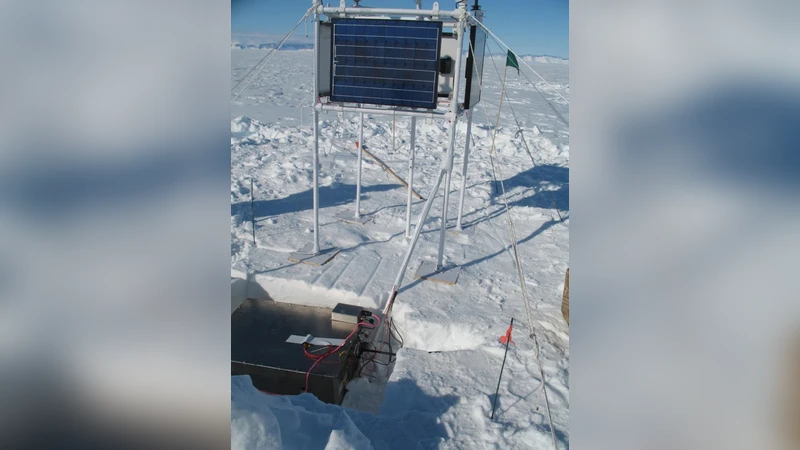
The Antarctic Ross Iceshelf Antenna Neutrino Array (ARIANNA) is a proposed detector for ultra-high energy astrophysical neutrinos. It will detect coherent radio Cherenkov emission from the particle showers produced by neutrinos with energies above about 10^17 eV. ARIANNA will be built on the Ross Ice Shelf just off the coast of Antarctica, where it will eventually cover about 900 km^2 in surface area. There, the ice-water interface below the shelf reflects radio waves, giving ARIANNA sensitivity to downward going neutrinos and improving its sensitivity to horizontally incident neutrinos. ARIANNA detector stations will each contain 4-8 antennas which search for brief pulses of 50 MHz to 1 GHz radio emission from neutrino interactions. We describe a prototype station for ARIANNA which was deployed in Moore’s Bay on the Ross Ice Shelf in December 2009, discuss the design and deployment, and present some initial figures on performance. The ice shelf thickness was measured to be 572 +/- 6 m at the deployment site.
💡 Research Summary
The paper presents the design, deployment, and initial performance of a prototype station for the Antarctic Ross Iceshelf Antenna Neutrino Array (ARIANNA), a proposed large‑scale detector for ultra‑high‑energy (UHE) astrophysical neutrinos. ARIANN A aims to instrument roughly 900 km² of the Ross Ice Shelf, using the unique property of the ice‑water interface beneath the shelf, which acts as a near‑perfect radio‑wave reflector. This reflection allows the array to be sensitive not only to neutrinos arriving from above (down‑going) but also to those arriving horizontally, thereby increasing the effective aperture for the most energetic neutrinos (E ≳ 10^17 eV).
Each ARIANN A station is a self‑contained unit equipped with 4–8 broadband log‑periodic dipole antennas covering 50 MHz to 1 GHz. The antennas are optimized to capture the coherent Cherenkov radio pulse (the Askaryan effect) generated by particle cascades initiated when a UHE neutrino interacts in the ice. The radio pulse is nanosecond‑scale, broadband, and linearly polarized, making it distinguishable from most background noise sources.
The prototype described in this work was installed in Moore’s Bay on the Ross Ice Shelf in December 2009. The station’s mechanical structure consists of a low‑profile, insulated frame that can be anchored directly on the snow surface without drilling. Four antennas were deployed in a cross‑pattern, each housed in a metal‑shielded enclosure to suppress electromagnetic interference (EMI). Power is supplied by a combination of solar panels and a lithium‑ion battery bank sized for winter operation; the system consumes less than 5 W on average, allowing months of autonomous operation. Data acquisition is handled by a low‑power field‑programmable gate array (FPGA) that implements a 5‑sigma trigger on the instantaneous voltage. When a trigger fires, a short waveform (≈ 256 ns) is stored locally and later transmitted via an Iridium satellite link.
During the field campaign the team performed a radar echo sounding measurement to determine the local ice thickness, obtaining a value of 572 ± 6 m, consistent with prior surveys. Background radio noise was characterized over the full band, showing a typical spectral power density of about –110 dBm Hz⁻¹, dominated by galactic synchrotron emission, occasional solar bursts, and anthropogenic satellite transmissions. With the 5‑sigma trigger threshold, the expected neutrino detection rate for a single station is on the order of 0.1 events per year, in agreement with Monte‑Carlo simulations that incorporate the ice‑reflection geometry and the Askaryan signal strength.
The prototype demonstrated reliable operation of all subsystems under extreme Antarctic conditions: the antenna response remained stable despite temperature swings of –30 °C to –5 °C, the power system maintained sufficient charge through the polar night, and the data link successfully delivered triggered events to a remote server. A small number of high‑amplitude transients were recorded; subsequent analysis identified them as likely originating from satellite downlinks or solar flares rather than genuine neutrino‑induced cascades.
Key lessons learned include the necessity for redundant power sources (e.g., adding a small wind turbine or thermoelectric generator to complement solar panels), the importance of robust EMI shielding for the trigger electronics, and the benefit of automated calibration routines to monitor antenna gain and timing offsets in situ. The authors propose scaling the design to a full array by increasing the antenna count per station (to improve angular resolution and polarization measurement), implementing self‑diagnostic firmware, and optimizing the data compression algorithm to reduce satellite bandwidth usage.
In summary, the prototype validates the core concepts of ARIANN A: the use of the ice‑water interface as a radio mirror, the feasibility of autonomous, low‑power stations detecting Askaryan pulses, and the ability to measure ice properties essential for event reconstruction. The successful deployment and operation pave the way for a multi‑year, multi‑station expansion that could ultimately provide the first statistically significant sample of neutrinos above 10^17 eV, opening a new window on the most energetic processes in the universe.
Comments & Academic Discussion
Loading comments...
Leave a Comment