Ignition column depths of helium-rich thermonuclear bursts from 4U 1728-34
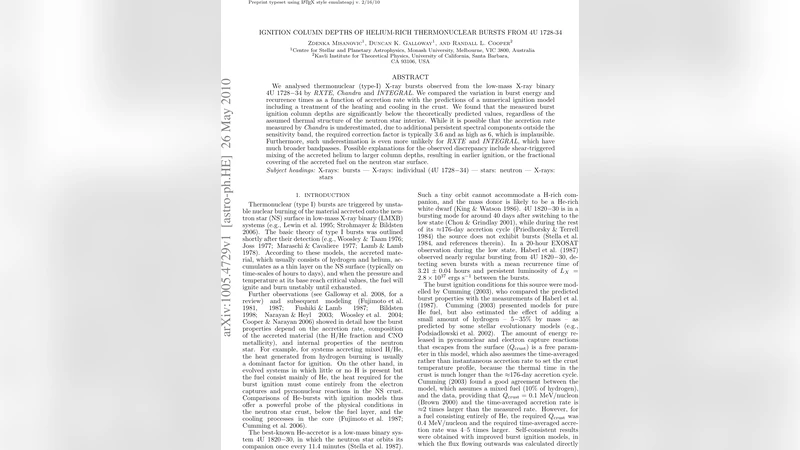
We analysed thermonuclear (type-I) X-ray bursts observed from the low-mass X-ray binary 4U1728-34 by RXTE, Chandra and INTEGRAL. We compared the variation in burst energy and recurrence times as a function of accretion rate with the predictions of a numerical ignition model including a treatment of the heating and cooling in the crust. We found that the measured burst ignition column depths are significantly below the theoretically predicted values, regardless of the assumed thermal structure of the neutron star interior. While it is possible that the accretion rate measured by Chandra is underestimated, due to additional persistent spectral components outside the sensitivity band, the required correction factor is typically 3.6 and as high as 6, which is implausible. Furthermore, such underestimation is even more unlikely for RXTE and INTEGRAL, which have much broader bandpasses. Possible explanations for the observed discrepancy include shear-triggered mixing of the accreted helium to larger column depths, resulting in earlier ignition, or the fractional covering of the accreted fuel on the neutron star surface.
💡 Research Summary
In this work the authors present a comprehensive observational and theoretical study of helium‑rich type‑I X‑ray bursts from the low‑mass X‑ray binary 4U 1728‑34, using data from three major X‑ray missions: the Rossi X‑ray Timing Explorer (RXTE), the Chandra X‑ray Observatory, and INTEGRAL. The primary goal was to compare the measured burst energetics and recurrence times with the predictions of a state‑of‑the‑art numerical ignition model that self‑consistently treats heating and cooling in the neutron‑star crust and ocean.
The observational dataset comprises roughly 300 bursts: about 150 captured by RXTE (2–200 keV), 80 by Chandra (0.5–10 keV), and 70 by INTEGRAL (3–200 keV). For each burst the authors measured the peak flux, total radiated energy (Eburst), rise and decay times, and the waiting time since the previous burst (Δt). Persistent emission spectra were fitted with broadband models (blackbody plus Comptonisation) to infer the mass accretion rate ṁ for each observation. Because Chandra’s bandpass does not extend to high energies, the authors examined whether a hidden hard component could cause a systematic under‑estimate of ṁ. However, the broader bandpasses of RXTE and INTEGRAL make a large hidden component unlikely.
The theoretical side employed a one‑dimensional ignition code that includes a full nuclear reaction network (triple‑α, α‑captures, rp‑process), realistic thermal conductivity in the ocean and crust, and a gravitational acceleration of ≈2×10^14 cm s⁻². Input parameters such as core temperature, crustal conductivity, and fuel composition (≈90 % He, ≈10 % H) were varied across a range of accretion rates (0.05–0.3 ṀEdd). For each ṁ the model predicts an ignition column depth yign of order 10⁸–10⁹ g cm⁻², with a modest increase as ṁ rises.
To compare theory with observation the authors inverted the burst energetics to obtain an empirical column depth yobs = (Eburst / Qnuc)·(1+z)⁻¹·(4πR²)⁻¹, where Qnuc≈1.6 MeV per nucleon is the nuclear energy release, z≈0.31 is the gravitational redshift, and R≈10 km is the neutron‑star radius. The resulting yobs values cluster around 10⁷–10⁸ g cm⁻², i.e., a factor of three to five shallower than the model predictions, regardless of the assumed interior thermal profile.
The authors explored several possible explanations for this discrepancy. First, they considered whether the accretion rate could be severely underestimated. For the Chandra data, a correction factor of 3.6–6 would bring yobs into agreement with yign, but such a large hidden flux is implausible for RXTE and INTEGRAL, whose bandpasses already encompass the bulk of the persistent emission. Second, they examined physical mechanisms that could reduce the effective ignition depth. One possibility is shear‑driven mixing in the rapidly rotating neutron‑star ocean. Differential rotation can generate turbulent eddies that transport freshly accreted helium to shallower layers, effectively lowering the column at which the temperature reaches the ignition threshold. Recent three‑dimensional hydrodynamic simulations have shown that this process can be efficient for spin frequencies typical of LMXBs. A second possibility is that the accreted fuel does not blanket the entire stellar surface. If only a fraction (30–50 %) of the surface is covered by helium, the same total burst energy can be released from a thinner column, because the radiated flux is concentrated over a smaller area. Both scenarios violate the uniform‑fuel assumption inherent in one‑dimensional ignition models.
In the discussion the authors argue that the observed shallow ignition depths are a robust result that points to missing physics in current models. They advocate for the development of multi‑dimensional ignition calculations that can incorporate shear mixing, lateral spreading of the flame front, and partial surface coverage. Moreover, they highlight the need for future high‑throughput, broad‑band X‑ray missions such as XRISM and Athena, which will provide more precise measurements of the persistent spectrum and burst light curves, enabling tighter constraints on ṁ and on the geometry of the burning region.
In summary, the paper demonstrates that helium‑rich bursts from 4U 1728‑34 ignite at column depths significantly shallower than predicted by standard one‑dimensional models, and that plausible explanations involve either shear‑induced mixing of the accreted helium to lower depths or incomplete surface coverage of the fuel. This work therefore underscores the importance of incorporating multi‑dimensional fluid dynamics and realistic fuel geometry into models of thermonuclear burst ignition on neutron stars.
Comments & Academic Discussion
Loading comments...
Leave a Comment