Rapid optical and X-ray timing observations of GX 339-4: multi-component optical variability in the low/hard state
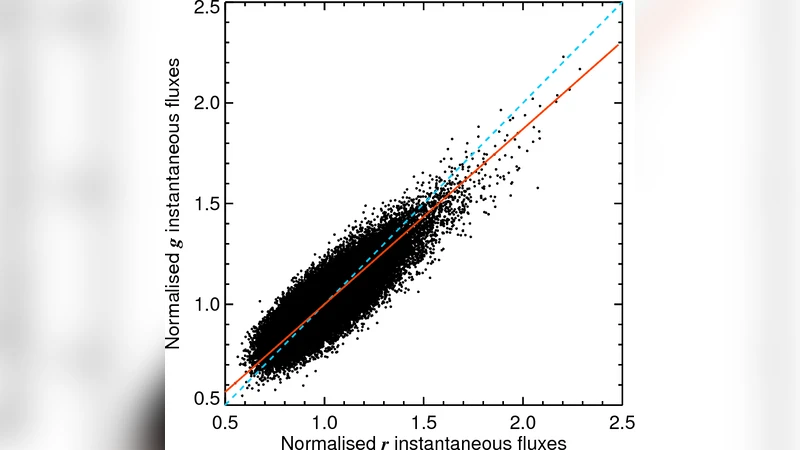
A rapid timing analysis of VLT/ULTRACAM and RXTE observations of the black hole binary GX 339-4 in its 2007 low/hard state is presented. The optical light curves in the r’, g’ and u’ filters show slow (~20 s) quasi-periodic variability. Upon this is superposed fast flaring activity on times approaching the best time resolution probed (~50 ms) and with maximum strengths of more than twice the local mean. Power spectral analysis over ~0.004-10 Hz is presented, and shows that although the average optical variability amplitude is lower than that in X-rays, the peak variability power emerges at a higher Fourier frequency in the optical. Energetically, we measure a large optical vs. X-ray flux ratio, higher than that seen when the source was fully jet-dominated. Such a large ratio cannot be easily explained with a disc alone. The optical:X-ray cross-spectrum shows a markedly different behaviour above and below ~0.2 Hz. The peak of the coherence function above this threshold is associated with a short optical time lag, also seen as the dominant feature in the time-domain cross-correlation at ~150 ms. The rms energy spectrum of these fast variations is best described by distinct physical components over the optical and X-ray regimes, and also suggests a maximal disc fraction of 20% at ~5000 A. If the constant time delay is due to propagation of fluctuations to (or within) the jet, this is the clearest optical evidence to date of the location of this component. The low-frequency QPO is seen in the optical but not in X-rays. Evidence of reprocessing emerges at the lowest Fourier frequencies, with optical lags at ~10 s and strong coherence in the blue u’ filter. Simultaneous optical spectroscopy also shows the Bowen fluorescence blend, though its emission location is unclear. But canonical disc reprocessing cannot dominate the optical power easily, nor explain the fast variability. (abridged)
💡 Research Summary
This paper presents a comprehensive high‑time‑resolution study of the black‑hole X‑ray binary GX 339‑4 during its 2007 low/hard state, using simultaneous optical observations with VLT/ULTRACAM and X‑ray data from RXTE. The optical light curves were obtained in three Sloan‑like filters (r′, g′, u′) with a time resolution down to ≈50 ms, while the X‑ray light curve covers the 2–15 keV band with comparable timing precision.
Two distinct variability components dominate the optical emission. A low‑frequency quasi‑periodic oscillation (QPO) with a characteristic timescale of ~20 s is evident in all three filters, most strongly in r′ and g′. Superimposed on this slow modulation are rapid flares that reach amplitudes >2 × the local mean and occur on timescales approaching the 50 ms resolution limit. By contrast, the X‑ray light curve shows only modest variability on comparable short timescales and no clear counterpart to the optical QPO.
Power spectral density (PSD) analysis over the 0.004–10 Hz range reveals that, although the overall fractional rms amplitude is lower in the optical than in the X‑rays, the optical power peaks at higher Fourier frequencies. The optical PSD displays a clear QPO peak around 0.05 Hz, while the X‑ray PSD lacks a corresponding feature. Above ≈0.2 Hz the optical PSD exceeds the X‑ray PSD, indicating that the fastest variations are primarily optical.
Cross‑spectral analysis between the optical and X‑ray bands uncovers a striking frequency‑dependent behavior. For frequencies >0.2 Hz the coherence function rises to 0.3–0.5, and the phase lag corresponds to a constant optical delay of ≈150 ms. This delay appears as the dominant peak in the time‑domain cross‑correlation function and suggests that fluctuations generated in the inner accretion flow propagate outward into the jet (or within the jet) on a timescale of a few × 10⁻¹ s, implying a propagation speed of order 0.1 c. At lower frequencies (0.01–0.1 Hz) the coherence drops sharply, but the u′ filter shows a weak but significant coherence together with a much larger lag of ~10 s. This low‑frequency lag, together with the stronger coherence in the blue band, is consistent with classic disc reprocessing of X‑ray photons.
The rms‑energy spectrum of the fast (≥0.2 Hz) variability further separates the optical and X‑ray contributions. In the optical, the rms spectrum can be modeled as a combination of a thermal disc component contributing at most ~20 % around 5000 Å and a dominant non‑thermal component, most plausibly synchrotron emission from the compact jet. The X‑ray rms spectrum follows the shape expected from thermal Comptonisation in a hot corona and shows no direct correlation with the optical rms, reinforcing the idea of distinct physical origins.
A notable result is the unusually high optical‑to‑X‑ray flux ratio measured during these observations, exceeding values reported when GX 339‑4 was fully jet‑dominated. Pure disc emission cannot account for such a ratio, implying that the jet contributes substantially to the optical band even in the low/hard state. Simultaneous optical spectroscopy also detects the Bowen fluorescence blend around 4640 Å and He II 4686 Å, but the spatial origin of these lines remains ambiguous; they may arise in the irradiated outer disc, the stream‑impact region, or the base of the jet.
Overall, the authors propose a multi‑component model for the optical variability: (1) a low‑frequency QPO likely linked to disc or corona oscillations, (2) a reprocessing component dominating the longest timescales and blue wavelengths, and (3) a fast, jet‑related component responsible for the high‑frequency optical power and the ~150 ms lag. The detection of a coherent, frequency‑dependent lag provides the clearest optical evidence to date that the compact jet is the site of rapid variability in the low/hard state of a black‑hole binary. These findings underscore the importance of simultaneous high‑time‑resolution optical and X‑ray observations for disentangling the complex interplay between accretion discs, coronae, and jets in accreting black holes.
Comments & Academic Discussion
Loading comments...
Leave a Comment