Geo-neutrinos and Silicate Earth Enrichment of U and Th
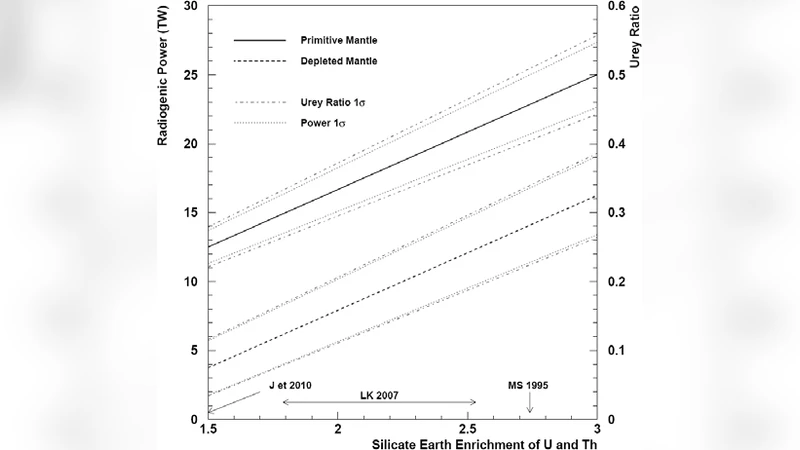
The terrestrial distribution of U, Th, and K abundances governs the thermal evolution, traces the differentiation, and reflects the bulk composition of the earth. Comparing the bulk earth composition to chondritic meteorites estimates the net amounts of these radiogenic heat-producing elements available for partitioning to the crust, mantle, and core. Core formation enriches the abundances of refractory lithophile elements, including U and Th, in the silicate earth by ~1.5. Global removal of volatile elements potentially increases this enrichment to ~2.8. The K content of the silicate earth follows from the ratio of K to U. Variable enrichment produces a range of possible heat-producing element abundances in the silicate earth. A model assesses the essentially fixed amounts of U, Th, and K in the approximately closed crust reservoir. Subtracting these sequestered crustal amounts from the variable amounts in the silicate earth results in a range of possible mantle allocations, leaving global dynamics and thermal evolution poorly constrained. Terrestrial antineutrinos from {\beta}-emitting daughter nuclei in the U and Th decay series traverse the earth with negligible attenuation. The rate at which large subsurface instruments observe these geo-neutrinos depends on the distribution of U and Th relative to the detector. Geo-neutrino observations with sensitivity to U and Th in the mantle are able to estimate silicate earth enrichment, leading to a more complete understanding of the origin, accretion, differentiation, and thermal history of the planet.
💡 Research Summary
The paper investigates how the abundances of the heat‑producing elements uranium (U), thorium (Th) and potassium (K) are distributed within the Earth’s silicate portion (crust and mantle) and how this distribution controls the planet’s thermal evolution. By comparing the bulk Earth composition to that of chondritic meteorites, the authors estimate the total inventory of these elements that were originally available for partitioning among the core, mantle and crust. Core formation preferentially removes refractory lithophile elements from the metallic core, enriching the silicate Earth in U and Th by a factor of roughly 1.5. If volatile loss is taken into account on a planetary scale, the enrichment factor can rise to about 2.8. The K content of the silicate Earth is then derived from the K/U ratio, which is assumed to remain essentially constant after core segregation.
The authors treat the continental crust as a nearly closed reservoir whose U, Th and K inventories can be constrained from geochemical surveys, radiogenic isotope dating and existing heat‑flow data. By subtracting these crustal inventories from the total silicate‑Earth inventories (which vary according to the chosen enrichment factor), a range of possible mantle inventories is obtained. Depending on the enrichment scenario, mantle U concentrations span roughly 5–15 ppb, leading to mantle radiogenic heat production estimates between 5 TW and 20 TW. This wide range translates into substantial uncertainty in models of mantle convection, plate tectonics and the long‑term thermal history of the planet.
Geo‑neutrinos—electron antineutrinos emitted in the β‑decay chains of U and Th—provide a unique observational probe because they travel through the Earth with negligible attenuation. The detection rate at large underground detectors (e.g., Borexino, KamLAND, SNO+, JUNO) depends on the spatial distribution of U and Th relative to the detector, with a strong weighting toward nearby sources. Consequently, the measured geo‑neutrino flux is a mixture of crustal and mantle contributions, and current data are dominated by the crust (≈70 % of the signal). The paper demonstrates that, if the mantle component can be isolated—through multi‑site measurements, improved detector sensitivity, and spectral separation techniques—geo‑neutrino observations can directly constrain the mantle’s U and Th content.
By linking geo‑neutrino measurements to the enrichment factor, the authors argue that future high‑precision, global geo‑neutrino networks will be able to narrow the allowed range of silicate‑Earth enrichment. This, in turn, will refine estimates of the Earth’s total radiogenic heat budget, improve thermal evolution models, and shed light on the processes of accretion, differentiation, and volatile loss that shaped the planet. The paper concludes that coordinated advances in detector technology, site selection (including oceanic locations to reduce crustal background), and geochemical modeling are essential to fully exploit geo‑neutrinos as a diagnostic of the Earth’s deep interior.
Comments & Academic Discussion
Loading comments...
Leave a Comment