The $E_{rm p}$-Flux Correlation in the Rising and Decaying Phases of Gamma-Ray Burst Pulses: Evidence for Viewing Angle Effect?
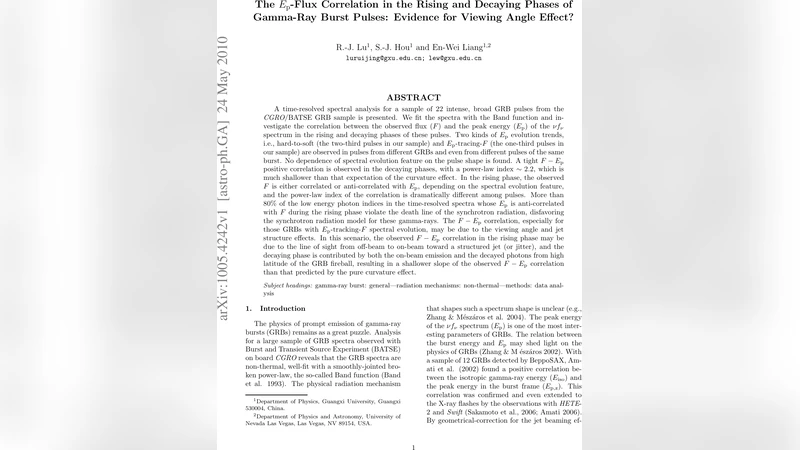
A time-resolved spectral analysis for a sample of 22 intense, broad GRB pulses from the BATSE GRB sample is presented. We fit the spectra with the Band function and investigate the correlation between the observed flux (F) and the peak energy (E_p) of the $\nu f_\nu$ spectrum in the rising and decaying phases of these pulses. Two kinds of E_p evolution trends, i.e., hard-to-soft (the two-third pulses in our sample) and $E_{\rm p}$-tracing-$F$ (the one-third pulses in our sample) are observed in pulses from different GRBs and even from different pulses of the same burst. No dependence of spectral evolution feature on the pulse shape is found. A tight $F-E_{\rm p}$ positive correlation is observed in the decaying phases, with a power-law index $\sim 2.2$, which is much shallower than that expectation of the curvature effect. In the rising phase, the observed $F$ is either correlated or anti-correlated with $E_{\rm p}$, depending on the spectral evolution feature, and the power-law index of the correlation is dramatically different among pulses. More than $80%$ of the low energy photon indices in the time-resolved spectra whose $E_{\rm p}$ is anti-correlated with $F$ during the rising phase violate the death line of the synchrotron radiation, disfavoring the synchrotron radiation model for these gamma-rays. The $F-E_{\rm p}$ correlation, especially for those GRBs with $E_{\rm p}$-tracking-$F$ spectral evolution, may be due to the viewing angle and jet structure effects. In this cenario, the observed $F-E_{\rm p}$ correlation in the rising phase may be due to the line of sight from off-beam to on-beam toward a structured jet (or jitter), and the decaying phase is contributed by both the on-beam emission and the decayed photons from high latitude of the GRB fireball,resulting in a shallower slope of the observed $F-E_{\rm p}$ correlation than that predicted by the pure curvature effect.
💡 Research Summary
The authors present a time‑resolved spectral study of 22 bright, broad pulses selected from the BATSE gamma‑ray burst (GRB) catalog. Each pulse was divided into intervals with sufficient signal‑to‑noise, and the spectra were fitted with the Band function to obtain the νFν peak energy (Eₚ) and the corresponding peak flux (F). The main goal was to examine how F and Eₚ are correlated during the rising and decaying portions of individual pulses.
Two distinct patterns of Eₚ evolution are identified. In roughly two‑thirds of the pulses the classic “hard‑to‑soft” (HTS) behavior is observed: Eₚ starts high and monotonically declines throughout the pulse, regardless of the pulse shape. In the remaining one‑third, Eₚ tracks the flux (Eₚ‑tracing‑F, or “Eₚ‑F” behavior), rising and falling together with F. Importantly, the same GRB can contain pulses of both types, and no systematic link between pulse morphology (symmetry, width, rise‑time) and the evolution pattern is found.
During the decay phase, all pulses display a tight positive correlation between flux and peak energy, well described by a power‑law F ∝ Eₚ^α with an average index α ≈ 2.2 ± 0.3. This slope is significantly shallower than the α ≈ 3 expected from a pure curvature (high‑latitude) effect, where the observed emission is solely the delayed photons from an abruptly switched‑off relativistic shell. The authors argue that the shallower slope indicates that, in addition to high‑latitude emission, on‑axis (on‑beam) radiation continues to contribute as the pulse fades.
In the rising phase the situation is more complex. For HTS pulses, Eₚ and F are anti‑correlated: as the spectrum softens (Eₚ decreases) the flux rises. Moreover, more than 80 % of the time‑resolved spectra in this regime have low‑energy photon indices (α_low) that are harder than the synchrotron “death line” (α = ‑2/3), violating the limit imposed by standard optically‑thin synchrotron radiation. This strongly disfavors a simple synchrotron origin for the prompt photons in these intervals. Conversely, for Eₚ‑tracing‑F pulses the rising phase shows a positive F–Eₚ correlation, but the power‑law index varies widely from pulse to pulse (≈ 0.5–1.5), suggesting that the underlying physics is not universal.
To explain these diverse behaviors, the paper proposes a viewing‑angle and jet‑structure scenario. If the GRB jet possesses a structured Lorentz‑factor or emissivity profile (e.g., a bright core surrounded by a fainter sheath), an observer initially located off the jet axis (off‑beam) will see a relatively soft, low‑flux emission. As the emitting region expands or the line of sight drifts toward the jet core, the observer moves effectively “on‑beam,” producing a simultaneous rise in both Eₚ and F – the observed Eₚ‑tracing‑F behavior. During the decay, the observed flux is a mixture of the lingering on‑beam emission and the high‑latitude photons, naturally yielding a correlation shallower than the pure curvature prediction. Alternative mechanisms such as jitter radiation, where small‑scale magnetic turbulence modifies the spectral shape, can also be accommodated within this geometric framework.
The key conclusions are: (1) GRB pulses exhibit at least two distinct spectral‑evolution modes that are independent of pulse shape; (2) the rising‑phase F–Eₚ relationship is highly sensitive to the evolution mode and often incompatible with simple synchrotron emission; (3) the decay‑phase correlation is robust but shallower than curvature‑only expectations, implying a combined contribution from on‑axis and high‑latitude emission; and (4) a structured jet viewed at varying angles provides a plausible unified explanation for both the positive and negative F–Eₚ trends. The work therefore places strong constraints on prompt‑emission models, highlighting the need for high‑time‑resolution spectroscopy and detailed jet‑structure simulations to further test the viewing‑angle hypothesis.
Comments & Academic Discussion
Loading comments...
Leave a Comment