Magnetic Tension of Sunspot Fine Structures
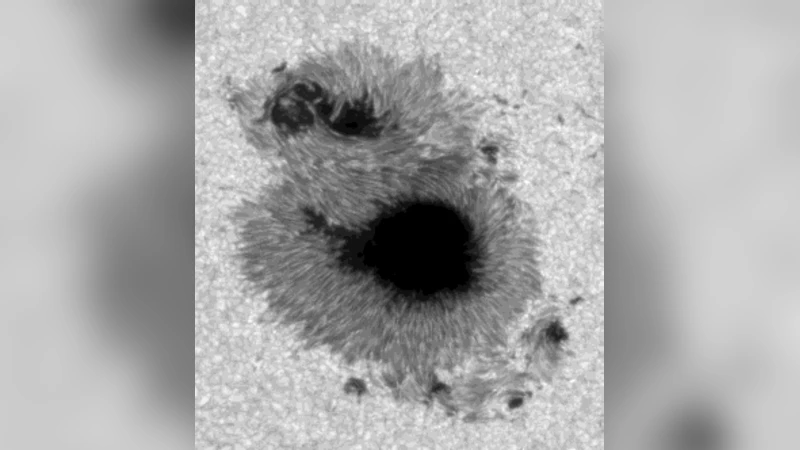
The equilibrium structure of sunspots depends critically on its magnetic topology and is dominated by magnetic forces. Tension force is one component of the Lorentz force which balances the gradient of magnetic pressure in force-free configurations. We employ the tension term of the Lorentz force to clarify the structure of sunspot features like penumbral filaments, umbral light bridges and outer penumbral fine structures. We compute vertical component of tension term of Lorentz force over two active regions namely NOAA AR 10933 and NOAA AR 10930 observed on 05 January 2007 and 12 December 2006 respectively. The former is a simple while latter is a complex active region with highly sheared polarity inversion line (PIL). The vector magnetograms used are obtained from Hinode(SOT/SP). We find an inhomogeneous distribution of tension with both positive and negative signs in various features of the sunspots. The existence of positive tension at locations of lower field strength and higher inclination is compatible with the uncombed model of the penumbral structure. Positive tension is also seen in umbral light bridges which could be indication of uncombed structure of the light bridge. Likewise, the upward directed tension associated with bipolar regions in the penumbra could be a direct confirmation of the sea serpent model of penumbral structures. Upward directed tension at the PIL of AR 10930 seems to be related to flux emergence. The magnitude of the tension force is greater than the force of gravity in some places, implying a nearly force-free configuration for these sunspot features. From our study, magnetic tension emerges as a useful diagnostic of the local equilibrium of the sunspot fine structures.
💡 Research Summary
The paper investigates the role of magnetic tension—the vertical component of the Lorentz force—in governing the fine‑scale equilibrium of sunspot structures. Using high‑resolution vector magnetograms from Hinode’s Solar Optical Telescope Spectro‑Polarimeter (SOT/SP), the authors compute the vertical tension term (T_z = (\mathbf{B}\cdot\nabla)B_z/\mu_0) for two active regions observed on 5 January 2007 (NOAA AR 10933, a relatively simple, circular sunspot) and 12 December 2006 (NOAA AR 10930, a complex region with a highly sheared polarity inversion line). After standard preprocessing (disambiguation, noise filtering, and re‑sampling to 0.3″ pixels), the tension is evaluated pixel‑by‑pixel across the entire field of view.
The analysis reveals a highly inhomogeneous distribution of (T_z) with both positive (upward‑directed) and negative (downward‑directed) values, tightly correlated with local magnetic field strength and inclination. In the penumbral filaments of both ARs, regions of relatively weak field (< 800 G) and large inclination (≈ 65°–85°) exhibit strong positive tension. This pattern matches the “uncombed” model, wherein nearly vertical, strong flux tubes are embedded in a more horizontal, weaker background field, producing an upward magnetic pressure that must be balanced by tension. Conversely, the umbral core, where fields are strong (> 2000 G) and nearly vertical, shows dominant negative tension, indicating a downward pull consistent with a force‑free configuration.
Umbral light bridges also display positive tension, suggesting that they, too, consist of interleaved magnetic components of differing orientation rather than a simple field‑free intrusion. In the outer penumbra, small bipolar structures—interpreted as the “sea‑serpent” undulations of flux tubes—show upward‑directed tension, providing direct observational support for the serpentine model of penumbral convection.
The most striking result concerns the polarity inversion line (PIL) of AR 10930. Here, a broad swath of positive tension reaches magnitudes of order 10³ dyn cm⁻³, exceeding the gravitational force per unit volume. This indicates that newly emerging flux is pushing upward against the overlying atmosphere, a signature of flux emergence that may precede flare or coronal mass ejection activity.
Across all examined features, the magnitude of the tension force often surpasses the weight of the plasma, implying that the magnetic field is close to a force‑free state locally. The authors argue that magnetic tension, being directly calculable from vector magnetograms, serves as a powerful diagnostic of the local force balance and can discriminate between competing structural models (e.g., uncombed versus monolithic penumbra, sea‑serpent versus flux‑tube models).
In summary, the study demonstrates that (1) upward magnetic tension is systematically associated with low‑field, highly inclined structures; (2) this association validates the uncombed picture of penumbral filaments and the serpentine geometry of outer‑penumbral flux tubes; (3) strong upward tension at a sheared PIL signals active flux emergence; and (4) the prevalence of tension values larger than gravity confirms that many sunspot fine structures are nearly force‑free. The work establishes magnetic tension as a quantitative, observationally accessible tool for probing the equilibrium and dynamics of sunspot fine structures, opening avenues for future time‑dependent studies linking tension evolution to eruptive solar phenomena.
Comments & Academic Discussion
Loading comments...
Leave a Comment