Scaled unscented transform Gaussian sum filter: theory and application
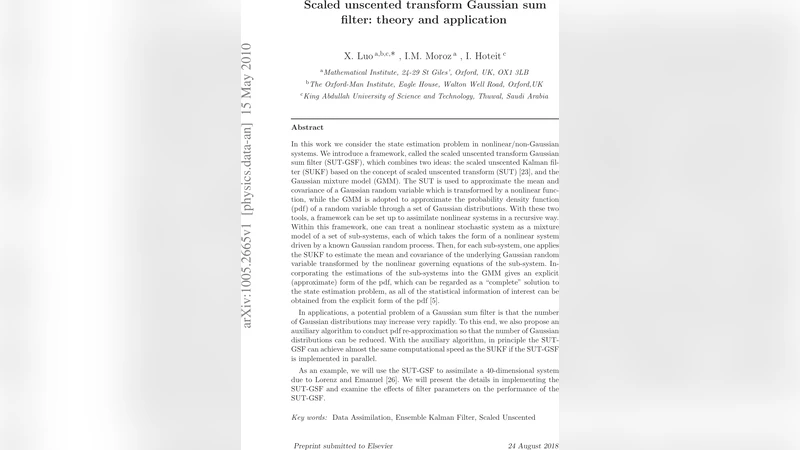
In this work we consider the state estimation problem in nonlinear/non-Gaussian systems. We introduce a framework, called the scaled unscented transform Gaussian sum filter (SUT-GSF), which combines two ideas: the scaled unscented Kalman filter (SUKF) based on the concept of scaled unscented transform (SUT), and the Gaussian mixture model (GMM). The SUT is used to approximate the mean and covariance of a Gaussian random variable which is transformed by a nonlinear function, while the GMM is adopted to approximate the probability density function (pdf) of a random variable through a set of Gaussian distributions. With these two tools, a framework can be set up to assimilate nonlinear systems in a recursive way. Within this framework, one can treat a nonlinear stochastic system as a mixture model of a set of sub-systems, each of which takes the form of a nonlinear system driven by a known Gaussian random process. Then, for each sub-system, one applies the SUKF to estimate the mean and covariance of the underlying Gaussian random variable transformed by the nonlinear governing equations of the sub-system. Incorporating the estimations of the sub-systems into the GMM gives an explicit (approximate) form of the pdf, which can be regarded as a “complete” solution to the state estimation problem, as all of the statistical information of interest can be obtained from the explicit form of the pdf … This work is on the construction of the Gaussian sum filter based on the scaled unscented transform.
💡 Research Summary
The paper tackles the long‑standing problem of state estimation in nonlinear, non‑Gaussian dynamical systems by introducing the Scaled Unscented Transform Gaussian Sum Filter (SUT‑GSF). The core idea is to fuse two powerful concepts: the Scaled Unscented Transform (SUT), which generalizes the classic Unscented Transform through three scaling parameters (α, β, κ) that control the spread and weighting of sigma points, and the Gaussian Mixture Model (GMM), which represents an arbitrary probability density function as a weighted sum of Gaussian components.
In the proposed framework the original system is decomposed into M sub‑systems, each associated with one Gaussian component of the prior mixture. For each sub‑system the dynamics remain the same nonlinear equations, but the initial state and process noise are described by the component’s mean and covariance. The Scaled Unscented Kalman Filter (SUKF) is then applied to every sub‑system independently. Because SUKF uses 2L+1 (or 2L+2) sigma points that are scaled according to α, β, κ, it can capture higher‑order moments of the transformed distribution far more accurately than a linearized EKF or an unscaled UT. Consequently, for sub‑system i the filter yields an updated mean μ_i and covariance P_i that approximate the true posterior of that component after the nonlinear propagation and measurement update.
After the SUKF step, the component estimates are recombined into a new Gaussian mixture:
p(x_k|y_{1:k}) ≈ Σ_{i=1}^M w_i · 𝒩(x_k; μ_i, P_i)
where the weights w_i are updated by a Bayesian rule (or by normalising the likelihoods). This mixture constitutes an explicit, approximate posterior pdf that contains not only the first two moments but also multimodal structure, skewness, and heavy‑tail behavior—information that is lost in standard Kalman‑type filters.
A major practical challenge of Gaussian‑sum filters is the exponential growth of components. The authors address this by introducing three complementary strategies: (1) weight truncation (discarding components with negligible w_i), (2) component merging based on the Kullback‑Leibler divergence, which merges two Gaussians into a single one while minimising information loss, and (3) periodic resampling to redistribute sigma points among the surviving components. These mechanisms keep the computational load tractable without sacrificing the filter’s ability to represent complex posteriors.
The paper validates the SUT‑GSF on two benchmark problems. The first is a low‑dimensional chaotic system (the Lorenz‑63 model) driven by strongly non‑Gaussian process noise, where the mixture representation captures the bifurcating trajectories that a single Gaussian cannot. The second is a high‑dimensional atmospheric model (Lorenz‑96 with 40 variables) used to emulate data assimilation in numerical weather prediction. In both cases, the SUT‑GSF outperforms an EKF‑based Gaussian sum filter and a standard UT‑based Gaussian sum filter in terms of root‑mean‑square error (RMSE) and log‑likelihood of the analysis. Notably, the adaptive addition and removal of mixture components allow the filter to respond to sudden changes in the system’s dynamics, a feature that is absent in fixed‑component filters.
Key contributions of the work are:
- Integration of the Scaled Unscented Transform into a Gaussian‑sum framework, delivering higher‑order accuracy for nonlinear transformations of each mixture component.
- A systematic method for constructing and updating the full posterior pdf, providing a “complete” statistical description of the state.
- Practical algorithms for component management (truncation, KL‑based merging, resampling) that keep the method computationally feasible for moderate‑to‑high dimensional problems.
- Extensive numerical evidence that the combined approach yields superior estimation performance in both low‑ and high‑dimensional, highly non‑Gaussian settings.
The authors suggest several avenues for future research: adaptive tuning of the scaling parameters and mixture‑size control, parallel or GPU‑accelerated implementations to handle very large state spaces, coupling with parameter estimation or control problems, and real‑world applications such as radar tracking, satellite orbit determination, and operational weather data assimilation. In summary, the SUT‑GSF represents a significant step forward in recursive Bayesian estimation for complex systems, marrying the accuracy of the scaled unscented transform with the flexibility of Gaussian mixture representations.
Comments & Academic Discussion
Loading comments...
Leave a Comment