The pulse profiles of the transient Be/X-ray binary EXO 2030+375 show strong dependence on energy, as well as on its luminosity state, and are asymmetric in shape. We want to identify the emission components of the two magnetic poles in the pulsed emission to understand the geometry of the neutron star and its beam pattern. We utilize a pulse-profile decomposition method that enables us to find two symmetric pulse profiles from the magnetic poles of the neutron star. The symmetry characteristics of these single-pole pulse profiles give information about the position of the magnetic poles of the neutron star relative to its rotation axis. We find a possible geometry for the neutron star in EXO 2030+375 through the decomposition of the pulse profiles, which suggests that one pole gets closer to the line of sight than the other and that, during the revolution of the neutron star, both poles disappear behind the horizon for a short period of time. A considerable fraction of the emission arises from a halo while the pole is facing the observer and from the accretion stream of the other pole while it is behind the neutron star, but the gravitational line bending makes the emission visible to us.
Deep Dive into Analyzing X-Ray Pulsar Profiles: Geometry and Beam Pattern of EXO 2030+375.
The pulse profiles of the transient Be/X-ray binary EXO 2030+375 show strong dependence on energy, as well as on its luminosity state, and are asymmetric in shape. We want to identify the emission components of the two magnetic poles in the pulsed emission to understand the geometry of the neutron star and its beam pattern. We utilize a pulse-profile decomposition method that enables us to find two symmetric pulse profiles from the magnetic poles of the neutron star. The symmetry characteristics of these single-pole pulse profiles give information about the position of the magnetic poles of the neutron star relative to its rotation axis. We find a possible geometry for the neutron star in EXO 2030+375 through the decomposition of the pulse profiles, which suggests that one pole gets closer to the line of sight than the other and that, during the revolution of the neutron star, both poles disappear behind the horizon for a short period of time. A considerable fraction of the emission ar
EXO 2030+375 is an accreting X-ray pulsar with a pulsation period of ∼42 s, which was discovered with EXOSAT in 1985 during a giant outburst (Parmar et al. 1989b). A B0 Ve star was found as its counterpart in follow-up observations in the optical and infrared bands (Janot-Pacheco et al. 1988;Motch & Janot-Pacheco 1987;Coe et al. 1988). During the giant outburst, EXO 2030+375 showed a spin-up of -P/ Ṗ ≈ 30 yr (Parmar et al. 1989b) and quasi-periodic oscillations with a frequency of ∼0.2 Hz (Angelini et al. 1989) interpreted as caused by the formation of an accretion disk. Detailed analyses have shown that its rate of pulse-period change Ṗ, energy spectrum, and pulse profile are strongly luminosity dependent (Parmar et al. 1989a,b;Reynolds et al. 1993). The orbital period is 46 days (Wilson et al. 2002), and a normal outburst has been detected for nearly every periastron passage since 1991 (Wilson et al. 2005). In 2006, EXO 2030+375 underwent the first giant outburst since its discovery in 1985 (Corbet & Levine 2006;Krimm et al. 2006;McCollough et al. 2006), during which it reached a maximum luminosity of L 1-20 keV ≈ 1.2 × 10 38 erg s -1 (Klochkov et al. 2008) and again showed a strong spin-up. Rossi X-ray Timing Explorer (RXTE) monitored EXO 2030+375 extensively during the 2006 giant outburst (Wilson et al. 2008). The source was also observed by the INTErnational Gamma Ray Astrophysics Laboratory (INTEGRAL, Winkler et al. 2003) and Swift (Gehrels et al. 2004). The spectra indicate a cyclotron absorption line (Klochkov et al. 2007;Wilson et al. 2008). Klochkov et al. (2008) have shown that the spectrum of EXO 2030+375 changes with pulse phase, suggesting a fan beam geometry during the maximum, while towards the end of the giant outburst, it changes to a combination of a fan beam and a pencil beam.
In X-ray pulsars, a neutron star accretes matter from a companion star via stellar wind or Roche lobe overflow. The accreted matter is channeled along the field lines of the strong magnetic field of the neutron star onto the magnetic poles. Xray emission from the neutron star is produced in regions around the two magnetic poles. As the magnetic dipole axis is most likely inclined against the rotation axis of the neutron star, a distant observer sees pulsed emission. X-ray pulsars exhibit a wide variety of pulse shapes that differ from source to source. Generally, high-energy pulses have simpler shapes than lowenergy pulses (White et al. 1983;Frontera & Dalfiume 1989;Bildsten et al. 1997, and references therein). If one assumes an axially symmetric geometry for the two emission regions of the neutron star in a dipole configuration, the observed pulse profile should be symmetric. However, the observed pulse profiles typically show an asymmetry. To explain the asymmetric shape of the total pulse profile, a distorted magnetic dipole field in which the two magnetic poles are not located opposite each other have been discussed (Parmar et al. 1989a;Leahy 1991;Riffert et al. 1993;Bulik et al. 1995). Kraus et al. (1995) shows that, starting from the observed, asymmetric pulse profile, it is possible to disentangle the contribution of the two emission regions of the neutron star. Once the pulsed emission from each of the poles has been obtained, one can derive the geometry of the neutron star. This again allows us to construct the beam pattern, i.e., the flux distribution from one emission region. Using this pulseprofile decomposition method, Kraus et al. (1996) have analyzed the pulse profiles of Cen X-3 and find indications of both pencil and fan beam. In the case of Her X-1, the results of the pulseprofile decomposition by Blum & Kraus (2000) have not only shed light on the beam pattern of the magnetic poles, but have also confirmed that a warped and tilted accretion disk attenuates the emission from one pole of the neutron star. For A 0535+26, the reconstructed beam pattern suggests that the emission comes from a hollow column plus a halo of scattered radiation on the neutron star surface (Caballero et al. 2010).
In this paper we present the analysis of the energy-resolved pulse profiles of EXO 2030+375 utilizing the decomposition method developed by Kraus et al. (1995). Section 2 gives an overview of the data used for our analysis and Sect. 3 describes the analysis and the results obtained with the pulse-profile decomposition method. The results are discussed in Sect. 4. Section 5 summarizes the possible geometry of the neutron star and the origin of the observed emission.
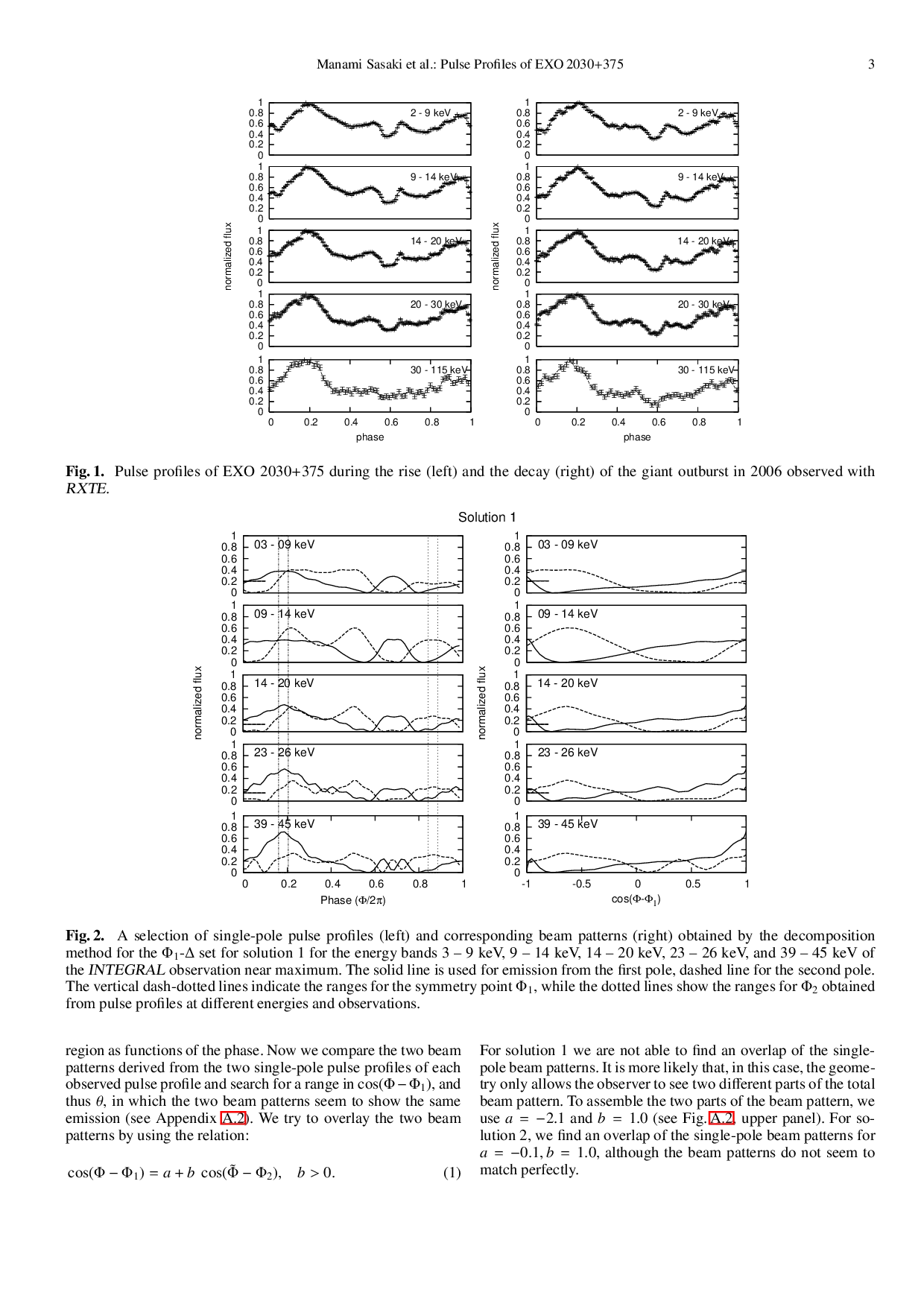
EXO 2030+375 experienced a giant outburst in 2006, during which the source was monitored continuously by RXTE and was also observed by INTEGRAL. We have used the pulse profiles obtained with the Joint European X-Ray Monitor (JEM-X, Lund et al. 2003) and the imaging system IBIS/ISGRI (Ubertini et al. 2003) as presented in Figs. 2 and 8 of Klochkov et al. (2008).
For better statistics, we also used publicly available archival data from two observati
…(Full text truncated)…
This content is AI-processed based on ArXiv data.