📝 Original Info
- Title: Relativistic Doppler-boosted emission in gamma-ray binaries
- ArXiv ID: 1004.0511
- Date: 2015-05-18
- Authors: Researchers from original ArXiv paper
📝 Abstract
Gamma-ray binaries could be compact pulsar wind nebulae formed when a young pulsar orbits a massive star. The pulsar wind is contained by the stellar wind of the O or Be companion, creating a relativistic comet-like structure accompanying the pulsar along its orbit. The X-ray and the very high energy (>100 GeV, VHE) gamma-ray emissions from the binary LS 5039 are modulated on the orbital period of the system. Maximum and minimum flux occur at the conjunctions of the orbit, suggesting that the explanation is linked to the orbital geometry. The VHE modulation has been proposed to be due to the combined effect of Compton scattering and pair production on stellar photons, both of which depend on orbital phase. The X-ray modulation could be due to relativistic Doppler boosting in the comet tail where both the X-ray and VHE photons would be emitted. Relativistic aberrations change the seed stellar photon flux in the comoving frame so Doppler boosting affects synchrotron and inverse Compton emission differently. The dependence with orbital phase of relativistic Doppler-boosted (isotropic) synchrotron and (anisotropic) inverse Compton emission is calculated, assuming that the flow is oriented radially away from the star (LS 5039) or tangentially to the orbit (LS I +61 303, PSR B1259-63). Doppler boosting of the synchrotron emission in LS 5039 produces a lightcurve whose shape corresponds to the X-ray modulation. The observations imply an outflow velocity of 0.15-0.33c consistent with the expected flow speed at the pulsar wind termination shock. In LS I +61 303, the calculated Doppler boosted emission peaks in phase with the observed VHE and X-ray maximum. Doppler boosting might provide an explanation for the puzzling phasing of the VHE peak in this system.
💡 Deep Analysis
Deep Dive into Relativistic Doppler-boosted emission in gamma-ray binaries.
Gamma-ray binaries could be compact pulsar wind nebulae formed when a young pulsar orbits a massive star. The pulsar wind is contained by the stellar wind of the O or Be companion, creating a relativistic comet-like structure accompanying the pulsar along its orbit. The X-ray and the very high energy (>100 GeV, VHE) gamma-ray emissions from the binary LS 5039 are modulated on the orbital period of the system. Maximum and minimum flux occur at the conjunctions of the orbit, suggesting that the explanation is linked to the orbital geometry. The VHE modulation has been proposed to be due to the combined effect of Compton scattering and pair production on stellar photons, both of which depend on orbital phase. The X-ray modulation could be due to relativistic Doppler boosting in the comet tail where both the X-ray and VHE photons would be emitted. Relativistic aberrations change the seed stellar photon flux in the comoving frame so Doppler boosting affects synchrotron and inverse Compton e
📄 Full Content
arXiv:1004.0511v1 [astro-ph.HE] 4 Apr 2010
Astronomy & Astrophysics manuscript no. 14023
c⃝ESO 2021
November 18, 2021
Relativistic Doppler-boosted emission in gamma-ray binaries
Guillaume Dubus, Benoˆıt Cerutti, and Gilles Henri
Laboratoire d’Astrophysique de Grenoble, UMR 5571 Universit´e Joseph Fourier Grenoble I / CNRS, BP 53, 38041 Grenoble, France
Draft November 18, 2021
ABSTRACT
Context. Gamma-ray binaries could be compact pulsar wind nebulae formed when a young pulsar orbits a massive star. The pulsar
wind is contained by the stellar wind of the O or Be companion, creating a relativistic comet-like structure accompanying the pulsar
along its orbit.
Aims. The X-ray and the very high energy (>100 GeV, VHE) gamma-ray emission from the binary LS 5039 are modulated on the
orbital period of the system. Maximum and minimum flux occur at the conjunctions of the orbit, suggesting that the explanation is
linked to the orbital geometry. The VHE modulation has been proposed to be due to the combined effect of Compton scattering and
pair production on stellar photons, both of which depend on orbital phase. The X-ray modulation could be due to relativistic Doppler
boosting in the comet tail where both the X-ray and VHE photons would be emitted.
Methods. Relativistic aberrations change the seed stellar photon flux in the comoving frame so Doppler boosting affects synchrotron
and inverse Compton emission differently. The dependence with orbital phase of relativistic Doppler-boosted (isotropic) synchrotron
and (anisotropic) inverse Compton emission is calculated, assuming that the flow is oriented radially away from the star (LS 5039) or
tangentially to the orbit (LS I +61◦303, PSR B1259-63).
Results. Doppler boosting of the synchrotron emission in LS 5039 produces a lightcurve whose shape corresponds to the X-ray
modulation. The observations imply an outflow velocity of 0.15–0.33c consistent with the expected flow speed at the pulsar wind
termination shock. In LS I +61◦303, the calculated Doppler boosted emission peaks in phase with the observed VHE and X-ray
maximum.
Conclusions. Doppler boosting is not negligible in gamma-ray binaries, even for mildly relativistic speeds. The boosted modulation
reproduces the X-ray modulation in LS 5039 and could also provide an explanation for the puzzling phasing of the VHE peak in
LS I +61◦303.
Key words. radiation mechanisms: non-thermal — stars: individual (LS 5039, LS I +61◦303, PSR B1259-63) — gamma rays: theory
— X-rays: binaries
1. Introduction
Gamma-ray binaries display non-thermal emission from radio to
very high energy gamma rays (VHE, >100 GeV). Their spectral
luminosities peak at energies greater than a MeV. At present,
three such systems are known: PSR B1259-63 (Aharonian et al.
2005b), LS 5039 (Aharonian et al. 2005a) and LS I +61◦303
(Albert et al. 2006). A fourth system, HESS J0632+057 may
also be a gamma-ray binary (Hinton et al. 2009). The systems
are composed of a O or Be massive star and a compact object,
identified as a young radio pulsar in PSR B1259-63. All gamma-
ray binaries could harbour young pulsars (Dubus 2006).
Electrons accelerated in the binary system upscatter UV pho-
tons from the companion to gamma-ray energies. The Compton
scattered radiation received by the observer is anisotropic be-
cause the source of seed photons is the companion star. VHE
gamma-rays will also produce e+e−pairs as they propagate
through the dense radiation field, absorbing part of the pri-
mary emission. This is also anisotropic. Both effects combine
to produce an orbital modulation of the gamma-ray flux if the
electrons are in a compact enough region. This modulation de-
pends only on the geometry. Orbital modulations of the high-
energy (HE, >100 MeV) and VHE fluxes have indeed been ob-
served. The modulations unambiguously identify the gamma-ray
source with the binary (Aharonian et al. 2006; Albert et al. 2006;
Acciari et al. 2008).
Synchrotron emission can dominate over inverse Compton
scattering at X-ray energies, providing additional information to
disentangle geometrical effects from intrinsic variations of the
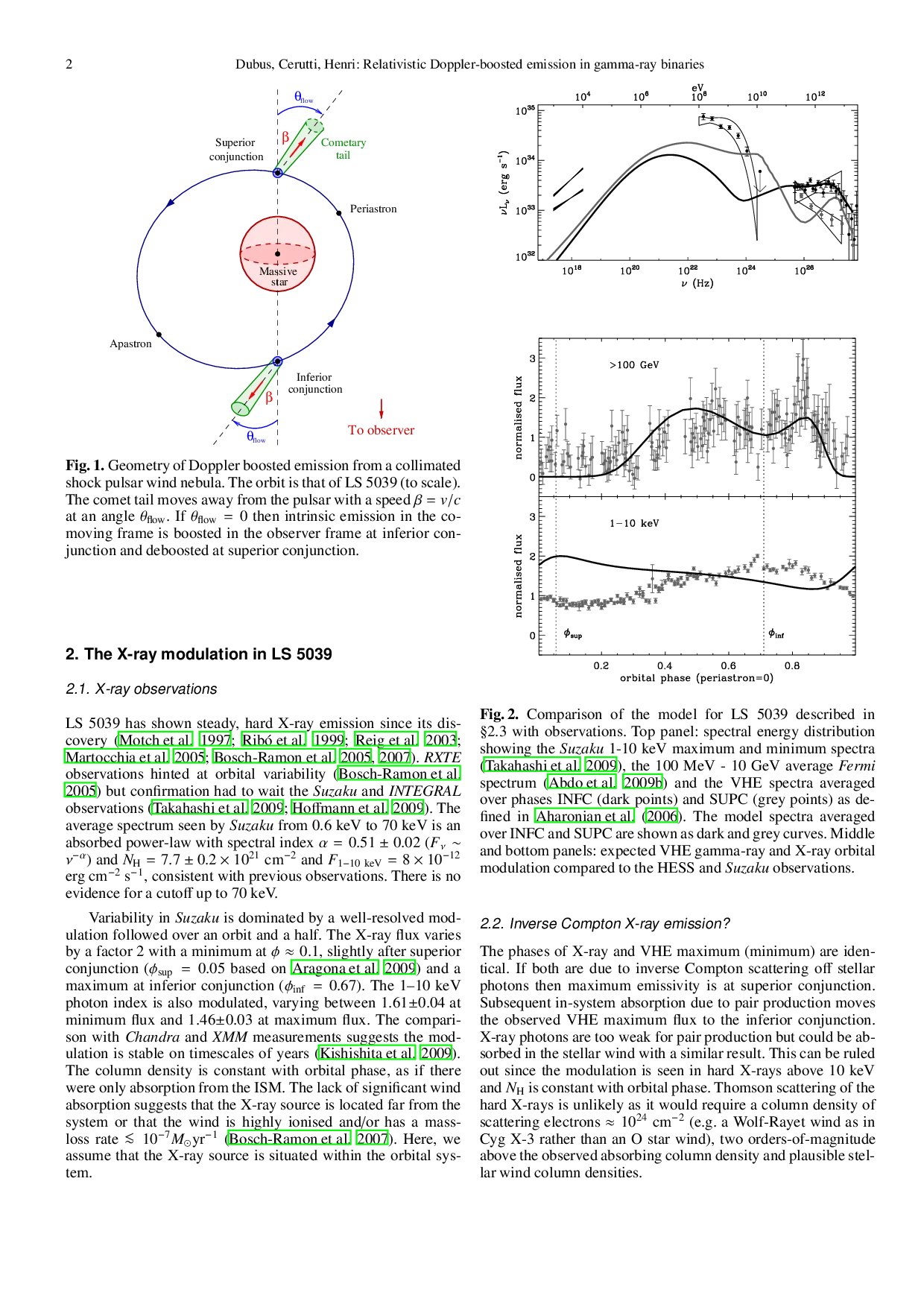
source. Suzaku and INTEGRAL observations of LS 5039 have
revealed a stable modulation of the X-ray flux (Takahashi et al.
2009; Hoffmann et al. 2009). Possible interpretations are dis-
cussed in §2. None are satisfying. The key point is that the X-
ray flux is maximum and minimum at conjunctions and that this
excludes any explanation unrelated to the system’s geometry as
seen by the observer.
In the pulsar wind scenario, the synchrotron emission is
expected to arise in shocked pulsar wind material collimated
by the stellar wind. This creates a cometary tail with a mildly
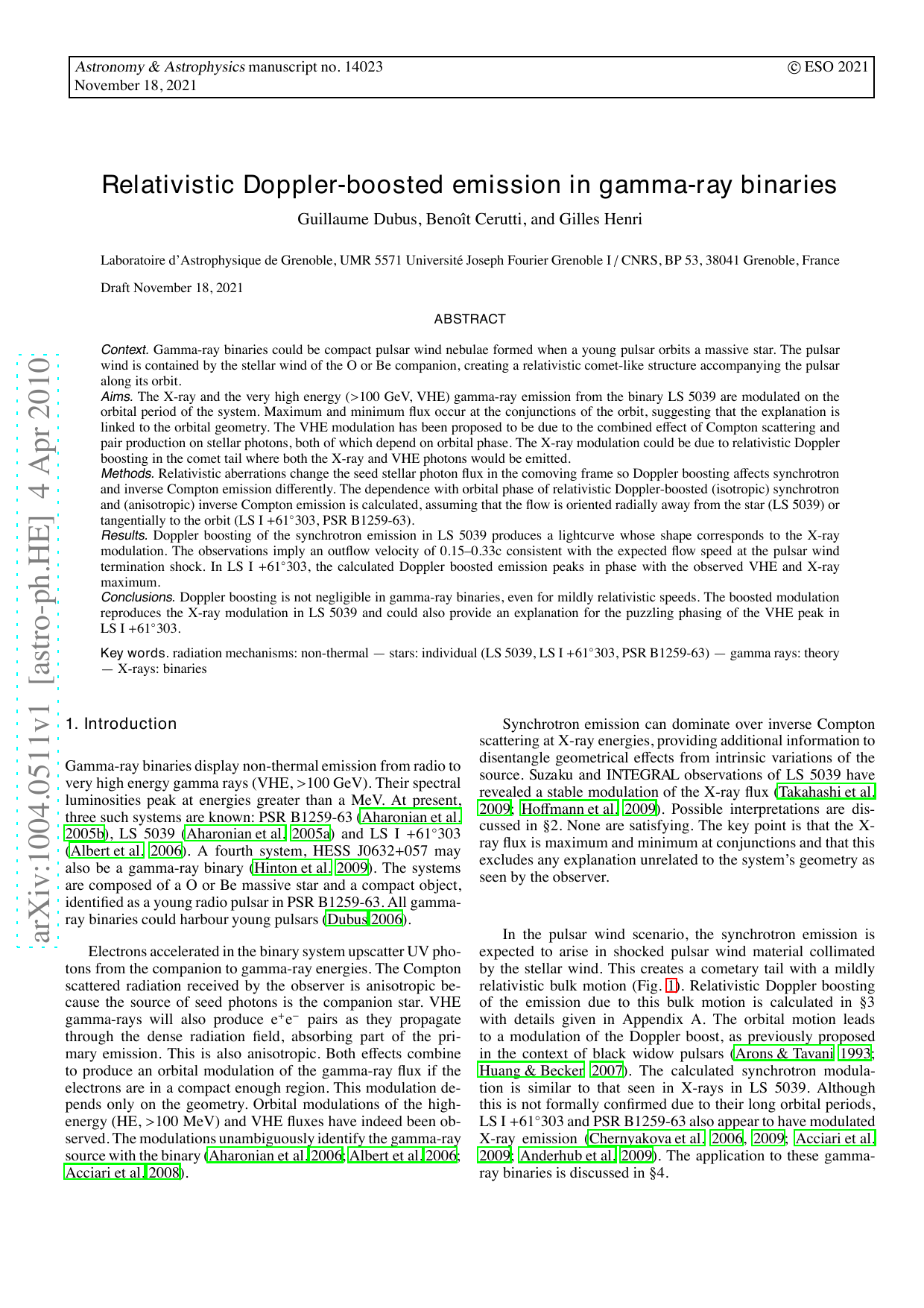
relativistic bulk motion (Fig. 1). Relativistic Doppler boosting
of the emission due to this bulk motion is calculated in §3
with details given in Appendix A. The orbital motion leads
to a modulation of the Doppler boost, as previously proposed
in the context of black widow pulsars (Arons & Tavani 1993;
Hu
…(Full text truncated)…
📸 Image Gallery
Reference
This content is AI-processed based on ArXiv data.