📝 Original Info
- Title: Is GRB afterglow emission intrinsically anisotropic ?
- ArXiv ID: 1003.1265
- Date: 2015-05-18
- Authors: ** A. M. Beloborodov, F. Daigne, R. Mochkovitch, Z. L. Uhm **
📝 Abstract
The curvature of a relativistic blast wave implies that its emission arrives to observers with a spread in time. This effect is believed to wash out fast variability in the lightcurves of GRB afterglows. We note that the spreading effect is reduced if emission is anisotropic in the rest-frame of the blast wave (i.e. if emission is limb-brightened or limb-darkened). In particular, synchrotron emission is almost certainly anisotropic, and may be strongly anisotropic, depending on details of electron acceleration in the blast wave. Anisotropic afterglows can display fast and strong variability at high frequencies (above the 'fast-cooling' frequency). This may explain the existence of bizarre features in the X-ray afterglows of GRBs, such as sudden drops and flares. We also note that a moderate anisotropy can significantly delay the 'jet break' in the lightcurve, which makes it harder to detect.
💡 Deep Analysis
Deep Dive into Is GRB afterglow emission intrinsically anisotropic ?.
The curvature of a relativistic blast wave implies that its emission arrives to observers with a spread in time. This effect is believed to wash out fast variability in the lightcurves of GRB afterglows. We note that the spreading effect is reduced if emission is anisotropic in the rest-frame of the blast wave (i.e. if emission is limb-brightened or limb-darkened). In particular, synchrotron emission is almost certainly anisotropic, and may be strongly anisotropic, depending on details of electron acceleration in the blast wave. Anisotropic afterglows can display fast and strong variability at high frequencies (above the ‘fast-cooling’ frequency). This may explain the existence of bizarre features in the X-ray afterglows of GRBs, such as sudden drops and flares. We also note that a moderate anisotropy can significantly delay the ‘jet break’ in the lightcurve, which makes it harder to detect.
📄 Full Content
arXiv:1003.1265v3 [astro-ph.HE] 10 Sep 2010
Mon. Not. R. Astron. Soc. 000, 000–000 (0000)
Printed 14 November 2018
(MN LATEX style file v2.2)
Is GRB afterglow emission intrinsically anisotropic?
A. M. Beloborodov1⋆, F. Daigne2†, R. Mochkovitch2 and Z. L. Uhm3
1Physics Department and Columbia Astrophysics Laboratory, Columbia University, New York, NY 10027, USA
2Institut d’Astrophysique de Paris, UMR 7095 Universit´e Pierre et Marie Curie-Paris 6 - CNRS,
98 bis, boulevard Arago, 75014 Paris, France
3Institute for the Early Universe and Research Center of MEMS Space Telescope,
Ewha Womans University, Seoul 120-750, South Korea
e-mail: amb@phys.columbia.edu ; daigne@iap.fr ; mochko@iap.fr ; z.lucas.uhm@gmail.com.
14 November 2018
ABSTRACT
The curvature of a relativistic blast wave implies that its emission arrives to
observers with a spread in time. This effect is believed to wash out fast vari-
ability in the light curves of GRB afterglows. We note that the spreading effect
is reduced if emission is anisotropic in the rest-frame of the blast wave (i.e.
if emission is limb-brightened or limb-darkened). In particular, synchrotron
emission is almost certainly anisotropic, and may be strongly anisotropic,
depending on details of electron acceleration in the blast wave. Anisotropic
afterglows can display fast and strong variability at high frequencies (above
the ‘fast-cooling’ frequency). This may explain the existence of bizarre fea-
tures in the X-ray afterglows of GRBs, such as sudden drops and flares. We
also note that a moderate anisotropy can significantly delay the ‘jet break’ in
the light curve, which makes it harder to detect.
Key words:
gamma ray: bursts; shock waves; radiation mechanisms: non-
thermal
1
INTRODUCTION
GRB afterglows are likely produced by relativistic blast waves propagating from the center
of the explosion. This model is, however, challenged by recent observations. In particular,
⋆Also at Astro-Space Center of Lebedev Physical Institute, Profsojuznaja 84/32, Moscow 117810, Russia
† Institut Universitaire de France
2
the Swift satellite revealed several puzzling features in the X-ray afterglow. It observed an
early plateau stage and flares with fast rise and decay times (Nousek et al. 2006; Burrows
et al. 2005). Less frequent but even more bizarre are sudden drops in the X-ray light curve
(as steep as t−10 in GRB 070110, Troja et al. 2007). These behaviors are inconsistent with
the standard model of afterglow production.
Can the emission from the forward or reverse shock of the blast wave show strong vari-
ations on timescales ∆t ≪t? It is usually argued that this is impossible: the spherical
curvature of the emitting surface (of radius R and Lorentz factor Γ) implies a spread in
arrival times of its emission, which washes out variability on timescales shorter than
τ =
R
2cΓ2.
(1)
For a relativistic blast wave, this duration is comparable to the observed time passed since the
beginning of the explosion, τ ∼t. This appears to prohibit any rapid and strong variations
in the light curve (see Ioka et al. 2005 for discussion).
Therefore, the observed fast variability in afterglows is usually associated with additional
emission from radii much smaller than the blast-wave radius. This model invokes a late
activity of the central engine (Zhang et al. 2006). The material ejected at large t and emitting
at radii R ≪Γ2tc will have τ ≪t and can produce flares with ∆t ≪t. Note however that
(i) it is unclear in this model why the observed flares have the approximately universal
∆t/t ∼0.1 (Chincarini et al. 2007; Lazzati & Perna 2007), (ii) the very steep drops at the
end of some plateaus can hardly be explained by this model unless it assumes that the entire
plateau is produced at small radii inside the ejecta and the emission from the blast wave is
negligible (Kumar, Narayan & Johnson 2008).
Another difficulty for GRB theory is that many afterglows lack the predicted ‘jet breaks’
(Burrows & Racusin 2006; Sato et al. 2007): only a small fraction of afterglow light curves
show a clear achromatic break that is expected from jets (Willingale et al. 2007).1 Some
bursts show X-ray light curves extending for tens to hundreds of days with a constant
temporal slope (Grupe et al. 2007). The interpretation of these observations is difficult and
often leads one to assume large jet opening angles, implying in some cases extremely high
energy for the explosion (Shady et al. 2007).
An implicit assumption in the general discussion of these puzzling features is that the
emission is isotropic in the rest frame of the relativistically moving source (however, see
1 Many afterglows show chromatic breaks, which occur either in the X-ray or in the optical, but not in both bands.
3
Lyutikov 2006). In this paper, we discuss the effects of a possible anisotropy and suggest
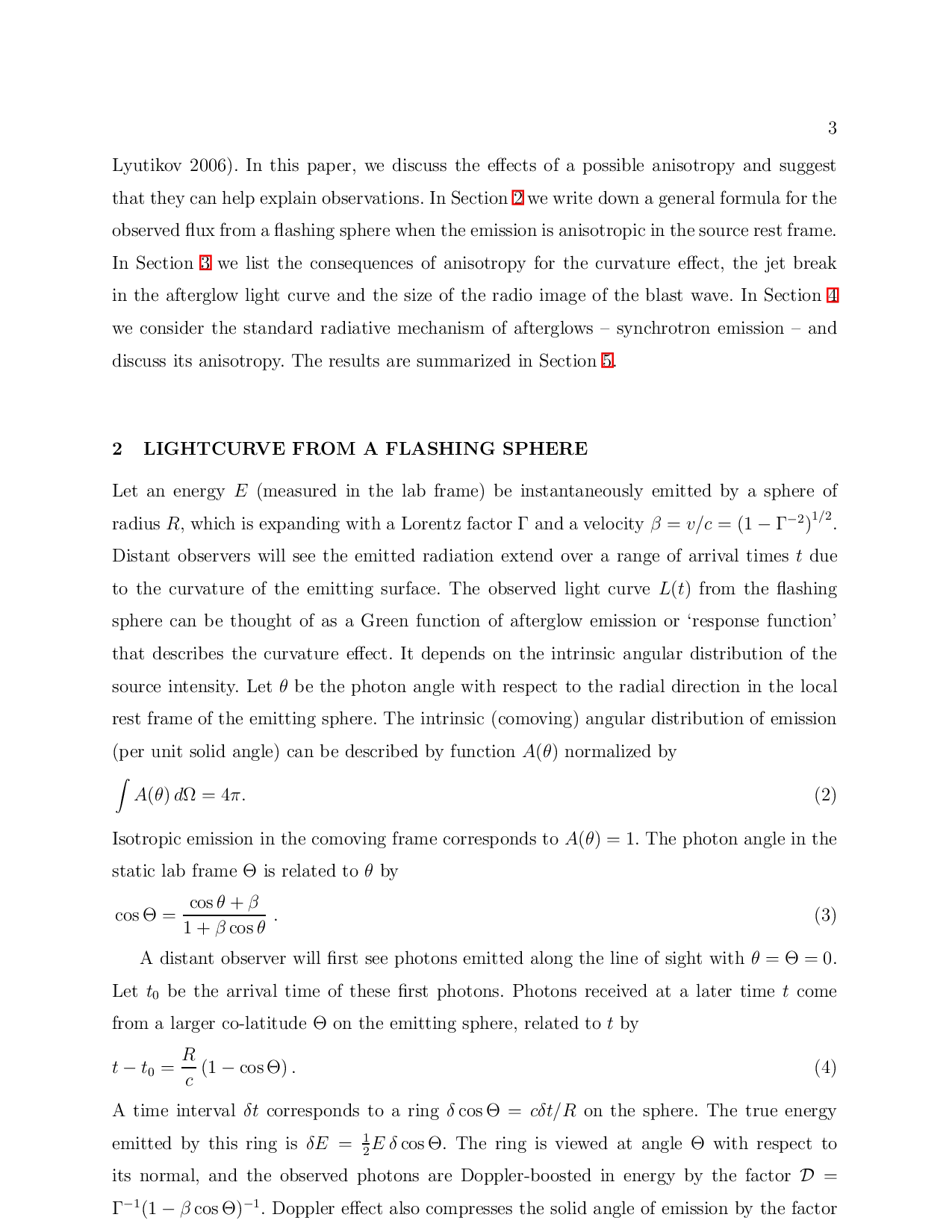
that they can help explain observations. In Section 2 we write down a general formula for the
observed flux from a flashing sphere when the emission is anisotropic in th
…(Full text truncated)…
📸 Image Gallery
Reference
This content is AI-processed based on ArXiv data.