Behavior of Quillen (co)homology with respect to adjunctions
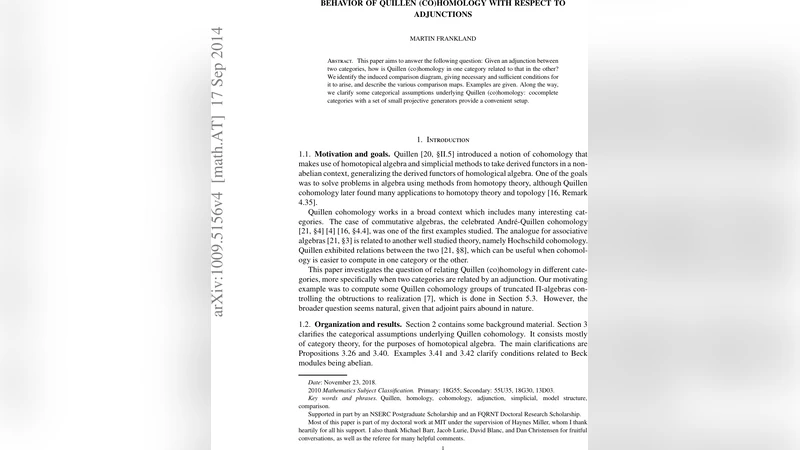
This paper aims to answer the following question: Given an adjunction between two categories, how is Quillen (co)homology in one category related to that in the other? We identify the induced comparison diagram, giving necessary and sufficient conditions for it to arise, and describe the various comparison maps. Examples are given. Along the way, we clarify some categorical assumptions underlying Quillen (co)homology: cocomplete categories with a set of small projective generators provide a convenient setup.
💡 Research Summary
The paper investigates how Quillen (co)homology behaves under an adjunction between two categories. After setting the stage with a convenient categorical framework—cocomplete categories equipped with a set of small projective generators—the author systematically derives comparison maps between the (co)homology theories of the source and target categories.
First, the author recalls the definition of Quillen (co)homology in a model category and emphasizes that the existence of enough projective (or injective) generators allows every object to be replaced by a cofibrant or fibrant model built from free or co‑free constructions. This replacement is crucial for defining derived functors and for ensuring that homology and cohomology groups are well behaved.
The core of the work focuses on an adjunction (F \dashv G : \mathcal{C} \leftrightarrows \mathcal{D}). The paper distinguishes two scenarios: (i) when the adjunction is a Quillen adjunction—i.e., (F) preserves cofibrations and trivial cofibrations while (G) preserves fibrations and trivial fibrations—and (ii) when the adjunction does not satisfy the full Quillen axioms but still interacts nicely with the chosen projective generators. In the Quillen case, the author constructs natural derived comparison maps
\
Comments & Academic Discussion
Loading comments...
Leave a Comment