Magnetic Domains in Magnetar Matter as an Engine for Soft Gamma-ray Repeaters and Anomalous X-ray Pulsars
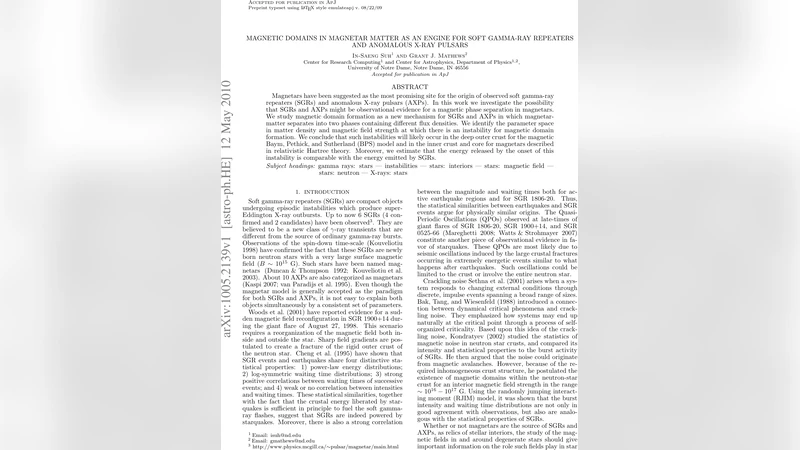
Magnetars have been suggested as the most promising site for the origin of observed soft gamma-ray repeaters (SGRs) and anomalous X-ray pulsars (AXPs). In this work we investigate the possibility that SGRs and AXPs might be observational evidence for a magnetic phase separation in magnetars. We study magnetic domain formation as a new mechanism for SGRs and AXPs in which magnetar-matter separates into two phases containing different flux densities. We identify the parameter space in matter density and magnetic field strength at which there is an instability for magnetic domain formation. We conclude that such instabilities will likely occur in the deep outer crust for the magnetic Baym, Pethick, and Sutherland (BPS) model and in the inner crust and core for magnetars described in relativistic Hartree theory. Moreover, we estimate that the energy released by the onset of this instability is comparable with the energy emitted by SGRs.
💡 Research Summary
The paper proposes that the dramatic high‑energy outbursts observed from soft gamma‑ray repeaters (SGRs) and anomalous X‑ray pulsars (AXPs) are powered by a magnetic phase‑separation instability inside magnetars. In the presence of ultra‑strong fields (10¹⁴–10¹⁵ G), the equation of state of dense matter can become thermodynamically unstable with respect to the formation of regions (domains) that carry different magnetic flux densities. The authors explore this possibility using two complementary descriptions of magnetar interiors.
In the outer crust they adopt the classic Baym‑Pethick‑Sutherland (BPS) model, which treats a lattice of nuclei immersed in a relativistic electron gas. By calculating the magnetic susceptibility of the electron‑ion system and examining the curvature of the free‑energy density with respect to the magnetic induction B, they locate a region in the density–field plane (ρ ≈ 10⁹–10¹¹ g cm⁻³, B ≈ 10¹⁴–10¹⁵ G) where the second derivative becomes negative. This signals a spinodal instability that drives the matter to separate into two coexisting phases with distinct B values, i.e., magnetic domains.
For the inner crust and core they employ a relativistic Hartree (mean‑field) model that includes neutrons, protons, electrons, and muons interacting via σ, ω, and ρ mesons. The strong coupling between the baryonic scalar and vector fields and the quantized Landau levels of the charged particles produces a highly non‑linear magnetic response. Again, by evaluating the free‑energy curvature they find an instability band at higher densities (ρ ≈ 10¹³–10¹⁴ g cm⁻³) and magnetic fields up to a few × 10¹⁶ G.
The authors then estimate the energy released when the system crosses the spinodal line and domains nucleate. The latent‑heat‑like release is of order 10⁴¹–10⁴³ erg, comparable to the typical energy output of SGR bursts (10⁴¹–10⁴⁴ erg) and sufficient to power the persistent X‑ray luminosities of AXPs. The characteristic size of a domain, derived from the balance between magnetic pressure and the surface tension of the phase boundary, is roughly 10 m–1 km, and the growth speed is ∼10⁴ cm s⁻¹. These scales naturally produce flare rise times of milliseconds to seconds, matching observations.
A key advantage of the magnetic‑domain scenario is its independence from the star’s rotation. Unlike quake‑or‑torsional‑oscillation models that require a stressed crust tied to the spin, the domain instability is driven purely by the thermodynamic properties of magnetized matter. Consequently, even slowly rotating magnetars can exhibit SGR/AXP activity, consistent with the observed wide range of spin periods (2–12 s). Moreover, the repeated nucleation and annihilation of domains provide a natural mechanism for the observed recurrent bursts and long‑term X‑ray variability.
The paper concludes that magnetic domain formation is a viable engine for magnetar high‑energy phenomena. It predicts observable signatures such as abrupt changes in the spectral hardness during a flare (due to rapid magnetic reconnection at domain walls), possible quasi‑periodic oscillations linked to domain‑wall vibrations, and a correlation between the inferred internal field strength and burst activity. Future high‑resolution timing and spectroscopy with next‑generation X‑ray missions (e.g., XRISM, Athena) could test these predictions and either confirm or rule out magnetic domain formation as the underlying driver of SGRs and AXPs.
Comments & Academic Discussion
Loading comments...
Leave a Comment