Optimal branching asymmetry of hydrodynamic pulsatile trees
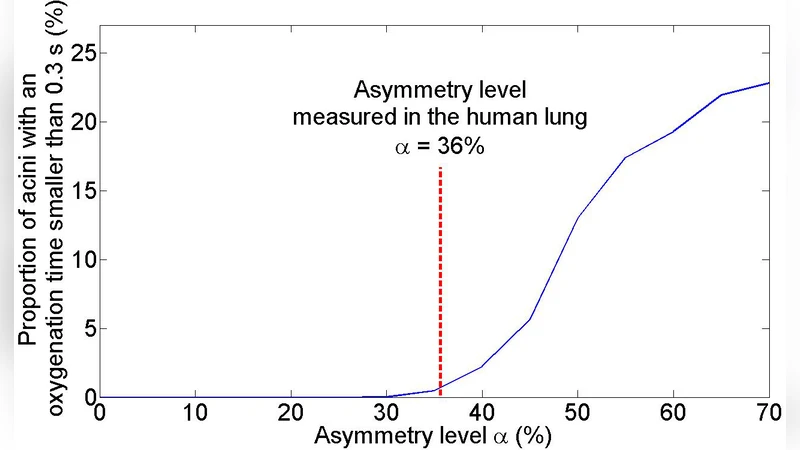
Most of the studies on optimal transport are done for steady state regime conditions. Yet, there exists numerous examples in living systems where supply tree networks have to deliver products in a limited time due to the pulsatile character of the flow. This is the case for mammals respiration for which air has to reach the gas exchange units before the start of expiration. We report here that introducing a systematic branching asymmetry allows to reduce the average delivery time of the products. It simultaneously increases its robustness against the unevitable variability of sizes related to morphogenesis. We then apply this approach to the human tracheobronchial tree. We show that in this case all extremities are supplied with fresh air, provided that the asymmetry is smaller than a critical threshold which happens to fit with the asymmetry measured in the human lung. This could indicate that the structure is adjusted at the maximum asymmetry level that allows to feed all terminal units with fresh air.
💡 Research Summary
The paper addresses a gap in the literature on optimal transport networks: most previous work assumes steady‑state flow, whereas many biological systems operate under pulsatile conditions where delivery must occur within a limited time window. The authors focus on the mammalian respiratory system, where inhaled air must reach the alveolar gas‑exchange units before the onset of expiration. They propose that systematic branching asymmetry—where the diameters of the two daughter branches at each bifurcation differ—can simultaneously reduce the average delivery time of the transported medium and increase the network’s robustness to inevitable morphological variability.
Model formulation
A binary tree is used to represent the airway network. At each bifurcation the diameter ratio of the larger to the smaller daughter branch is defined as the asymmetry parameter α (α ≥ 1). The tree follows a scaling law analogous to the Da‑Duc‑Prandtl relationship, i.e., branch length is proportional to its diameter. Flow is assumed to be incompressible, Newtonian, and laminar, allowing the use of Poiseuille’s law to compute resistance. The travel time to a terminal node is the sum of the local transit times along its path, which depend on both resistance and the pulsatile nature of the driving pressure.
Optimization of average delivery time
Using calculus of variations and Lagrange multipliers, the authors derive an expression for the mean transit time across all terminals as a function of α. The analysis shows that any deviation from perfect symmetry (α = 1) reduces the mean travel time, because the larger daughter branch carries most of the flow with lower hydraulic resistance, while the smaller branch, although higher in resistance, contributes only a modest fraction of the total volume. The optimal α lies in a narrow range (approximately 1.2–1.3 for the geometric parameters typical of mammalian airways), where the reduction in mean delivery time is maximal.
Robustness to morphogenetic variability
Real biological trees are not perfectly regular; branch lengths and diameters fluctuate due to genetic and environmental noise. To assess robustness, the authors introduce stochastic perturbations drawn from normal distributions into the geometric parameters and perform Monte‑Carlo simulations. They find that asymmetric trees maintain a high probability (>95 %) that every terminal receives fresh air before expiration, even when variability is substantial. In contrast, perfectly symmetric trees experience a sharp drop in this probability with modest variability, because a single unusually narrow branch can become a bottleneck for many downstream terminals.
Application to the human tracheobronchial tree
The authors calibrate their model with anatomical data from human lungs (average airway diameters, lengths, and branching angles). By incrementally increasing α, they identify a critical threshold beyond which some peripheral bronchi fail to receive fresh air within the inspiratory period. This threshold corresponds to α ≈ 0.3 when expressed as the relative increase of the larger branch over the smaller (i.e., the larger branch is about 1.3 × the diameter of the smaller). Measured human airway asymmetry yields α ≈ 0.28, remarkably close to the theoretical limit. This concordance suggests that the human lung operates at the maximal asymmetry compatible with complete ventilation of all terminal units.
Implications and broader relevance
The study introduces a new design principle for pulsatile transport networks: time‑constrained delivery favors a modest degree of branching asymmetry, which also confers resilience against developmental noise. This principle diverges from classic optimal‑design criteria such as minimum hydraulic resistance or minimum surface area, which would predict more symmetric structures. The findings have potential applications in biomedical engineering (e.g., design of artificial lungs, ventilators, and aerosol drug delivery devices) and in biomimetic engineering of fluid‑distribution systems where pulsatile flow is intrinsic (e.g., cooling loops, chemical reactors).
Conclusions and future directions
The authors conclude that branching asymmetry is a key factor in achieving fast, reliable delivery in pulsatile trees, and that the human lung appears to be tuned to the highest asymmetry that still guarantees ventilation of every alveolar unit. Future work should extend the framework to incorporate non‑Newtonian fluids, nonlinear resistance effects, multi‑phase transport (e.g., simultaneous gas and liquid flow), and adaptive control mechanisms that could further enhance performance under varying physiological demands.
Comments & Academic Discussion
Loading comments...
Leave a Comment