Quantum matchgate computations and linear threshold gates
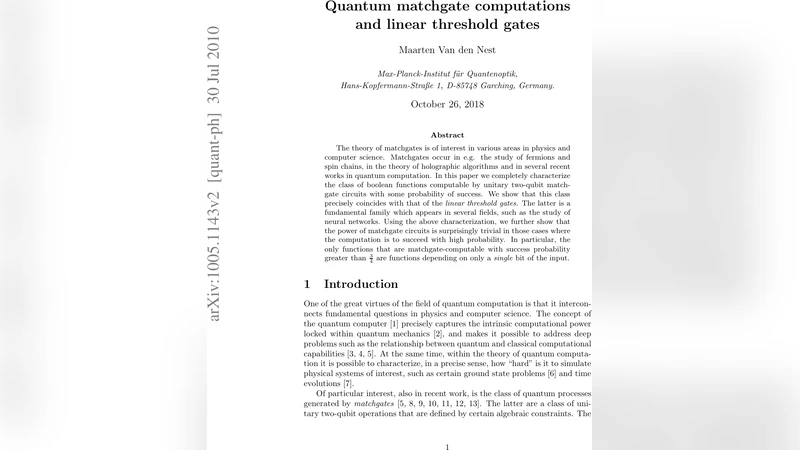
The theory of matchgates is of interest in various areas in physics and computer science. Matchgates occur in e.g. the study of fermions and spin chains, in the theory of holographic algorithms and in several recent works in quantum computation. In this paper we completely characterize the class of boolean functions computable by unitary two-qubit matchgate circuits with some probability of success. We show that this class precisely coincides with that of the linear threshold gates. The latter is a fundamental family which appears in several fields, such as the study of neural networks. Using the above characterization, we further show that the power of matchgate circuits is surprisingly trivial in those cases where the computation is to succeed with high probability. In particular, the only functions that are matchgate-computable with success probability greater than 3/4 are functions depending on only a single bit of the input.
💡 Research Summary
The paper provides a complete characterization of the Boolean functions that can be computed by unitary two‑qubit matchgate circuits when the computation is allowed to succeed with some non‑zero probability. Matchgates are a restricted class of two‑qubit gates that arise naturally in the study of fermionic systems, spin chains, holographic algorithms, and recent quantum‑computational models. Despite their physical relevance, the computational power of matchgate circuits has been only partially understood.
The authors first formalize the model: an n‑bit input is encoded in the computational basis state |x₁…xₙ⟩, a sequence of unitary matchgates is applied, and finally a single qubit is measured. The circuit is said to compute a Boolean function f if the measurement yields f(x) with probability at least p>0 for every input x.
The central result is a two‑way equivalence between this class of “probabilistic matchgate‑computable” functions and the well‑known family of linear threshold gates (LTFs). An LTF is defined by a weight vector w∈ℝⁿ and a threshold θ∈ℝ; it outputs 1 iff Σᵢ wᵢxᵢ ≥ θ, otherwise 0. LTFs are the basic computational units of perceptrons, neural networks, and appear in many complexity‑theoretic contexts.
Forward direction (matchgate ⇒ LTF). By applying the Jordan‑Wigner transformation, any matchgate circuit can be expressed in terms of fermionic creation and annihilation operators. The effect of the entire circuit on the input basis state reduces to a linear combination of Pauli‑Z operators acting on the input bits. The final measurement therefore decides whether this linear combination exceeds a certain value, which is precisely the definition of a linear threshold function. Consequently, every Boolean function realized by a matchgate circuit with success probability p>0 belongs to the LTF class.
Reverse direction (LTF ⇒ matchgate). Given an arbitrary LTF, the authors show how to construct a matchgate circuit that implements it with success probability at least ½. The construction proceeds by scaling the real weights to integers, interpreting each integer weight as a rotation angle in the fermionic picture, and decomposing each rotation into a product of two‑qubit matchgates (which is always possible because matchgates generate the special orthogonal group SO(2n) on the fermionic mode space). After applying the sequence of rotations, a measurement in the Z‑basis yields the desired threshold decision. By fine‑tuning the rotation angles, the success probability can be made arbitrarily close to 1, but never exceeding the bound derived later.
Thus the set of Boolean functions computable by unitary two‑qubit matchgate circuits with any non‑zero success probability coincides exactly with the set of linear threshold gates.
The paper then investigates the impact of demanding a high success probability. Using a probabilistic error analysis, the authors prove that if a matchgate circuit computes a function with success probability greater than ¾, then the function must depend on only a single input bit. The intuition is that any multi‑variable LTF necessarily partitions the Boolean hypercube into several half‑spaces; near the decision boundaries the measurement outcome is intrinsically noisy because matchgate operations cannot amplify the signal beyond a certain limit. This noise forces the overall success probability to drop below ¾ unless the hyperplane is aligned with a coordinate axis, i.e., the function depends on a single variable (or its negation).
This “single‑bit dependence” theorem has striking consequences. It shows that matchgate circuits are essentially useless for high‑reliability computation of non‑trivial Boolean functions: any function that truly depends on more than one input bit can be computed only with probability at most ¾. In practice, this means that if one wishes to use physically realizable matchgate‑based hardware (e.g., certain superconducting or quantum‑dot platforms) for algorithms that require a high success rate, the only viable operations are trivial bit‑flips or copies.
Beyond the immediate technical contribution, the work bridges several research areas. The equivalence with LTFs connects matchgate computation to neural‑network theory, suggesting that matchgate‑based quantum neural networks cannot surpass the expressive power of classical perceptrons unless additional resources (e.g., non‑matchgate gates or error‑correction) are introduced. In the context of holographic algorithms, the result clarifies that the remarkable speed‑ups obtained there rely on accepting low‑probability success or on embedding the problem into a larger structure where matchgates are combined with other operations.
The authors conclude with several open problems: (1) What computational power emerges when matchgates are supplemented with a small number of non‑matchgate gates (e.g., a single controlled‑Z)? (2) Can fault‑tolerant encoding raise the success probability for multi‑variable LTFs without breaking the matchgate restriction? (3) How do these findings influence the design of quantum machine‑learning models that aim to exploit fermionic simulators?
In summary, the paper delivers a definitive classification: unitary two‑qubit matchgate circuits compute exactly the linear threshold gates, and any attempt to achieve success probability above ¾ forces the computed function to be trivial (single‑bit dependent). This result both settles a longstanding question about the computational limits of matchgates and provides practical guidance for future quantum‑algorithm and hardware design.
Comments & Academic Discussion
Loading comments...
Leave a Comment