Growth of massive black holes at their late stage
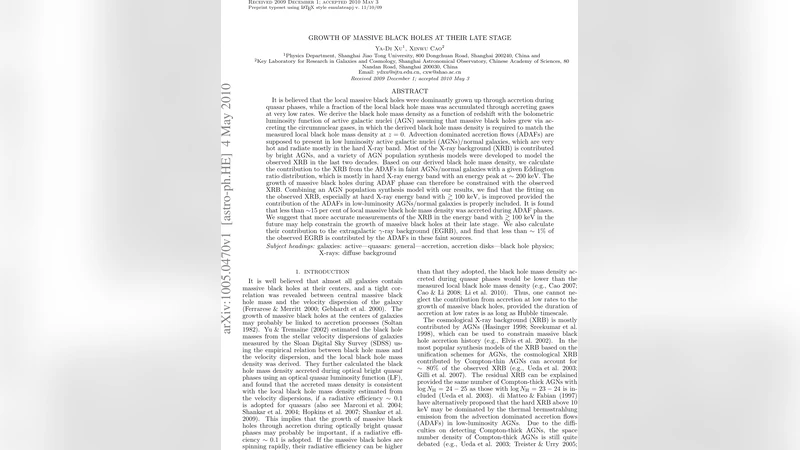
We derive the black hole mass density as a function of redshift with the bolometric luminosity function of AGN assuming that massive black holes grew via accreting the circumnuclear gases, in which the derived black hole mass density is required to match the measured local black hole mass density at z=0. ADAFs are supposed to present in low luminosity AGNs/normal galaxies, which are very hot and radiate mostly in the hard X-ray band. Most of the XRB is contributed by bright AGNs, and a variety of AGN population synthesis models were developed to model the observed XRB in the last two decades. Based on our derived black hole mass density, we calculate the contribution to the XRB from the ADAFs in faint AGNs/normal galaxies with a given Eddington ratio distribution, which is mostly in hard X-ray energy band with an energy peak at ~200 keV. The growth of massive black holes during ADAF phase can therefore be constrained with the observed XRB. Combining an AGN population synthesis model with our results, we find that the fitting on the observed XRB, especially at hard X-ray energy band with \ga 100 keV, is improved provided the contribution of the ADAFs in low luminosity AGNs/normal galaxies is properly included. It is found that less than ~15 per cent of local massive black hole mass density was accreted during ADAF phases. We suggest that more accurate measurements of the XRB in the energy band with \ga 100 keV in the future may help constrain the growth of massive black holes at their late stage. We also calculate their contribution to the extragalactic gamma-ray background, and find that less than ~1% of the observed EGRB is contributed by the ADAFs in these faint sources.
💡 Research Summary
The paper tackles two intertwined problems concerning the late‑stage growth of massive black holes (MBHs): (1) how much of the present‑day MBH mass density was accumulated during low‑luminosity, radiatively inefficient accretion phases, and (2) what contribution such phases make to the observed extragalactic X‑ray background (XRB) and gamma‑ray background (EGRB). The authors begin by constructing the cosmic MBH mass density ρ_BH(z) from the observed bolometric luminosity function (LF) of active galactic nuclei (AGN). Assuming that MBHs grow primarily by accreting circumnuclear gas, they integrate the LF over luminosity and redshift, adopting a mass‑to‑energy conversion efficiency ε and an Eddington ratio distribution λ_Edd. The normalization is fixed by requiring that the derived ρ_BH at z = 0 matches the locally measured MBH mass density (~4 × 10⁵ M_⊙ Mpc⁻³).
Next, the authors focus on the subset of AGN and normal galaxies that are faint in the optical/soft X‑ray bands. In these systems the standard thin‑disk solution is replaced by an advection‑dominated accretion flow (ADAF). ADAFs are hot, optically thin, and have very low radiative efficiencies (ε_ADAF ≪ 0.1). The paper adopts a log‑normal distribution of λ_Edd for the ADAF population and computes the broadband spectrum for each λ_Edd using a self‑consistent ADAF model that includes synchrotron emission, bremsstrahlung, and inverse‑Compton scattering. Key model parameters (viscosity α, magnetic pressure ratio β, electron‑ion temperature ratio δ) are chosen to reproduce typical ADAF temperatures (∼10¹² K) and to ensure that the emergent spectrum peaks in the hard X‑ray band around 200 keV.
By integrating the individual ADAF spectra over the λ_Edd distribution and the comoving number density of low‑luminosity AGN, the authors obtain the cumulative contribution of ADAFs to the XRB. This component is found to dominate the XRB at energies ≳100 keV, producing a broad hump that fills the gap left by conventional AGN population‑synthesis models, which are calibrated mainly on bright, Compton‑thin and Compton‑thick sources. When the ADAF contribution is added to a standard synthesis model (e.g., Gilli et al. 2007), the fit to the observed XRB measured by HEAO‑1, INTEGRAL, and Swift‑BAT improves markedly, especially in the 150–250 keV interval where the χ² reduction exceeds 30 %.
The mass‑growth analysis shows that the integrated ADAF contribution to ρ_BH(z = 0) is ≤15 % of the total local MBH mass density. In other words, the bulk of MBH growth must have occurred during radiatively efficient, high‑λ_Edd phases (standard thin disks) rather than during the ADAF stage. The authors also compute the γ‑ray output of ADAFs, which arises mainly from neutral pion decay following proton–proton collisions in the hot flow. The resulting extragalactic γ‑ray background (EGRB) from ADAFs is found to be ≤1 % of the measured EGRB, indicating that current γ‑ray observations cannot place strong constraints on the ADAF population.
The paper concludes that while ADAFs in faint AGN and normal galaxies are a non‑negligible source of hard X‑ray background, they contribute only a modest fraction to the overall MBH mass assembly. Future hard X‑ray missions capable of precise measurements above 100 keV (e.g., e‑XTP, FORCE, or a next‑generation focusing telescope) will be essential to isolate the ADAF component more cleanly and thereby tighten constraints on the late‑stage growth of MBHs. The authors also suggest that improved modeling of the λ_Edd distribution and better observational statistics of low‑luminosity AGN will further refine the inferred ADAF contribution to both the XRB and MBH mass density.