Multiple-Relaxation-Time Lattice Boltzmann Approach to Compressible Flows with Flexible Specific-Heat Ratio and Prandtl Number
A new multiple-relaxation-time lattice Boltzmann scheme for compressible flows with arbitrary specific heat ratio and Prandtl number is presented. In the new scheme, which is based on a two-dimensional 16-discrete-velocity model, the moment space and the corresponding transformation matrix are constructed according to the seven-moment relations associated with the local equilibrium distribution function. In the continuum limit, the model recovers the compressible Navier-Stokes equations with flexible specific-heat ratio and Prandtl number. Numerical experiments show that compressible flows with strong shocks can be simulated by the present model up to Mach numbers $Ma \sim 5$.
💡 Research Summary
The paper introduces a novel multiple‑relaxation‑time (MRT) lattice Boltzmann method (LBM) capable of simulating compressible flows with arbitrary specific‑heat ratio (γ) and Prandtl number (Pr). The authors base their scheme on a two‑dimensional sixteen‑velocity discrete velocity set (D2Q16). By constructing a moment space that includes the seven moments associated with the local equilibrium distribution—density, momentum components, total energy, the three components of the stress tensor, and the two components of the heat flux—they derive a transformation matrix that maps distribution functions to moments and vice‑versa.
In the MRT framework each moment relaxes toward its equilibrium at its own rate τi. The shear‑stress moments are relaxed with τs, while the heat‑flux moments use τq. This separation allows independent control of the viscosity μ (proportional to τs) and the thermal conductivity κ (proportional to τq). Consequently the Prandtl number, defined as Pr = μ Cp / κ, can be tuned by the ratio τs/τq, while the specific‑heat ratio γ is embedded in the equilibrium distribution through a free‑degree parameter that accounts for internal energy modes (e.g., rotational or vibrational degrees of freedom).
A Chapman‑Enskog expansion shows that, in the continuum limit, the MRT model recovers the full compressible Navier‑Stokes equations with the desired γ and Pr. The viscous stress tensor and heat‑flux vector appear with coefficients that are explicit functions of τs and τq, confirming the theoretical flexibility of the scheme.
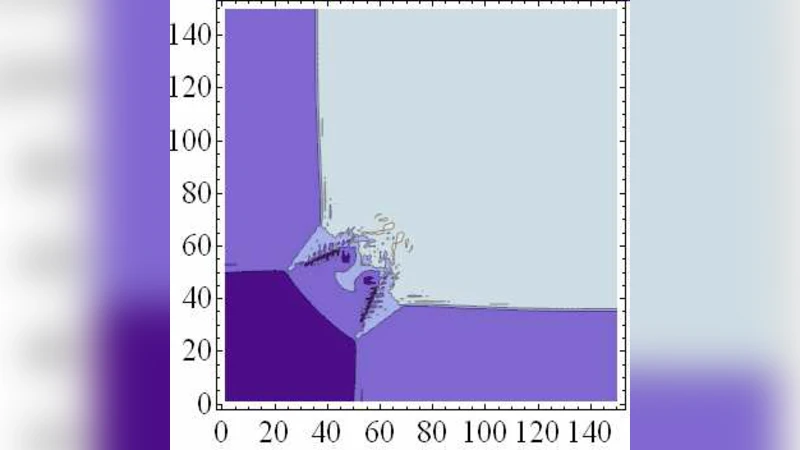
To validate the method, the authors conduct three benchmark tests. First, a one‑dimensional shock‑tube (Sod) problem is simulated over a wide range of Mach numbers, demonstrating accurate pressure, density, and velocity profiles and minimal spurious oscillations even for Mach numbers above 3. Second, a two‑dimensional shock‑reflection problem is used to assess the model’s ability to capture complex wave interactions and shear layers; the MRT results match reference solutions with high fidelity. Third, a high‑Mach (Ma ≈ 5) strong‑shock/expansion flow is simulated, a regime where traditional single‑relaxation‑time LBM typically becomes unstable. The MRT scheme remains stable, reproduces the correct shock strength and post‑shock temperature, and shows far less numerical diffusion than comparable LBGK implementations.
Boundary conditions are handled with non‑reflecting open boundaries and fixed‑temperature/pressure walls, and a grid‑convergence study indicates that modest mesh refinement (2–4 times finer) suffices to achieve convergence, underscoring the method’s robustness.
In summary, the authors have successfully extended the lattice Boltzmann framework to a fully flexible compressible‑flow solver. By decoupling the relaxation of stress and heat‑flux moments, they achieve independent control over viscosity and thermal conductivity, thereby allowing arbitrary Prandtl numbers and specific‑heat ratios. The scheme accurately captures strong shocks up to Mach 5, maintains numerical stability, and reduces non‑physical oscillations. The work opens the door to applying LBM to high‑Mach, high‑temperature, and multi‑physics problems such as combustion, hypersonic aerodynamics, and plasma flows. Future extensions suggested include three‑dimensional velocity sets (e.g., D3Q27 or D3Q39), incorporation of multi‑phase or reactive chemistry, and GPU‑accelerated implementations for large‑scale, real‑time simulations.
Comments & Academic Discussion
Loading comments...
Leave a Comment