Recursion operators, conservation laws and integrability conditions for difference equations
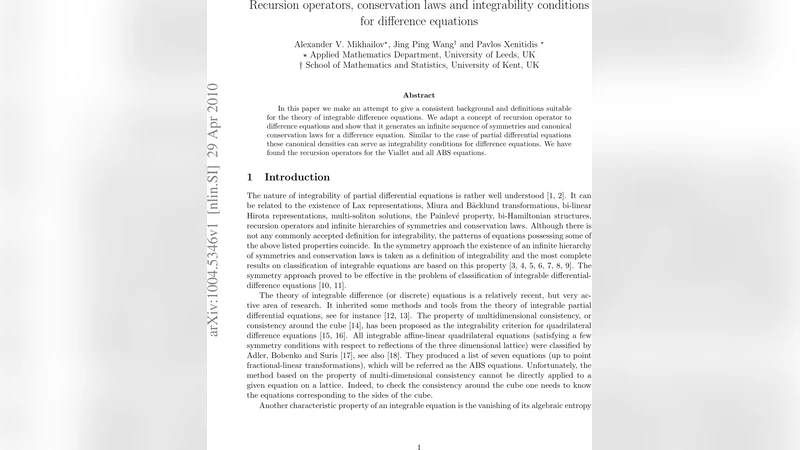
In this paper we make an attempt to give a consistent background and definitions suitable for the theory of integrable difference equations. We adapt a concept of recursion operator to difference equations and show that it generates an infinite sequence of symmetries and canonical conservation laws for a difference equation. Similar to the case of partial differential equations these canonical densities can serve as integrability conditions for difference equations. We have found the recursion operators for the Viallet and all ABS equations.
💡 Research Summary
The paper establishes a coherent theoretical framework for integrable difference equations by adapting the concept of a recursion operator—originally developed for continuous partial differential equations (PDEs)—to the discrete setting. The authors begin by reviewing the role of recursion operators in generating infinite hierarchies of symmetries and conservation laws for PDEs, then argue that a comparable structure is essential for assessing the integrability of lattice (difference) equations, which are defined on a multi‑dimensional grid and involve shift and difference operators rather than derivatives.
To overcome the lack of a natural inverse for discrete difference operators, the authors introduce a combined algebra of shift operators (T_i) (which translate the lattice in direction (i)) and forward/backward difference operators (\Delta_i). Within this algebra they define a linear difference operator (L) (essentially a sum of first‑order differences) and a nonlinear operator (N) that encodes the given difference equation. The recursion operator is then formally set as
\
Comments & Academic Discussion
Loading comments...
Leave a Comment