Exactly and quasi-exactly solvable `discrete quantum mechanics
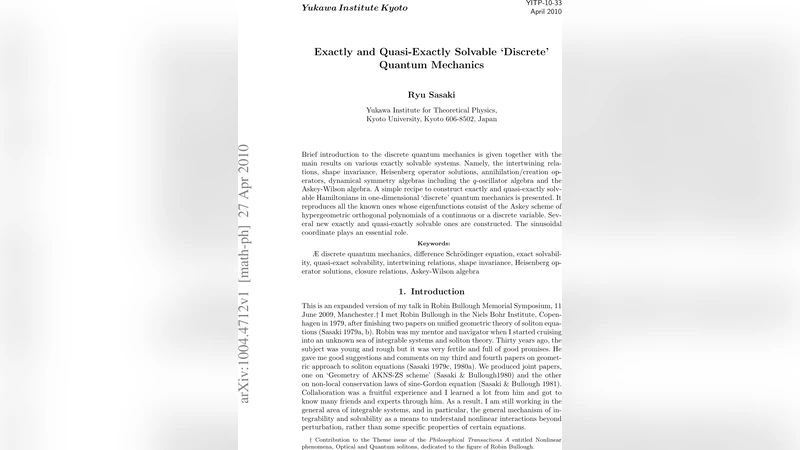
Brief introduction to the discrete quantum mechanics is given together with the main results on various exactly solvable systems. Namely, the intertwining relations, shape invariance, Heisenberg operator solutions, annihilation/creation operators, dynamical symmetry algebras including the $q$-oscillator algebra and the Askey-Wilson algebra. A simple recipe to construct exactly and quasi-exactly solvable Hamiltonians in one-dimensional `discrete’ quantum mechanics is presented. It reproduces all the known ones whose eigenfunctions consist of the Askey scheme of hypergeometric orthogonal polynomials of a continuous or a discrete variable. Several new exactly and quasi-exactly solvable ones are constructed. The sinusoidal coordinate plays an essential role.
💡 Research Summary
The paper provides a comprehensive treatment of discrete quantum mechanics (DQM), a formulation in which the kinetic term is represented by shift (difference) operators rather than differential operators. Starting from the basic construction, the authors introduce the factorisation of the Hamiltonian H into a pair of intertwining operators A and A†, satisfying H = A†A + ε0 and its partner Hamiltonian H̃ = AA† + ε0. This intertwining relation is the discrete analogue of supersymmetric quantum mechanics and serves as the foundation for the algebraic analysis that follows.
A central theme is the extension of shape invariance to the discrete setting. By defining a parameter map σ(λ) that relates the original Hamiltonian H(λ) to its partner H(σ(λ)), the authors derive the condition under which the entire spectrum can be generated recursively. When the shape‑invariance condition holds, the eigenfunctions are expressed in terms of orthogonal polynomials belonging to the Askey scheme (continuous and discrete families such as Hermite, Laguerre, Jacobi, Hahn, Meixner, Krawtchouk, q‑Racah, etc.). The paper shows that the shape‑invariance condition translates into a simple algebraic relation among the shift operators and the parameters, making the construction of exactly solvable models systematic.
The Heisenberg picture is treated in detail. By exponentiating the Hamiltonian in terms of the shift operators, the authors obtain exact operator solutions for the time evolution of observables. A key ingredient is the sinusoidal coordinate η(x), which satisfies a low‑order difference equation (typically quadratic) and linearises the dynamics. The commutation relations between η, its shift derivative Dη, and the ladder operators A, A† generate well‑known algebras: the q‑oscillator algebra (with a q‑deformed commutator) and the Askey–Wilson algebra (characterised by a cubic relation among the generators). These algebras encode the dynamical symmetry of the discrete models and provide a unified language for both exactly and quasi‑exactly solvable systems.
The authors present a general recipe for constructing Hamiltonians that are either exactly solvable (ES) or quasi‑exactly solvable (QES) in one dimension. The steps are: (1) choose an appropriate sinusoidal coordinate η; (2) define the forward and backward shift operators Dη and Dη⁻¹; (3) build A and A† as linear combinations of η and Dη (e.g., A = f(η)Dη + g(η)); (4) specify a parameter transformation σ that guarantees shape invariance; (5) set H = A†A. If the difference equation for η is of order two or less, the system is ES and its eigenfunctions are members of the Askey scheme. If the order is three or higher, only a finite part of the spectrum can be obtained algebraically, leading to a QES model. This construction reproduces all known exactly solvable DQM models and simultaneously yields new families.
Several new Hamiltonians are explicitly constructed. For instance, a Hamiltonian based on the q‑Racah polynomials is obtained by a particular choice of η and a non‑trivial σ, extending the Askey–Wilson model. Another example is a “dual‑q‑Krawtchouk” system, where the discrete variable appears in a dual fashion and the resulting algebraic structure still respects the q‑oscillator relations. In each case, the eigenfunctions are either known orthogonal polynomials (exact case) or a finite set of polynomial solutions (quasi‑exact case), confirming the power of the proposed method.
The paper concludes by emphasizing that DQM provides a natural bridge between quantum mechanics, orthogonal polynomial theory, and quantum algebras. The sinusoidal coordinate acts as a universal variable that linearises the dynamics and reveals the underlying algebraic symmetry. The authors suggest future directions such as extending the framework to multi‑particle systems, exploring non‑Hermitian or PT‑symmetric extensions, and applying the discrete models to quantum information tasks where finite‑dimensional Hilbert spaces are advantageous. Overall, the work unifies a broad class of exactly and quasi‑exactly solvable models under a single algebraic scheme, highlighting the central role of shape invariance, intertwining relations, and the Askey‑scheme polynomials in discrete quantum mechanics.
Comments & Academic Discussion
Loading comments...
Leave a Comment