Interdependent networks: Reducing the coupling strength leads to a change from a first to second order percolation transition
We study a system composed from two interdependent networks A and B, where a fraction of the nodes in network A depends on the nodes of network B and a fraction of the nodes in network B depends on the nodes of network A. Due to the coupling between the networks when nodes in one network fail they cause dependent nodes in the other network to also fail. This invokes an iterative cascade of failures in both networks. When a critical fraction of nodes fail the iterative process results in a percolation phase transition that completely fragments both networks. We show both analytically and numerically that reducing the coupling between the networks leads to a change from a first order percolation phase transition to a second order percolation transition at a critical point. The scaling of the percolation order parameter near the critical point is characterized by the critical exponent beta=1.
💡 Research Summary
The paper investigates the robustness of two mutually dependent networks, A and B, when a fraction of nodes in each network rely on nodes in the other. The authors model the interdependence through a coupling parameter (q) (0 ≤ (q) ≤ 1) that denotes the proportion of nodes that have a dependent counterpart in the opposite network. When a random fraction (p) of nodes fails, the failure propagates iteratively: a failed node in one network instantly disables its dependent node in the other, and after each cascade step the remaining functional nodes reorganize into a new giant component. The process repeats until no further nodes are removed, and the size of the final giant component, (P_{\infty}(p,q)), serves as the order parameter of the percolation transition.
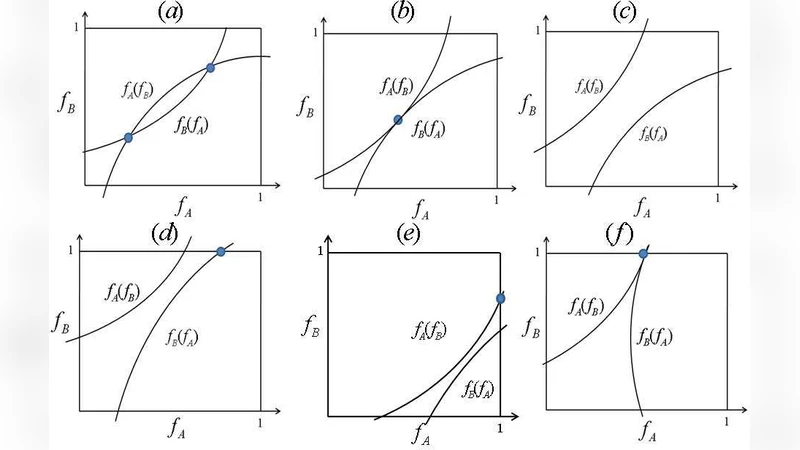
Using generating‑function formalism, the authors derive coupled self‑consistency equations for the survival probabilities of the two networks. Analytical treatment shows that for high coupling ((q) close to 1) the equations admit multiple fixed points, leading to a discontinuous (first‑order) transition: as (p) crosses a critical threshold (p_c), (P_{\infty}) drops abruptly to zero, reflecting a catastrophic collapse of both networks. Conversely, when the coupling is weakened, the equations possess a single fixed point and the transition becomes continuous (second‑order). The authors identify a critical coupling strength (q_c) at which the nature of the transition changes.
Near the critical point, they perform a Taylor expansion of the self‑consistency equations and find the scaling law
\
Comments & Academic Discussion
Loading comments...
Leave a Comment