The Energy Spectrum of Anomalous X-ray Pulsars and Soft Gamma-ray Repeaters
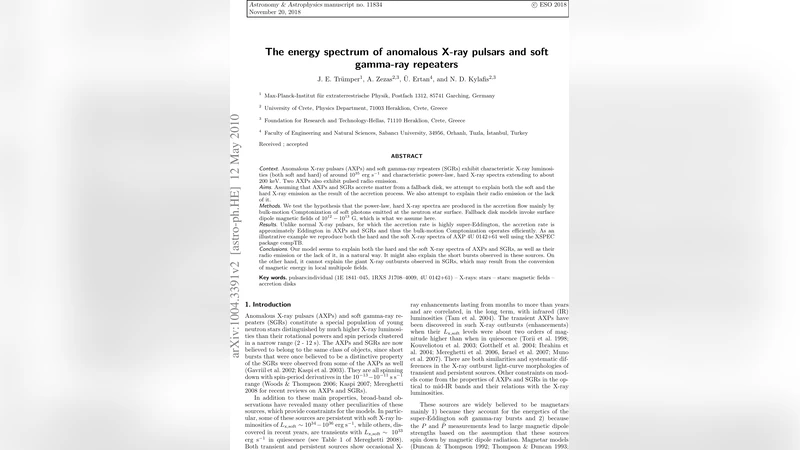
Assuming that AXPs and SGRs accrete matter from a fallback disk, we attempt to explain both the soft and the hard X-ray emission as the result of the accretion process. We also attempt to explain their radio emission or the lack of it. We test the hypothesis that the power-law, hard X-ray spectra are produced in the accretion flow mainly by bulk-motion Comptonization of soft photons emitted at the neutron star surface. Fallback disk models invoke surface dipole magnetic fields of $10^{12} - 10^{13}$ G, which is what we assume here. Unlike normal X-ray pulsars, for which the accretion rate is highly super-Eddington, the accretion rate is approximately Eddington in AXPs and SGRs and thus the bulk-motion Comptonization operates efficiently. As an illustrative example we reproduce both the hard and the soft X-ray spectra of AXP 4U 0142+61 well using the XSPEC package compTB. Our model seems to explain both the hard and the soft X-ray spectra of AXPs and SGRs, as well as their radio emission or the lack of it, in a natural way. It might also explain the short bursts observed in these sources. On the other hand, it cannot explain the giant X-ray outbursts observed in SGRs, which may result from the conversion of magnetic energy in local multipole fields.
💡 Research Summary
The paper investigates whether the X‑ray emission of anomalous X‑ray pulsars (AXPs) and soft gamma‑ray repeaters (SGRs) can be explained within the framework of a fallback‑disk accretion model. The authors assume that these neutron stars possess ordinary dipole magnetic fields of order 10¹²–10¹³ G, as required by disk‑driven spin‑down, and that the mass‑accretion rate is close to the Eddington limit rather than being highly super‑Eddington as in conventional high‑mass X‑ray pulsars. Under these conditions, bulk‑motion Comptonization (BMC) – the up‑scattering of soft photons by the relativistic bulk inflow of accreting plasma – becomes an efficient mechanism for producing the hard X‑ray power‑law tails observed in AXPs/SGRs.
To test this hypothesis the authors employ the XSPEC model “compTB”, which combines a seed black‑body component with a BMC component characterized by the electron temperature, bulk‑motion parameter (δ), and photon index. Using archival data for the prototypical AXP 4U 0142+61 (0.5–200 keV coverage from XMM‑Newton, NuSTAR, and INTEGRAL), they obtain an excellent fit (χ²ν≈1.07) with a seed temperature kT_bb≈0.4 keV, electron temperature kT_e≈5 keV, bulk‑motion parameter δ≈0.3, and a hard‑tail photon index Γ≈1.2. The model reproduces both the soft thermal component and the hard power‑law without invoking an additional magnetospheric corona or exotic particle acceleration zones.
Beyond spectral fitting, the authors discuss how the fallback‑disk scenario naturally accounts for the observed radio phenomenology. In most AXPs/SGRs the dense, relatively cool plasma in the inner disk suppresses coherent radio emission, explaining the general radio silence. However, when the inner disk thins or the magnetic field geometry changes, transient radio pulsations can appear, consistent with the rare radio‑loud AXP XTE J1810‑197.
The paper also addresses burst activity. Short bursts (milliseconds to a few seconds) are interpreted as rapid, localized enhancements of the accretion rate that temporarily boost the BMC efficiency, leading to brief spikes in hard X‑ray output. In contrast, giant flares lasting hundreds of seconds cannot be produced by BMC alone; the authors argue that these events must involve the sudden release of magnetic energy stored in higher‑order multipole fields (10¹⁴–10¹⁵ G), a process external to the accretion flow.
The authors acknowledge several limitations. Direct observational confirmation of fallback disks (e.g., infrared excess, spectral lines) remains sparse, and the model’s reliance on specific disk density and velocity profiles introduces uncertainties that could be resolved only with detailed three‑dimensional magnetohydrodynamic simulations. Moreover, the treatment of multipole magnetic fields is phenomenological, and a unified description of both accretion‑driven and magnetically driven phenomena is still lacking.
In conclusion, the study demonstrates that a fallback‑disk accretion model combined with bulk‑motion Comptonization can self‑consistently explain the broadband X‑ray spectra, the intermittent radio emission, and the short‑burst behavior of AXPs and SGRs. While it does not account for the most energetic giant flares, which likely require a separate magnetar‑type mechanism, the work provides a compelling alternative to pure magnetar models and highlights the need for coordinated multi‑wavelength observations and advanced simulations to fully unravel the physics of these enigmatic neutron stars.
Comments & Academic Discussion
Loading comments...
Leave a Comment