Robust Parameter Selection for Parallel Tempering
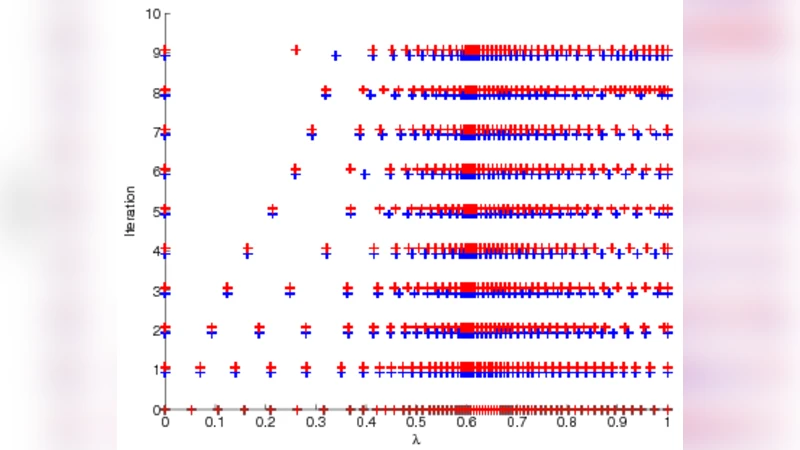
This paper describes an algorithm for selecting parameter values (e.g. temperature values) at which to measure equilibrium properties with Parallel Tempering Monte Carlo simulation. Simple approaches to choosing parameter values can lead to poor equilibration of the simulation, especially for Ising spin systems that undergo $1^st$-order phase transitions. However, starting from an initial set of parameter values, the careful, iterative respacing of these values based on results with the previous set of values greatly improves equilibration. Example spin systems presented here appear in the context of Quantum Monte Carlo.
💡 Research Summary
The paper addresses a long‑standing practical problem in Parallel Tempering (PT) Monte Carlo simulations: how to choose the set of control parameters—most commonly temperatures—so that the ensemble of replicas equilibrates efficiently. While naïve schemes such as equally spaced or logarithmically spaced temperatures are easy to implement, they often fail dramatically for systems that exhibit first‑order phase transitions. In such cases the energy distribution changes abruptly over a narrow temperature interval, causing the acceptance probability for swaps between neighboring replicas to drop to near zero. Consequently, information cannot flow from high‑temperature replicas (which explore configuration space freely) to low‑temperature replicas (which are trapped in metastable states), and the overall simulation suffers from poor mixing and long autocorrelation times.
To overcome this limitation the authors propose an iterative “respacing” algorithm that adapts the temperature schedule based on empirical data collected from previous PT runs. The procedure can be summarized in five steps:
- Initial Schedule – Start with a crude set of temperatures (e.g., linear or log spacing) covering the desired range (
Comments & Academic Discussion
Loading comments...
Leave a Comment