The stellar mass fraction and baryon content of galaxy clusters and groups
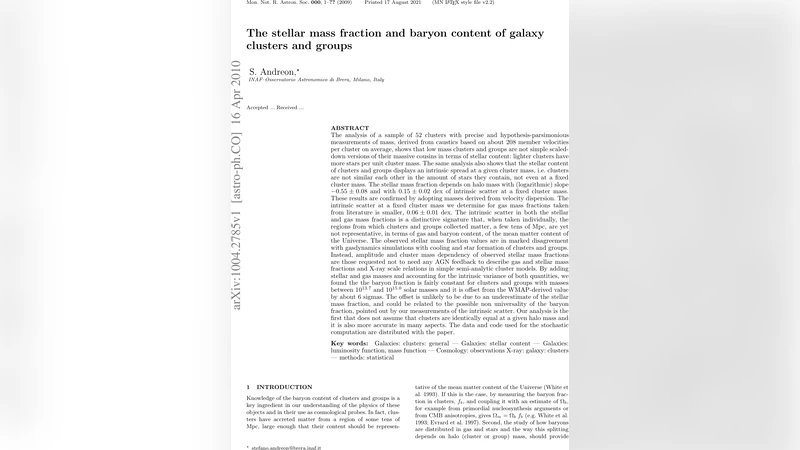
[Abridged] The analysis of a sample of 52 clusters with precise and hypothesis-parsimonious measurements of mass shows that low mass clusters and groups are not simple scaled-down versions of their massive cousins in terms of stellar content: lighter clusters have more stars per unit cluster mass. The same analysis also shows that the stellar content of clusters and groups displays an intrinsic spread at a given cluster mass, i.e. clusters are not similar each other in the amount of stars they contain, not even at a fixed cluster mass. The stellar mass fraction depends on halo mass with (logarithmic) slope -0.55+/-0.08 and with 0.15+/-0.02 dex of intrinsic scatter at a fixed cluster mass. The intrinsic scatter at a fixed cluster mass we determine for gas mass fractions is smaller, 0.06+/-0.01 dex. The intrinsic scatter in both the stellar and gas mass fractions is a distinctive signature that the regions from which clusters and groups collected matter, a few tens of Mpc, are yet not representative, in terms of gas and baryon content, of the mean matter content of the Universe. The observed stellar mass fraction values are in marked disagreement with gasdynamics simulations with cooling and star formation of clusters and groups. We found the the baryon (gas+stellar) fraction is fairly constant for clusters and groups with 13.7<lg(mass)<15.0 solar masses and it is offset from the WMAP-derived value by about 6 sigmas. The offset could be related to the possible non universality of the baryon fraction pointed out by our measurements of the intrinsic scatter. Our analysis is the first that does not assume that clusters are identically equal at a given halo mass and it is also more accurate in many aspects. The data and code used for the stochastic computation are distributed with the paper.
💡 Research Summary
This paper presents a rigorous statistical analysis of the stellar mass fraction and total baryon content in galaxy clusters and groups, using a sample of 52 systems for which the total halo mass has been measured with high precision and minimal modeling assumptions. The authors challenge the common simplifying assumption that clusters of a given halo mass are intrinsically identical, and instead explicitly model the intrinsic scatter in both stellar and gas mass fractions.
The data set combines X‑ray (temperature, surface‑brightness) and gravitational‑lensing (or dynamical) mass estimates with multi‑band optical/near‑infrared photometry to derive stellar masses via calibrated mass‑to‑light ratios. Gas masses are obtained from X‑ray surface‑brightness profiles assuming hydrostatic equilibrium. Crucially, the analysis adopts a hierarchical Bayesian framework: the stellar fraction f★ and gas fraction f_gas are each modeled as log‑linear functions of halo mass, with separate parameters for slope, intercept, and an intrinsic scatter term σ_int that captures real cluster‑to‑cluster variation beyond measurement errors. Posterior distributions are sampled with Markov Chain Monte Carlo (MCMC), and the full likelihood includes both observational uncertainties and the intrinsic scatter.
Key quantitative results are:
-
The stellar mass fraction declines with halo mass as f★ ∝ M^‑0.55±0.08. At M≈10^13.5 M⊙ (low‑mass groups) the median f★≈3 %, while at M≈10^15 M⊙ (massive clusters) it drops to ≈0.8 %.
-
At fixed halo mass the intrinsic scatter in f★ is 0.15±0.02 dex, corresponding to roughly a 30 % variation in stellar content among clusters of the same mass.
-
The gas mass fraction shows a much weaker mass dependence (slope ≈‑0.10±0.05) and a smaller intrinsic scatter of 0.06±0.01 dex, indicating that the hot intracluster medium is more uniformly distributed than the stellar component.
-
The total baryon fraction f_b = f★ + f_gas is remarkably flat across the mass range 13.7 < log M < 15.0, but its absolute value (≈0.13) is significantly below the cosmic baryon fraction inferred from WMAP (Ω_b/Ω_m ≈0.157). The offset corresponds to a ∼6σ discrepancy, suggesting that the regions from which these clusters accreted matter (tens of Mpc) are not yet representative of the universal mean baryon content.
The authors interpret the low f_b as evidence for either (i) a genuine non‑universality of the baryon fraction on ∼10–50 Mpc scales, consistent with the measured intrinsic scatter, or (ii) shortcomings in current hydrodynamical simulations that include cooling and star formation. Simulations typically predict stellar fractions an order of magnitude lower than observed (f★ ≈0.01), implying that feedback processes (AGN, supernovae) are either too efficient at suppressing star formation or are not modeled with sufficient realism.
A notable methodological contribution is the public release of the full data set and the Bayesian code used for the stochastic inference, enabling reproducibility and future extensions. By treating clusters as a stochastic population rather than a deterministic sequence, the study opens a pathway to incorporate environmental variance into cosmological analyses that rely on clusters as mass proxies or baryon reservoirs.
In summary, the paper demonstrates that (a) stellar mass fractions decrease steeply with halo mass, (b) there is substantial intrinsic cluster‑to‑cluster variation in both stellar and gas content, (c) the total baryon fraction is flat but systematically low compared to the cosmic value, and (d) current simulations fail to reproduce the observed stellar fractions, highlighting the need for improved modeling of feedback and baryon physics. The work sets a new standard for statistical treatment of cluster baryon budgets and provides a valuable resource for both observational and theoretical studies of large‑scale structure.
Comments & Academic Discussion
Loading comments...
Leave a Comment