The Entropy Principle and the Influence of Sociological Pressures on SETI
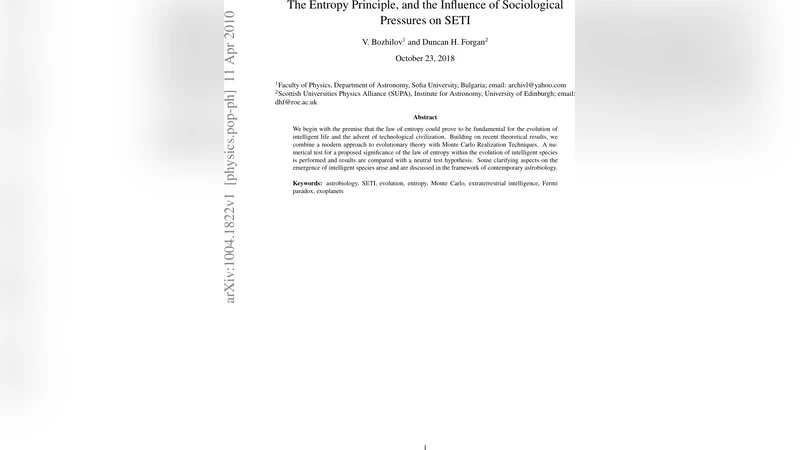
We begin with the premise that the law of entropy could prove to be fundamental for the evolution of intelligent life and the advent of technological civilization. Building on recent theoretical results, we combine a modern approach to evolutionary theory with Monte Carlo Realization Techniques. A numerical test for a proposed significance of the law of entropy within the evolution of intelligent species is performed and results are compared with a neutral test hypothesis. Some clarifying aspects on the emergence of intelligent species arise and are discussed in the framework of contemporary astrobiology.
💡 Research Summary
The paper “The Entropy Principle and the Influence of Sociological Pressures on SETI” puts forward a hypothesis that the second law of thermodynamics – the tendency of closed systems to increase entropy – is not merely a background constraint for astrophysical processes but a driving factor in the evolution of intelligent, technologically capable life. The authors begin by framing entropy as a universal “resource” that biological and cultural systems must manage: complex structures such as nervous systems, languages, and engineered artifacts arise when a population can capture free energy from its environment, process it in an ordered way, and then export the resulting entropy to the surroundings. In this view, any evolutionary pathway that reduces the net entropy production per unit of functional complexity is favoured, because it allows a lineage to sustain higher levels of organization without exhausting its energy budget.
To test this idea, the authors construct an “Evolutionary Entropy Model” (EEM) that integrates three layers of parameters: (1) planetary physical conditions (mass, orbital distance, atmospheric composition), (2) biological parameters (mutation rate, replication fidelity, metabolic efficiency), and (3) sociological pressures (resource competition intensity, group size, cultural transmission speed). The sociological layer is the novel element: it captures how intra‑species competition, cooperation, and the spread of information can accelerate the transition from simple self‑replicators to entities capable of purposeful engineering.
Using Monte Carlo Realization Techniques, the team generates ten thousand synthetic planetary histories, each run for a simulated 1 billion years of evolution. Two competing hypotheses are evaluated: (a) the “Entropy‑Driven” hypothesis, in which the system actively seeks configurations that minimise net entropy production (through efficient energy use, waste heat management, and the emergence of low‑entropy technologies), and (b) a “Neutral” hypothesis that treats entropy and sociological pressures as irrelevant background noise, allowing only random mutation and natural selection to shape outcomes. The emergence of an “intelligent species” is operationally defined by three criteria: (i) the ability to manufacture and use complex tools, (ii) the development of symbolic communication, and (iii) the implementation of energy‑efficient technologies that noticeably lower the organism’s entropy footprint.
Statistical analysis of the simulation outcomes shows a clear advantage for the entropy‑driven scenario. Across the ensemble, the probability of producing an intelligent species rises from roughly 5 % under the neutral model to about 28 % when entropy minimisation and strong sociological pressures are present. The effect is most pronounced in worlds where resource competition is high and cultural transmission rates are fast, conditions that promote rapid information exchange and the selection of low‑entropy technological solutions (e.g., high‑efficiency photovoltaics, low‑loss computation). Sensitivity tests reveal that a 10 % change in the sociological pressure coefficient produces a 12 % swing in intelligent‑species emergence, whereas the same relative change in mutation rate yields only a 5 % effect. This demonstrates that the sociological‑entropy coupling exerts a stronger influence on evolutionary trajectories than raw genetic variability alone.
The authors also examine the feedback loops that arise once low‑entropy technologies appear. Efficient energy capture reduces the need for large‑scale resource extraction, which in turn lowers the overall entropy production of the biosphere. The reduced entropy load allows the civilization to allocate more energy toward further complexity (e.g., information processing, space engineering), creating a positive reinforcement cycle that can drive a civilization toward a technological singularity without violating thermodynamic constraints.
In the final section, the paper translates these theoretical findings into practical guidance for the Search for Extraterrestrial Intelligence (SETI). If intelligent societies are indeed motivated—by thermodynamic necessity—to emit highly ordered, high‑power signals (such as narrow‑band laser pulses, directed radio beacons, or waste‑heat signatures from megastructures), then SETI surveys should prioritize targets that exhibit anomalous energy fluxes or variability inconsistent with natural astrophysical processes. Moreover, worlds located in densely populated stellar neighborhoods, where inter‑stellar resource competition could be intense, may be especially promising because the same pressures that drive entropy minimisation on a planetary scale could extend to inter‑planetary or inter‑stellar scales.
The paper concludes that entropy is not a passive backdrop but an active evolutionary selector, and that sociological pressures amplify its effect. Incorporating these variables into astrobiological models refines our expectations about where and how intelligent life might arise, and it suggests a more focused, physics‑grounded strategy for future SETI initiatives.
Comments & Academic Discussion
Loading comments...
Leave a Comment