A Chandra Study of the Rosette Star-Forming Complex. III. The NGC 2237 Cluster and the Regions Star Formation History
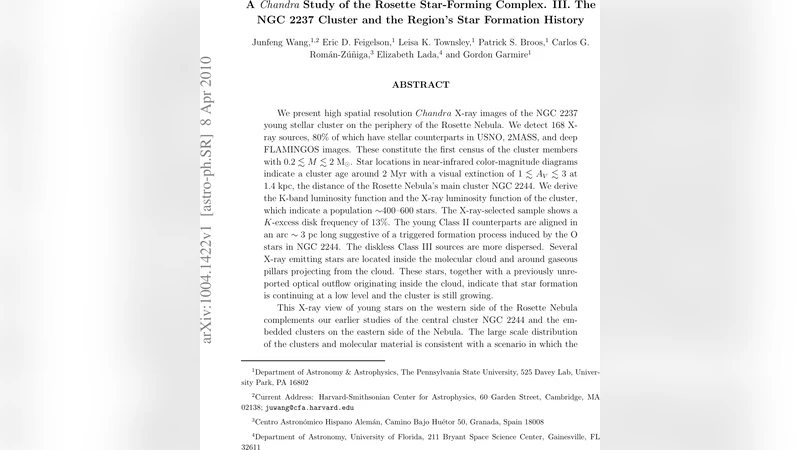
We present Chandra X-ray images of the NGC 2237 young star cluster on the periphery of the Rosette Nebula. We detect 168 X-ray sources, 80% of which have counterparts in USNO, 2MASS, and deep FLAMINGOS images. These constitute the first census of the cluster members with 0.2<~M<~2 Msun. Star locations in near-infrared color-magnitude diagrams indicate a cluster age around 2 Myr with a visual extinction of 1<Av<3 at 1.4 kpc, the distance of the Rosette Nebula’s main cluster NGC 2244. We derive the K-band luminosity function and the X-ray luminosity function of the cluster, which indicate a population ~400-600 stars. The X-ray-selected sample shows a K-excess disk frequency of 13%. The young Class II counterparts are aligned in an arc ~3 pc long suggestive of a triggered formation process induced by the O stars in NGC 2244. The diskless Class III sources are more dispersed. Several X-ray emitting stars are located inside the molecular cloud and around gaseous pillars projecting from the cloud. These stars, together with a previously unreported optical outflow originating inside the cloud, indicate that star formation is continuing at a low level and the cluster is still growing. This X-ray view of young stars on the western side of the Rosette Nebula complements our earlier studies of the central cluster NGC 2244 and the embedded clusters on the eastern side of the Nebula. The large scale distribution of the clusters and molecular material is consistent with a scenario in which the rich central NGC 2244 cluster formed first, and its expanding HII region triggered the formation of the now-unobscured clusters RMC XA and NGC 2237. A large swept-up shell material around the HII region is now in a second phase of collect-and-collapse fragmentation, leading to the recent formation of subclusters. Other clusters deeper in the molecular cloud appear unaffected by the Nebula expansion.
💡 Research Summary
This paper presents a comprehensive Chandra X‑ray study of the young stellar cluster NGC 2237, which lies on the western periphery of the Rosette Nebula. Using deep ACIS‑I observations, the authors detected 168 X‑ray sources. About 80 % of these sources have counterparts in optical (USNO), near‑infrared (2MASS), and deep FLAMINGOS JHK images, allowing a reliable cross‑identification of cluster members across a broad wavelength range. The X‑ray selection is particularly powerful for uncovering low‑mass pre‑main‑sequence stars (≈0.2–2 M⊙) that are often missed in purely optical or infrared surveys because of extinction or faintness.
The near‑infrared color–color and color–magnitude diagrams place the bulk of the population at a visual extinction of Av ≈ 1–3 mag, a distance of 1.4 kpc (the same as the central NGC 2244 cluster), and an age of roughly 2 Myr. This age estimate is consistent with the presence of both Class II (disk‑bearing) and Class III (disk‑less) objects, indicating that star formation began a few million years ago and is still ongoing at a low level.
By constructing both the K‑band luminosity function (KLF) and the X‑ray luminosity function (XLF), the authors infer a total cluster population of about 400–600 stars, substantially larger than previous estimates based only on infrared excess sources. The X‑ray selected sample yields a disk fraction (identified via K‑band excess) of only 13 %, lower than typical for 2 Myr clusters. This suggests rapid disk dispersal, likely driven by the intense ultraviolet radiation and stellar winds from the O‑type stars in the neighboring NGC 2244 cluster.
Spatially, the Class II sources are not randomly distributed; they trace a ∼3 pc long arc that appears to follow the edge of the ionized bubble created by NGC 2244. This morphology is characteristic of triggered star formation, either through radiation‑driven implosion of pre‑existing dense clumps or via the collect‑and‑collapse mechanism in which the expanding H II region sweeps up a dense shell that subsequently fragments. In contrast, the Class III objects are more widely dispersed, indicating that they either formed earlier and have since migrated or that they represent a population that never possessed substantial disks.
A number of X‑ray sources are located inside the molecular cloud and along pillar‑like structures protruding from the cloud surface. The detection of an optical outflow emerging from within the cloud, together with these embedded X‑ray sources, provides direct evidence that star formation is still proceeding in the dense gas, albeit at a modest rate. This ongoing activity suggests that the NGC 2237 cluster is still accreting new members and has not yet reached a fully evolved state.
Putting NGC 2237 in the context of the larger Rosette complex, the authors propose a sequential formation scenario. The massive, centrally concentrated NGC 2244 cluster likely formed first. Its expanding H II region then triggered the formation of the relatively unobscured peripheral clusters RMC XA and NGC 2237. The large swept‑up shell now appears to be entering a second phase of collect‑and‑collapse, giving rise to newer sub‑clusters observed at the periphery. Deeper, more embedded clusters on the eastern side of the nebula seem to be largely unaffected by the H II expansion, indicating that the triggering influence is limited to the western side where the molecular material is less dense.
The study demonstrates the unique power of X‑ray observations for constructing a nearly complete census of young, low‑mass stars in a star‑forming region, especially when combined with multi‑wavelength infrared data. It also highlights how the spatial distribution, disk fraction, and luminosity functions of X‑ray selected members can be used to diagnose the impact of massive star feedback on subsequent generations of star formation. Future work that couples these X‑ray results with high‑resolution infrared spectroscopy (e.g., JWST) and molecular line mapping will be essential to quantify the physical conditions (density, temperature, kinematics) within the triggered shells and to test the collect‑and‑collapse model in greater detail.
Comments & Academic Discussion
Loading comments...
Leave a Comment