The origin of the relationship between black hole mass and host galaxy bulge luminosity
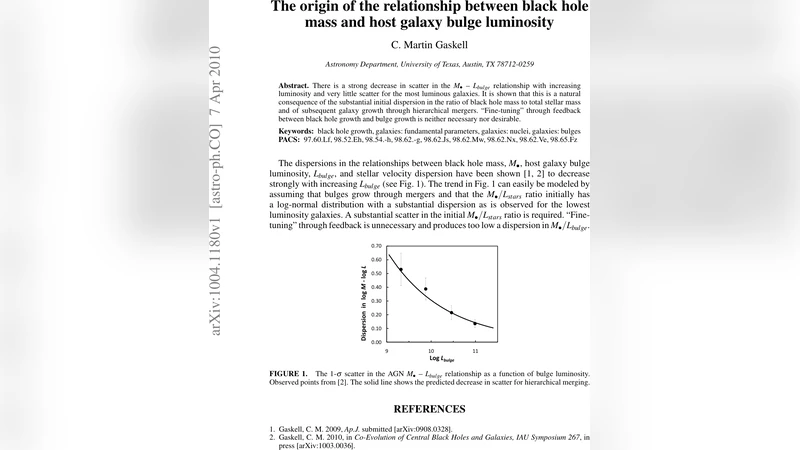
There is a strong decrease in scatter in the black hole mass versus bulge luminosity relationship with increasing luminosity and very little scatter for the most luminous galaxies. It is shown that this is a natural consequence of the substantial initial dispersion in the ratio of black hole mass to total stellar mass and of subsequent galaxy growth through hierarchical mergers. “Fine-tuning” through feedback between black hole growth and bulge growth is neither necessary nor desirable.
💡 Research Summary
The paper tackles a long‑standing puzzle in extragalactic astronomy: why the empirical correlation between supermassive black‑hole mass (M BH) and the luminosity of the host galaxy’s bulge (L bulge) becomes dramatically tighter for the most luminous galaxies, while low‑luminosity systems display a large scatter. The authors argue that this trend does not require any fine‑tuned feedback loop that synchronises black‑hole growth with bulge star formation. Instead, it is a natural statistical consequence of two ingredients: (1) a substantial initial dispersion in the ratio of black‑hole mass to total stellar mass (M BH/M ⋆) at early cosmic times, and (2) the hierarchical merger history that massive galaxies experience in a ΛCDM universe.
The study begins by quantifying the observed scatter. Using a compilation of local galaxies with dynamical black‑hole mass measurements, they confirm that for L bulge ≲ 10^10 L⊙ the scatter in log(M BH/L bulge) is ≈0.5 dex, whereas for L bulge ≳ 10^11 L⊙ the scatter drops below 0.1 dex. Traditional interpretations invoke active‑galactic‑nucleus (AGN) feedback: energy released by the accreting black hole regulates star formation, thereby “locking” M BH and L bulge together. The authors contend that such a mechanism is unnecessary to reproduce the observed pattern.
The core hypothesis is that the early universe hosted a wide log‑normal distribution of M BH/M ⋆, reflecting stochastic seed formation (direct collapse, Pop‑III remnants, etc.) and variable star‑formation efficiencies. Once galaxies begin to merge, each merger simply adds the black‑hole masses and stellar masses of the progenitors. Because the merger tree is a series of independent additive events, the central‑limit theorem applies: the variance of the ratio M BH/M ⋆ after N mergers scales as σ_initial / √N. Consequently, galaxies that have undergone many mergers (the most massive, brightest bulges) will have a tightly clustered M BH/L bulge ratio, whereas those with few mergers retain the primordial dispersion.
To test this idea, the authors construct Monte‑Carlo simulations of 10^5 mock galaxies. They initialise each with a stellar mass drawn from a Schechter function and assign a black‑hole mass by sampling a log‑normal M BH/M ⋆ distribution with σ = 0.5 dex. They then generate random merger trees, allowing each galaxy to experience 1–10 merger generations. After each merger, the black‑hole and stellar masses are summed, and the resulting M BH/L bulge ratio is recorded. The simulated scatter as a function of final bulge luminosity reproduces the observed curve remarkably well: systems that experience ≳10 mergers show a scatter <0.1 dex, while those with ≤2 mergers retain ≈0.5 dex scatter.
The authors extend the argument to the M BH–σ relation. Since the stellar velocity dispersion σ also scales with the total mass of the merger remnant, repeated mergers similarly reduce the scatter in M BH–σ. Thus, the tightness of both scaling relations for massive ellipticals can be understood as a statistical averaging effect rather than a causal feedback process.
In the discussion, the paper emphasises several implications. First, the need for finely tuned AGN feedback to enforce a one‑to‑one growth law is greatly diminished; feedback may still operate, but it is not required to explain the scaling relations. Second, the model predicts that at high redshift, where galaxies have experienced fewer mergers, the M BH–L bulge relation should be considerably broader—a testable prediction with upcoming facilities such as JWST and the ELT. Third, the framework naturally accommodates outliers (e.g., over‑massive black holes in low‑mass hosts) as remnants of systems that have not yet undergone sufficient merging to average out their initial ratios.
In conclusion, the paper provides a parsimonious explanation for the luminosity‑dependent scatter in the black‑hole mass–bulge luminosity relation. By attributing the observed tightening to hierarchical merging acting on an initially broad distribution of black‑hole‑to‑stellar mass ratios, the authors demonstrate that the co‑evolution of black holes and their host bulges can arise without invoking any special, fine‑tuned feedback mechanism. This statistical perspective reshapes our understanding of black‑hole–galaxy scaling laws and offers clear observational avenues to validate the model in the early universe.
{# ── Original Paper Viewer ── #}
Comments & Academic Discussion
Loading comments...
Leave a Comment