Impact of Type Ia Supernova Ejecta on a Helium-star Binary Companion
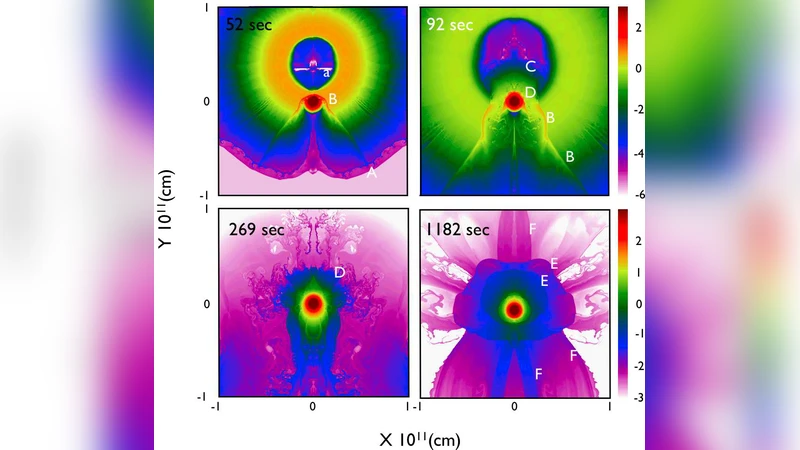
The impact of Type Ia supernova ejecta on a helium-star companion is investigated via high-resolution, two-dimensional hydrodynamic simulations. For a range of helium-star models and initial binary separations it is found that the mass unbound in the interaction, $\delta M_{\rm ub}$, is related to the initial binary separation, $a$, by a power law of the form $\delta M_{\rm ub} \propto a^{m}$. This power-law index is found to vary from -3.1 to -4.0, depending on the mass of the helium star. The small range of this index brackets values found previously for hydrogen-rich companions, suggesting that the dependence of the unbound mass on orbital separation is not strongly sensitive to the nature of the binary companion. The kick velocity is also related to the initial binary separation by a power law with an index in a range from -2.7 to -3.3, but the power-law index differs from those found in previous studies for hydrogen-rich companions. The space motion of the companion after the supernova is dominated by its orbital velocity in the pre-supernova binary system. The level of Ni/Fe contamination of the companion resulting from the passage of the supernova ejecta is difficult to estimate, but an upper limit on the mass of bound nickel is found to be $\sim 5\times 10^{-4}\ M_\odot$.
💡 Research Summary
This paper investigates the dynamical impact of a Type Ia supernova (SN Ia) explosion on a helium‑star (He‑star) binary companion using high‑resolution, two‑dimensional hydrodynamic simulations. The authors construct a suite of models that span three He‑star masses (≈0.8, 1.0, and 1.2 M☉) and four initial orbital separations (2–5 R☉). The supernova is modeled as a standard Chandrasekhar‑mass carbon‑oxygen white dwarf releasing ≈10⁵¹ erg of kinetic energy in a spherically symmetric ejecta profile. The FLASH code is employed with an adaptive mesh that resolves the shock–star interaction down to ≈10⁸ cm, allowing a detailed capture of the forward shock as it strikes the companion, the subsequent stripping of surface layers, and the propagation of an internal compression wave through the star.
The main quantitative results are expressed as power‑law relations between the unbound mass (δM₍ub₎) or the kick velocity (v_kick) imparted to the companion and the initial binary separation a. For all He‑star masses the unbound mass follows
δM₍ub₎ ∝ a^m, with m ranging from –3.1 (for the lowest‑mass He‑star) to –4.0 (for the highest‑mass He‑star).
These indices are remarkably close to those previously reported for hydrogen‑rich companions (main‑sequence or red‑giant donors), which typically lie near –3.5. The similarity suggests that the amount of material stripped from the companion is governed primarily by geometric dilution of the ejecta and the surface gravity of the star, rather than by the detailed composition of the envelope.
The kick velocity, defined as the net velocity change of the companion due to the impact, also obeys a power law
v_kick ∝ a^n, with n between –2.7 and –3.3.
These exponents are somewhat steeper than those found for hydrogen‑rich donors (n ≈ –2.5). The authors attribute the difference to the more compact structure and higher surface gravity of He‑stars, which reduces the efficiency of momentum transfer from the ejecta. Nevertheless, the absolute magnitude of the kick is modest: for the closest separations (a ≈ 2 R☉) the kick reaches only a few tens of km s⁻¹, i.e., less than 10 % of the pre‑explosion orbital velocity. Consequently, the post‑supernova space motion of the surviving companion is dominated by its original orbital motion, and the system is unlikely to produce a high‑velocity runaway star.
A secondary focus of the study is the contamination of the companion by supernova nucleosynthetic products, primarily nickel and iron. By tracking tracer particles representing Ni/Fe in the ejecta, the authors estimate an upper bound on the bound nickel mass of ≈5 × 10⁻⁴ M☉. This level of enrichment is low enough that spectroscopic signatures of Ni/Fe on the surface of a surviving He‑star would be subtle, posing a challenge for observational identification of such remnants.
The paper discusses several methodological limitations. The use of a 2‑D axisymmetric geometry precludes the capture of fully three‑dimensional asymmetries such as off‑center explosions, companion rotation, or orbital eccentricity. Radiative cooling, detailed nuclear reaction networks, and post‑impact thermal relaxation are omitted, potentially leading to an overestimate of the temperature and density of stripped material. The authors argue that despite these simplifications, the derived power‑law scalings are robust because they are set by large‑scale hydrodynamic momentum and energy conservation.
In the broader context, the results support the viability of He‑star donors in the single‑degenerate SN Ia progenitor channel. The similarity of the δM₍ub₎–a scaling to that of hydrogen‑rich donors implies that observational constraints based on stripped hydrogen (e.g., non‑detection of Hα in late‑time spectra) can be extended to helium‑rich systems, albeit with the expectation of weaker hydrogen signatures. The modest kick velocities and limited Ni/Fe contamination suggest that surviving He‑stars would retain most of their pre‑explosion orbital characteristics, making them difficult to distinguish from normal field He‑stars without precise kinematic or abundance measurements.
Future work should aim at three‑dimensional simulations that incorporate realistic explosion asymmetries, companion rotation, and detailed radiation transport. Such studies would refine the estimates of stripped mass, momentum transfer, and surface pollution, thereby improving the predictive power of models that link SN Ia observations (e.g., early light‑curve excesses, nebular line profiles) to the nature of their binary progenitors.
Comments & Academic Discussion
Loading comments...
Leave a Comment